Band 5.0 IELTS Writing Task 1 Model Answer
Overall Band Score: 5.0 · Cambridge IELTS 12 · 2026-11-19
IELTS Writing Task 1 question
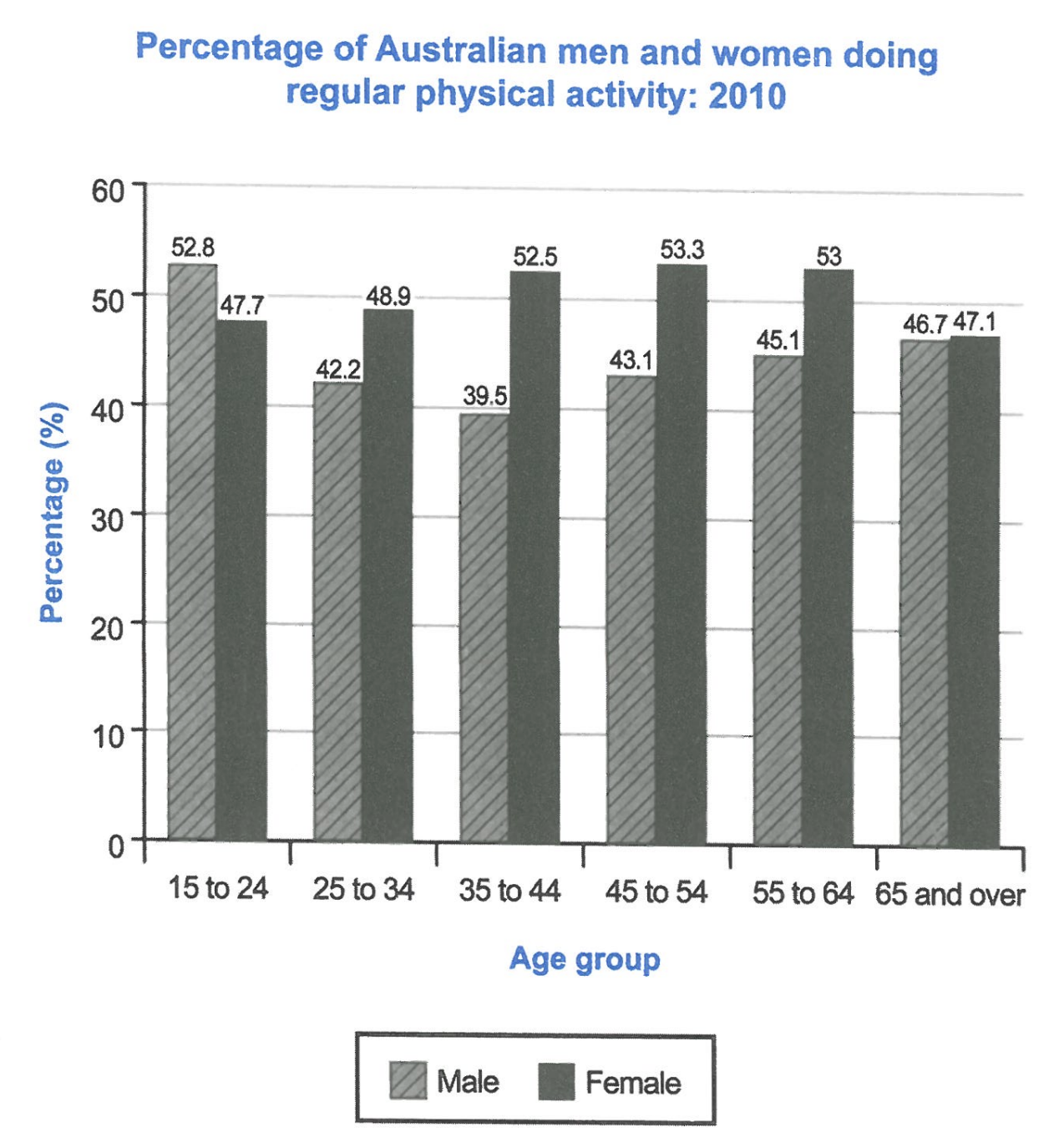
The bar chart below shows the percentage of Australian men and women in different age groups who did regular physical activity in 2010.
Summarise the information by selecting and reporting the main features, and make comparisons where relevant.
Student answer (Band 5.0)
Here, the bar char illustrates the percentage of Australian men and women in different age groups who did regular physical activity in 2010.
In this bar chat we can see the comparision between Australian male and female who were more physical active in 2010.In this bar graph we can see see clearly 25 to 65 and over old all women were more physical active then men.The first bar show 15 to 24 year old men and women where men were did more physical activity around 52.8%.Second bar show 25 to 34 year old persons where women dominate around 48.9%.In third bar we see 35 to 44 old peoples where also women dominate in physical activity around52.5%.Fourth bar show the 45 to 54 year old peoples where also women dominate 53.3%.In fifth bar we see 55 to 64 year old peoples where women dominate 53%.In the last bar we can see minor difference between men and women who were 65 and over year old to performed physical activity where men were 46.7% and women were 47.1%.
In the conclusion we can say that the women did more physical activity then men in 2010.
AI examiner evaluation
| Criterion | Band |
|---|---|
| Task Achievement / Task Response | 5.0 |
| Coherence and Cohesion | 5.0 |
| Lexical Resource | 5.0 |
| Grammatical Range and Accuracy | 5.0 |
| Overall | 5.0 |
Task Achievement / Task Response: Band 5.0
You identify the chart’s subject and report several relevant figures, including the male peak of 52.8% among 15–24-year-olds and the female figure of 53.3% for ages 45–54. You also recognise that women exceed men in most age groups. However, the overview is incomplete and partly inaccurate: the conclusion says women were more active overall, but men lead in the youngest group, and the smallest gap is in the oldest group. The main pattern—that male participation falls to a low at 35–44 before rising, while female participation peaks in middle age and then declines—is not clearly summarised. Select the key trends and contrasts rather than describing each bar in sequence.
Coherence and Cohesion: Band 5.0
The response has a basic structure, with an opening, a body paragraph and a concluding statement, and the age groups are presented in chart order. This gives the reader some sense of progression. However, the body relies heavily on repetitive sequencing phrases such as “Second bar,” “In third bar,” and “Fourth bar,” so the information reads like a list rather than a comparison. The overview is also embedded in the body, while the conclusion repeats a broad claim without resolving the exception in the youngest group. Organise the response around an overview followed by meaningful comparisons—for example, the age groups where men lead and those where women lead—and use clear references to avoid repetition.
Lexical Resource: Band 5.0
You use relevant chart vocabulary such as “percentage,” “age groups,” “physical activity,” and “difference,” and terms like “dominate” show an attempt to describe comparisons. However, the range is limited and several expressions are inaccurate or unnatural, including “more physical active,” “women dominate in physical activity,” and “minor difference.” There are also noticeable spelling errors, such as “bar char,” “bar chat,” and “comparision,” which reduce the clarity and polish of the report. Aim for precise, conventional language for describing data, such as “the proportion,” “was higher than,” “reached a peak,” and “the gap was narrow.” Check spelling carefully and avoid repeating the same wording for every age group.
Grammatical Range and Accuracy: Band 5.0
The response communicates the general topic, but grammatical errors occur frequently and sometimes make relationships between ideas difficult to follow. Examples include “men were did more physical activity,” “25 to 65 and over old,” and “who were 65 and over year old to performed physical activity.” Articles and plural forms are often missing or incorrect, as in “First bar show” and “old peoples,” while sentence boundaries and spacing are also poorly controlled. Most sentences follow a similar simple pattern, with limited accurate use of more complex structures. Practise forming clear comparisons with correct subject–verb agreement and past-tense forms, and use punctuation to separate ideas. For example: “Men recorded a higher figure in the youngest group, whereas women were more active in the other five groups.”
See this exact question answered at other band scores. The same prompt compared across bands.
Browse more IELTS Writing model answers or get your own writing scored by the same AI examiner.