Band 5.5 IELTS Writing Task 1 Model Answer
Overall Band Score: 5.5 · Cambridge IELTS 12 · 2026-11-19
IELTS Writing Task 1 question
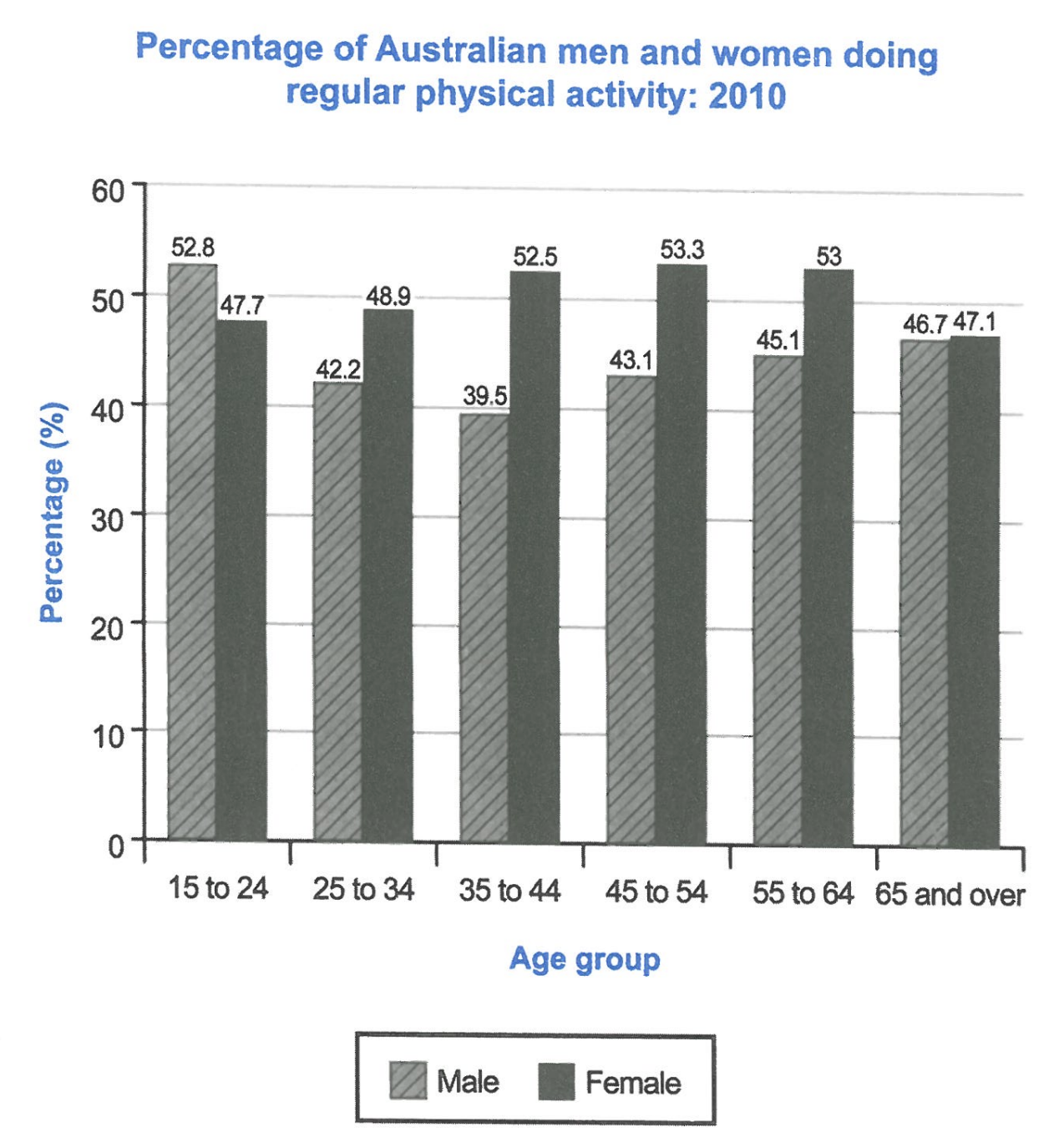
The bar chart below shows the percentage of Australian men and women in different age groups who did regular physical activity in 2010.
Summarise the information by selecting and reporting the main features, and make comparisons where relevant.
Student answer (Band 5.5)
The bar graph illustrates how many Australian people of various age groups including men and women took part in daily physical activity during 2010.
Overall, it can be seen that, male of young ages was more active than older as well as female of all age groups were highly interested in physical activity rather than male.
First of all, age range from 15 to 24, those were young, among them 52.8% men were trying to attend in regular exercise for being fit whereas, women were about 47.7%. Moreover, in following two age group, women were more appreciated to join in regular basis physical activity rather than men.
Basically, the middle-aged women who were from 45-54 age range as well as those who were from 55-64 age group elderly women, they were more interested in the physical activity. On the other hand, male people those who were belonging from this range they were less active than women. Finally, both elderly men and women those who were upper than 65, among them 46.7% men and 47.1% women were taking part in daily basis fitness task which was less than other age range.
AI examiner evaluation
| Criterion | Band |
|---|---|
| Task Achievement / Task Response | 6.0 |
| Coherence and Cohesion | 6.0 |
| Lexical Resource | 5.5 |
| Grammatical Range and Accuracy | 5.0 |
| Overall | 5.5 |
Task Achievement / Task Response: Band 6.0
You identify the chart’s subject and include several accurate figures, including the male lead among 15–24-year-olds and the near-equal rates among people aged 65 and over. Your overview also recognises that women were more active than men in most age groups. However, it is not fully accurate to say that women were more active in “all age groups”: men led in the youngest group. The overview could also state the main pattern more precisely: male participation fell to a low among 35–44-year-olds before rising, while female participation peaked at 45–54 and then declined. Some comparisons, especially for the 25–44 groups, are mentioned only generally rather than supported with figures.
Coherence and Cohesion: Band 6.0
The response has a recognisable structure: an introduction, an overview, and paragraphs describing age-group comparisons. Sequencing phrases such as “Overall,” “First of all,” and “Finally” help signal movement through the chart. However, the progression is sometimes mechanical, and the grouping of details is not always clear. For example, “in following two age group” does not specify which groups, while the next paragraph shifts to the 45–64 groups without a clear comparison of the earlier figures. Some references, such as “this range,” are also vague. Organise the body around clear age bands or trends, and use linking expressions to show contrasts and changes rather than simply marking the next point.
Lexical Resource: Band 5.5
You use relevant vocabulary such as “age groups,” “physical activity,” “active,” and “participate,” so the topic remains understandable. There is also an attempt to vary wording with phrases such as “middle-aged” and “elderly.” However, several choices are unnatural or imprecise for describing chart data: “attend in regular exercise,” “more appreciated to join,” and “daily basis fitness task.” “Daily” also changes the chart’s meaning, which refers to regular activity. Repeated use of “interested” describes motivation rather than the measured participation rate. Aim for accurate collocations such as “engaged in regular physical activity” and “the proportion who exercised,” and use “higher participation” rather than implying preference or interest.
Grammatical Range and Accuracy: Band 5.0
You attempt both simple and more complex sentences, including clauses beginning with “whereas” and “who,” and the main comparisons can generally be understood. However, some sentence structures are faulty, particularly in the overview: “male of young ages was more active” has problems with number and sentence construction, and “female of all age groups were” is also grammatically awkward. Other examples include “age range from 15 to 24, those were young” and “men were trying to attend,” where clause structure and verb choice make the meaning less controlled. Punctuation around long clauses is also inconsistent. Practise forming direct comparison sentences with clear subjects and verbs, and check agreement and clause boundaries; for example, “Men aged 15–24 had a higher rate than women.”
See this exact question answered at other band scores. The same prompt compared across bands.
Browse more IELTS Writing model answers or get your own writing scored by the same AI examiner.