Band 6.0 IELTS Writing Task 1 Model Answer
Overall Band Score: 6.0 · Cambridge IELTS 12 · 2026-11-19
IELTS Writing Task 1 question
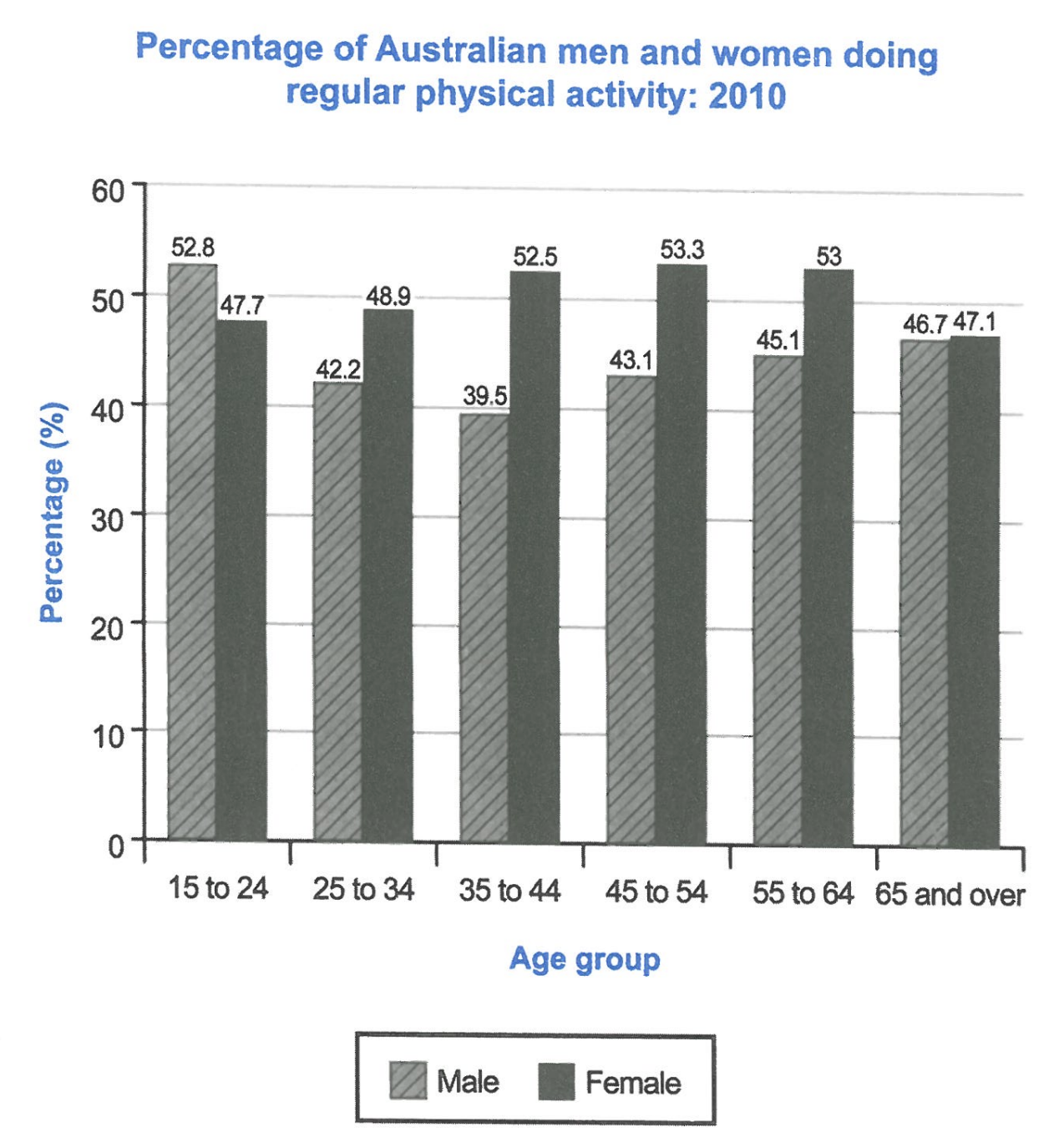
The bar chart below shows the percentage of Australian men and women in different age groups who did regular physical activity in 2010.
Summarise the information by selecting and reporting the main features, and make comparisons where relevant.
Student answer (Band 6.0)
The multiple bar chart compares the proportion of both Austalian males and females in different age groups who did regular physical activity in 2010. Young males aged 15-24 were most active among all whereas women in other age groups were more active as compared to males of their age group.
While there is no significant difference of doing physical activity between oldest men and women.
Total 52.8% of young aged 15-24 was doing regular physical activity as compared to girls aged 15-24 which was 47.7% who were active in the given year. Adults aged 25-34 included 42.2% men and 48.9% women who did regular physical exercise. Similarly middle age group comprises of more active women than men. Roughly 52.5% (figures nearly to the youngest males) of women of age between 35 to 44 and 45 to 54 was active whereas, 39.5% active men was from age group 35-44 and 43.1% was from adults aged 45-54. 53% of women aged 55-64 was doing regular physical activity more than the males of similar age agroup. The percentages of men and women of age 65 and over was nearly same which was approximately 47%.
AI examiner evaluation
| Criterion | Band |
|---|---|
| Task Achievement / Task Response | 6.5 |
| Coherence and Cohesion | 5.0 |
| Lexical Resource | 6.0 |
| Grammatical Range and Accuracy | 5.5 |
| Overall | 6.0 |
Task Achievement / Task Response: Band 6.5
You identify the main pattern accurately: men lead only in the youngest group, women have higher participation in the other age groups, and the figures for those aged 65 and over are close. Most reported values match the chart, including 52.8% and 47.7% for the youngest group and 39.5% and 43.1% for men aged 35–44 and 45–54. This gives the response a clear overview and relevant supporting detail. However, the overview could be more precise: women peak at 53.3% among 45–54-year-olds, while men reach their low point at 35–44 before rising. Also, “52.5% ... of women of age between 35 to 44 and 45 to 54” incorrectly applies the 35–44 figure to both groups; the 45–54 figure is 53.3%. These omissions and imprecisions limit fuller coverage.
Coherence and Cohesion: Band 5.0
The response has a recognisable overall shape: an opening summary is followed by figures for successive age groups, and expressions such as “whereas” and “Similarly” attempt to connect comparisons. However, the progression is not consistently clear because the overview combines several claims in one sentence, then the body moves through age groups without a distinct, well-organised comparison of the male and female trends. Some linking is awkward or repetitive, and “Similarly” does not clearly signal the relationship that follows. The sentence about the middle age groups also groups two figures together in a way that obscures which value belongs to which age band. Use a separate overview paragraph and organise the details into clear comparisons, with each age group and its figures explicitly linked.
Lexical Resource: Band 6.0
You use an adequate range of task-related vocabulary, including “proportion,” “active,” “regular physical activity,” and “age group,” and the meaning is generally clear. There are also attempts to vary wording, such as “physical exercise” and “most active.” However, some choices are inaccurate or unnatural for describing chart data: “Total 52.8%” is not an appropriate way to introduce a figure, and “girls” is unsuitable for adult women. “Nearly to the youngest males” is also an awkward comparison, while “agroup” and “Austalian” show spelling control that needs attention. Aim for precise, conventional reporting language and avoid unnecessary variation when it makes the comparison less clear.
Grammatical Range and Accuracy: Band 5.5
You attempt both simple and more complex sentence forms, including comparisons with “whereas” and clauses beginning “who did regular physical exercise.” The main relationships remain understandable, but some grammatical errors recur. For example, “52.8% of young aged 15-24 was doing” has an unclear noun phrase and incorrect agreement, while “39.5% active men was” also needs a clearer subject and plural agreement. In “53% of women ... was doing,” the plural subject requires a plural verb. Articles and sentence boundaries also need attention, particularly in the opening overview and the sentence beginning “While there is no significant difference.” Check agreement with plural groups and percentages, and build comparisons in complete, clearly punctuated sentences.
See this exact question answered at other band scores. The same prompt compared across bands.
Browse more IELTS Writing model answers or get your own writing scored by the same AI examiner.