Band 6.0 IELTS Writing Task 1 Model Answer
Overall Band Score: 6.0 · Cambridge IELTS 12 · 2026-11-19
IELTS Writing Task 1 question
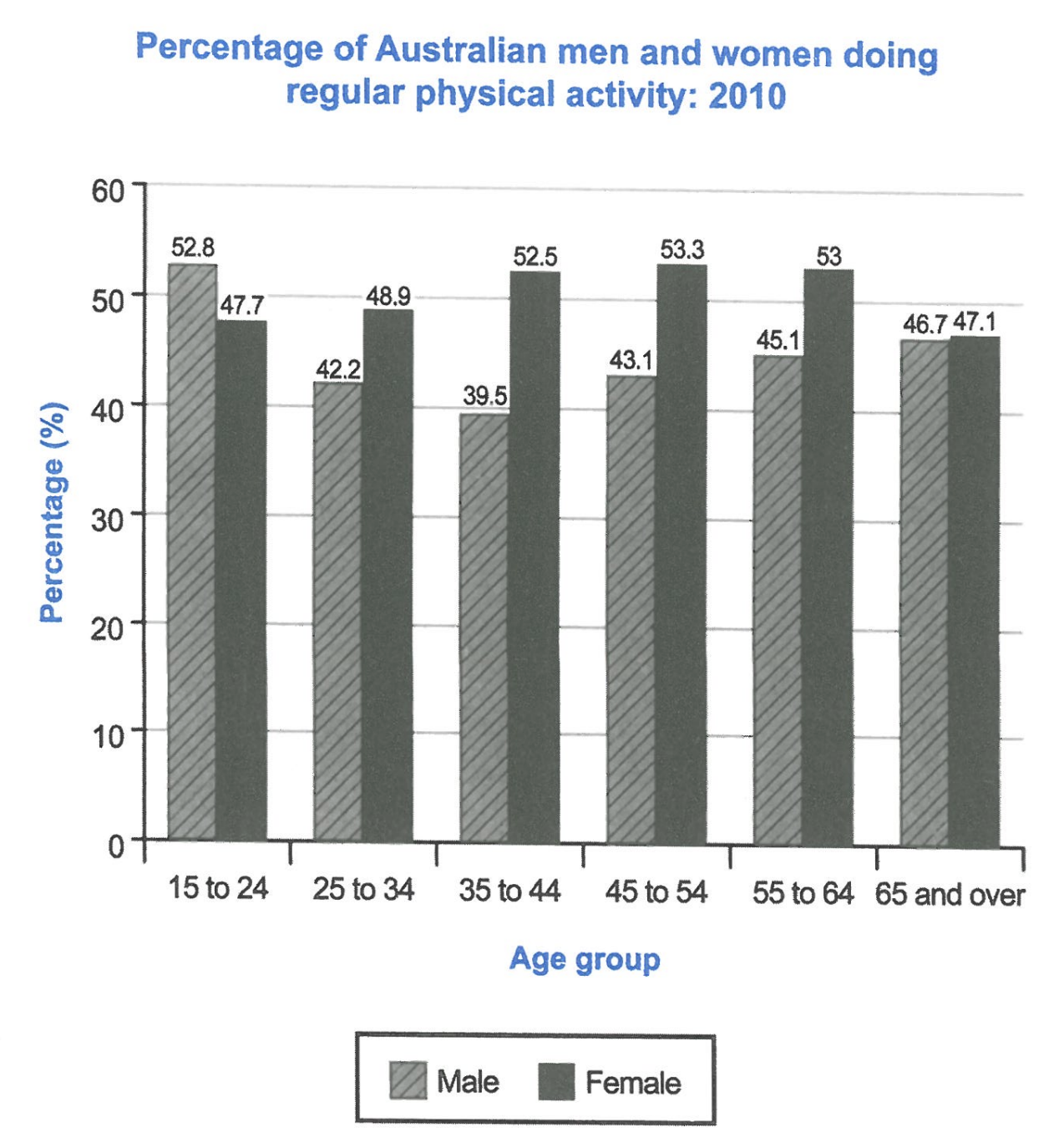
The bar chart below shows the percentage of Australian men and women in different age groups who did regular physical activity in 2010.
Summarise the information by selecting and reporting the main features, and make comparisons where relevant.
Student answer (Band 6.0)
The bar chart illustrates the average percentage of Australian males and females from the different age categories who perform daily exercise in 2010.
Overall, it is evident that females were more active than males from all the age group, except t group from 15 to 24. However, the highest number of women who did regular physical activity was from 45 to 54.
Firstly, men and women from the age group 15 to 24 accounted for 52.8% and 47.7%. From age group 25 to 34, the percentage of women is higher than the male which was 48.9, following this in age group 35 to 44 the women stood at 52.5, whereas, male at 39.5%.
Moreover, the female from the age group 45 to 54 were recorded the highest percentage at 53.3 , male at 43%. In the age group 55 to 64, male percentage accounted forn 45.1%, while female stood at 53. In people below 65 and over, were approx equivalent in percentage at 46.7% and 47.1%.
AI examiner evaluation
| Criterion | Band |
|---|---|
| Task Achievement / Task Response | 6.5 |
| Coherence and Cohesion | 6.5 |
| Lexical Resource | 6.0 |
| Grammatical Range and Accuracy | 5.5 |
| Overall | 6.0 |
Task Achievement / Task Response: Band 6.5
You identify the main comparison accurately: women recorded higher activity rates in every age group except 15–24, and you report several figures correctly. The overview also notes the female peak at 45–54, which is a relevant feature. However, the overview is incomplete: it would be stronger if it also described the men’s pattern, whose rate falls to a low at 35–44 before rising in older groups, and noted that women peak around middle age before declining. The claim that the 65-and-over figures are “approx equivalent” is broadly supported, but the comparison could be expressed more precisely. These accurate selections and a clear overview are effective, while the limited coverage of overall trends keeps the summary from being fully developed.
Coherence and Cohesion: Band 6.5
The response has a clear overall structure: an introduction and overview are followed by details for the age groups, with “Firstly” and “Moreover” signalling progression. The figures are generally presented in a sensible order, making the comparisons easy to follow. Some linking is mechanical, however, and the long sentence beginning “From age group 25 to 34” joins several comparisons without a clear structure. The final phrase, “In people below 65 and over,” also makes the age-group reference difficult to follow. Grouping the younger ages in one paragraph and the older ages in another, while using clearer transitions such as “By contrast” and “In the two oldest groups,” would make the progression more controlled and cohesion less noticeable.
Lexical Resource: Band 6.0
You use an adequate range of task-related vocabulary, including “accounted for,” “stood at,” “recorded,” and “percentage,” and the meaning is generally clear. There are also some imprecise or unnatural choices: “average percentage” does not describe the chart’s figures, which are proportions, and “daily exercise” changes the task’s wording from regular physical activity. “Highest number of women” is also less accurate than referring to the highest percentage. These choices do not prevent understanding, but they limit precision and naturalness. Aim for consistent, accurate chart language and avoid varying terms when the alternatives do not fit the data. The spelling slip in “forn” should also be corrected.
Grammatical Range and Accuracy: Band 5.5
You attempt both simple and more complex sentence forms, including comparisons with “whereas” and clauses introduced by “who.” Some sentences communicate the data clearly, but grammatical control is uneven. For example, “females were more active than males from all the age group” has an agreement and number problem, while “the percentage of women is higher than the male which was 48.9” has an unclear comparison and inconsistent tense. The construction “were recorded the highest percentage” is also faulty, and “In people below 65 and over, were approx equivalent” lacks a clear subject. Use complete subject–verb structures, maintain past tense for the 2010 data, and check articles and plural forms. These errors sometimes interrupt smooth reading, despite the intended meaning usually being recoverable.
See this exact question answered at other band scores. The same prompt compared across bands.
Browse more IELTS Writing model answers or get your own writing scored by the same AI examiner.