Band 6.0 IELTS Writing Task 1 Model Answer
Overall Band Score: 6.0 · Cambridge IELTS 12 · 2026-11-20
IELTS Writing Task 1 question
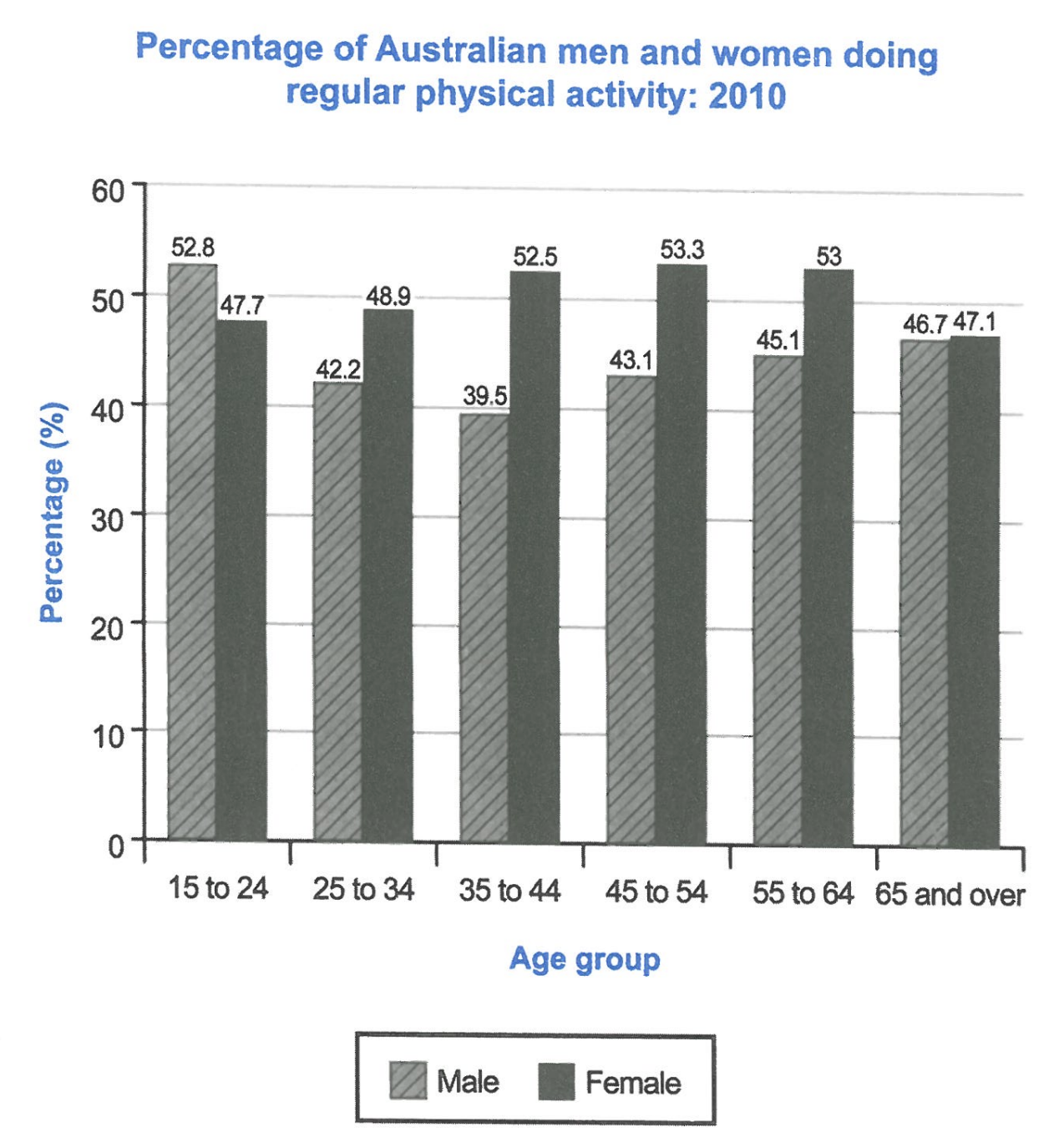
The bar chart below shows the percentage of Australian men and women in different age groups who did regular physical activity in 2010.
Summarise the information by selecting and reporting the main features, and make comparisons where relevant.
Student answer (Band 6.0)
The given bar graph illustrates the comparison between the percentage of Australian men and women in various age groups who did physical activity on day-to-day basis in 2010.
Overall, The analysed trend indicates females in major age groups have involved themselves more than men in physical activity. Except the age group of 15 to 24 where percentage of men were higher than females.
The segment between the age group of 15 to 24, were dominated by men which stood at 52.8% whereas females in the same group accounted for 47.7%. The elder females between the age of 25 to 64 always followed a similar trend of preferring more than men in the every age group. In addition, the only segment with little difference in numbers was the group between 65 and over where figures for males stood at 46.7 while the females amounted for 47.1%. While the difference in the age group is minimal which accounted for 0.
AI examiner evaluation
| Criterion | Band |
|---|---|
| Task Achievement / Task Response | 6.0 |
| Coherence and Cohesion | 6.0 |
| Lexical Resource | 6.0 |
| Grammatical Range and Accuracy | 5.5 |
| Overall | 6.0 |
Task Achievement / Task Response: Band 6.0
You identify the main overall comparison: women recorded higher activity in every age group except 15–24, and you correctly report the figures for that youngest group and for people aged 65 and over. This gives the response a relevant overview and some accurate supporting detail. However, the middle-age pattern is only described generally; the chart shows women peaking at 53.3% among 45–54-year-olds, while men reach their low point of 39.5% at ages 35–44 before rising. The final statement, “the difference … accounted for 0,” is incomplete and inaccurate: the figures differ by 0.4 percentage points. Include these key trends and complete the comparison to make the report more fully informative.
Coherence and Cohesion: Band 6.0
The response has a recognisable structure, moving from an introduction to an overview and then to details, so the reader can follow its general purpose. The contrast signalled by “Except” is also relevant. However, the final paragraph combines several age groups and comparisons in a way that makes the progression less clear, and it ends abruptly with “accounted for 0.” Some linking is mechanical or awkward, such as “In addition” before a point that is part of the same comparison. Organise the details by age pattern—for example, youngest group, middle groups, then oldest—and use complete sentences to show how each comparison relates to the overview.
Lexical Resource: Band 6.0
You use a reasonable range of task-related vocabulary, including “percentage,” “age groups,” “accounted for,” and “difference,” and the meaning is generally understandable. There are also attempts at more formal phrasing, such as “illustrates the comparison.” However, several expressions are unnatural or imprecise for describing a chart: “involved themselves more than men,” “dominated by men,” and “preferring more than men” do not clearly describe participation rates. “Day-to-day basis” also suggests daily activity, which the chart does not specify. Choose direct reporting language such as “were more physically active” or “the proportion was higher.” More precise collocations would make the comparisons clearer and more appropriately academic.
Grammatical Range and Accuracy: Band 5.5
You attempt both simple and more complex sentence forms, including a relative clause in “where figures for males stood at 46.7.” Most of the intended comparisons can be understood, but some grammatical errors and punctuation problems remain. For example, “The analysed trend indicates females … have involved themselves” has awkward tense and agreement, while “where percentage of men were higher” needs an article and a singular verb (“the percentage … was higher”). The sentence beginning “The segment between the age group …, were dominated” has an unnecessary comma and an incorrect subject–verb relationship. The final “While” clause is left incomplete. Check sentence boundaries, articles, and agreement, and ensure every subordinate clause is attached to a complete main clause.
See this exact question answered at other band scores. The same prompt compared across bands.
Browse more IELTS Writing model answers or get your own writing scored by the same AI examiner.