Band 6.0 IELTS Writing Task 1 Model Answer
Overall Band Score: 6.0 · Cambridge IELTS 12 · 2026-11-21
IELTS Writing Task 1 question
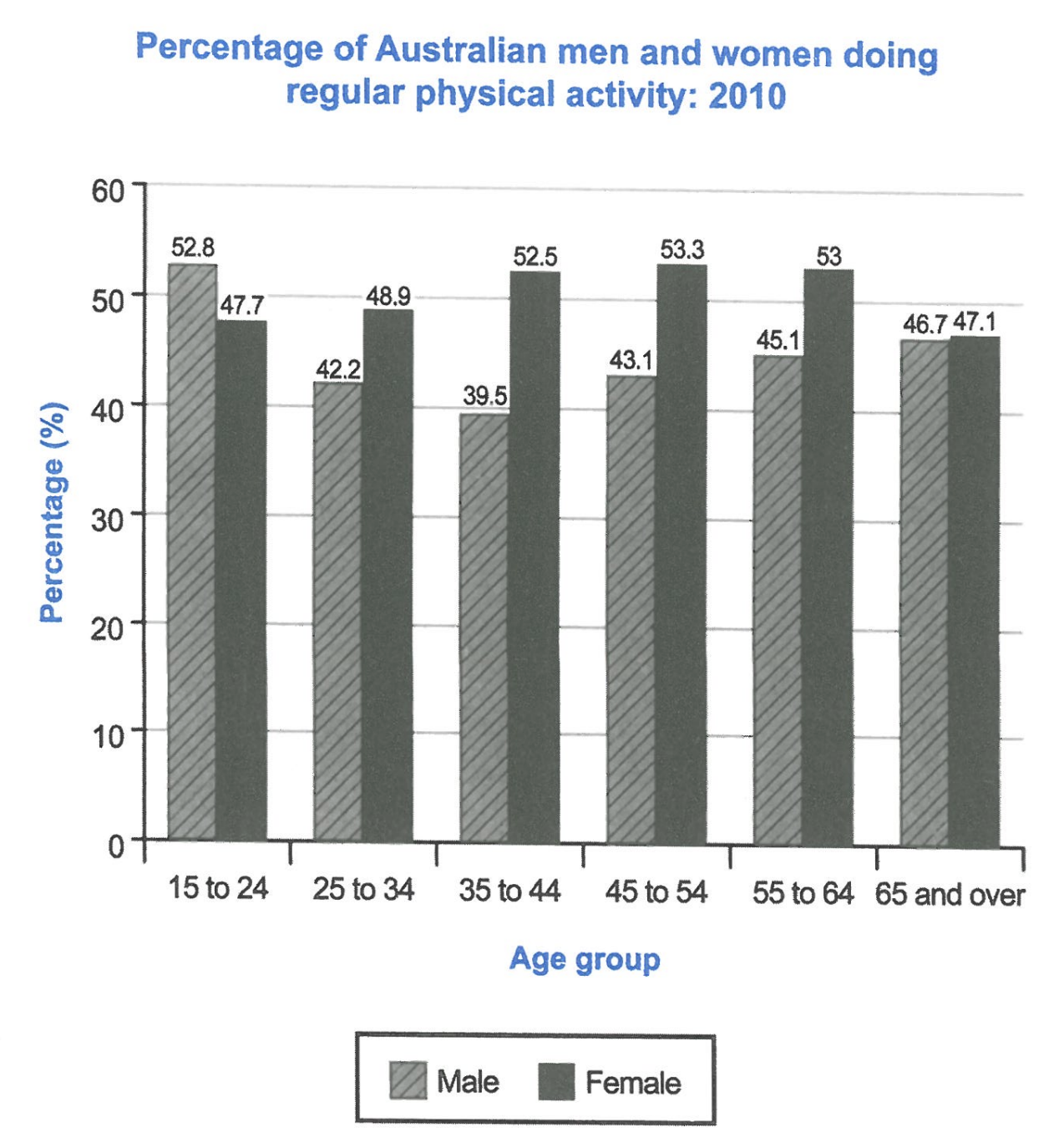
The bar chart below shows the percentage of Australian men and women in different age groups who did regular physical activity in 2010.
Summarise the information by selecting and reporting the main features, and make comparisons where relevant.
Student answer (Band 6.0)
The given bar graph represents the data about Australian men and women of different age groups who were regularly involved in physical activity in 2010.
Overall, females were more involved in regular physical activity in comparison to male. The percentage of female involved in regular physical activity showed increased trend across growing age expect for age group 65 and above, whereas certain fluctuations is showed in involvement of male across different age group.
52.8% of males aged 15 to 24 were involved in regular physical activity which declined to 38.5% for age group 35 to 44. By the end 46.7% of male from age group 65 and above were actively involved in regular physical activity.
While analysing the data for female,it was always higher than male except for age group 15 to 24 where 47.7% of women were involved in regular physical activity. The figure peaked with 53.3% for age group 45 to 54. The data for female regularly doing physical activity decreased by 0.3% with 53% for age group 55 to 64. Finally, 47.1% of female aged 65 and above were involved in regular physical activity.
AI examiner evaluation
| Criterion | Band |
|---|---|
| Task Achievement / Task Response | 6.0 |
| Coherence and Cohesion | 7.0 |
| Lexical Resource | 6.0 |
| Grammatical Range and Accuracy | 5.5 |
| Overall | 6.0 |
Task Achievement / Task Response: Band 6.0
You provide a relevant overview, identifying that women generally had higher participation and that male figures fluctuated. You also select several useful comparisons, including the female peak of 53.3% at ages 45–54 and the final figures for both sexes. However, the overview is not fully accurate: women did not show a steady increase across the age groups, since their rate fell from 53.3% to 47.1% in the oldest group. There is also a factual error in the male data: the 35–44 figure is 39.5%, not 38.5%. The claim that women were higher except among 15–24-year-olds is correct, but the male low point and the contrasting overall patterns could be reported more precisely.
Coherence and Cohesion: Band 7.0
The response is organised into a clear introduction, overview and two body sections, and the information generally progresses from the overall picture to details for each sex. Linking expressions such as “Overall,” “While analysing,” and “Finally” help guide the reader. The comparison between the sexes is also easy to follow. To make the progression more effective, group the figures around the main trends rather than treating each sex separately throughout; for example, directly contrast the male low point with the female peak in the middle age groups. Some transitions are slightly mechanical, and the long overview sentence combines several ideas without a clean structure. More precise referencing would also help the comparisons feel connected.
Lexical Resource: Band 6.0
You use an adequate range of task-related vocabulary, including “declined,” “peaked,” “fluctuations,” and “actively involved,” so the main trends are understandable. There are, however, some inaccurate or unnatural choices and repeated phrasing. “The percentage of female involved” is not a natural construction, while “in comparison to male” is imprecise; use “women” and “men” or “female participation” and “male participation.” “Showed increased trend” is also awkward, and “by the end” does not clearly describe the oldest age group. Aim for concise, conventional chart language and avoid repeating “involved in regular physical activity” in nearly every sentence. These refinements would make your descriptions more precise and fluent.
Grammatical Range and Accuracy: Band 5.5
You attempt a mix of simple and complex sentences, including a contrast introduced by “While,” and most of the intended meaning remains clear. Some grammatical errors recur, however. In “females were more involved … in comparison to male,” the comparison lacks a parallel plural noun; “women were more active than men” would be clearer. The overview also has agreement and verb-form problems in “certain fluctuations is showed,” and “expect” should be “except.” In “the percentage of female involved,” the noun phrase needs a grammatical form such as “the percentage of women who were active.” Check articles, plural forms and subject–verb agreement, and punctuate consistently after introductory phrases. More accurate control of these patterns would strengthen the range you are already attempting.
See this exact question answered at other band scores. The same prompt compared across bands.
Browse more IELTS Writing model answers or get your own writing scored by the same AI examiner.