Band 5.5 IELTS Writing Task 1 Model Answer
Overall Band Score: 5.5 · Cambridge IELTS 12 · 2026-11-21
IELTS Writing Task 1 question
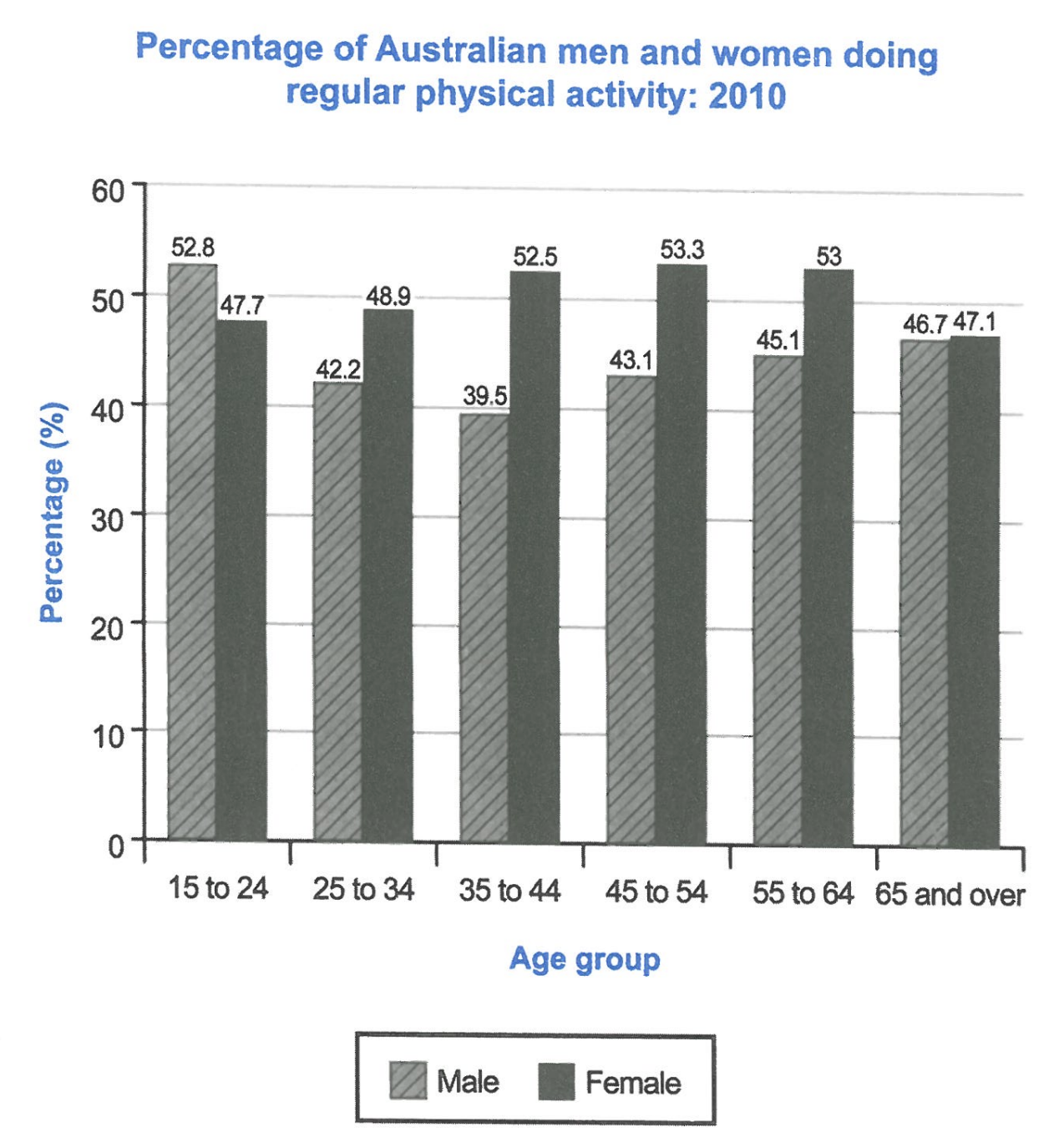
The bar chart below shows the percentage of Australian men and women in different age groups who did regular physical activity in 2010.
Summarise the information by selecting and reporting the main features, and make comparisons where relevant.
Student answer (Band 5.5)
The graph chart compares the Australian men and women who did the regular physical activity in different age group during 2010.
Overall, it is clear that females who did regualr physcial exercise from age 15 to 24 significantly increasing until they reached age 55 to 64. While, males physical activity going down but after 25 to 44 age it's increasing.
Looking first at, age of 15 to 24 where females exercising about 47.7 percentage, while males did 52.8%. With the age of 25 to 34, oppsites result came out. Where, 42.2% males did physical activity and woman did 48.9% activity. Age of 25 to 44, mens ratio for exercise was decrased by 4%. Whereas, females ration increases by 3%.
Turning to the age of 45 to 54, Females were still doing activity about 53.3%. While, males activity percentage grew by 4%. With the age of 55 to 64, males physical activity ratio again increased by 2% but females activity ration go down by 0.3%.
At the end age of 65 and over, both sex were almost had same activity ratio. Where female were 46.7% and males were 47.1%.
AI examiner evaluation
| Criterion | Band |
|---|---|
| Task Achievement / Task Response | 6.0 |
| Coherence and Cohesion | 6.0 |
| Lexical Resource | 5.0 |
| Grammatical Range and Accuracy | 5.0 |
| Overall | 5.5 |
Task Achievement / Task Response: Band 6.0
You identify the chart’s subject and provide an overview of the broad gender patterns: men start higher, while women are more active across most later age groups. You also include several relevant figures. However, some comparisons are unclear or inaccurate. The overview says female activity increased until 55–64, but it actually peaks at 45–54 (53.3%) before edging down to 53.0%. The final figures are reversed: women are at 47.1% and men at 46.7%. The statement that male activity “grew by 4%” at 45–54 is also imprecise; it rises from 39.5% to 43.1%, or 3.6 percentage points. A more accurate overview and clearer reporting of the main turning points would strengthen the response.
Coherence and Cohesion: Band 6.0
The response has a recognisable structure, moving from an introduction and overview to age-group details, and the sequence broadly follows the chart from youngest to oldest. This makes the information reasonably easy to follow. However, some linking is mechanical or awkward, particularly the repeated “While” and “Where” sentence openings, and several fragments interrupt the flow: “Where, 42.2% males…” and “At the end age of 65 and over…” The grouping of ages is also confusing: “Age of 25 to 44” combines two groups without clearly explaining the change between them. Use complete sentences, connect comparisons within the same sentence where appropriate, and organise the body into clearer age-group comparisons.
Lexical Resource: Band 5.0
You use relevant chart vocabulary, including “percentage,” “age group,” “increased,” and “decreased,” so the topic is generally clear. However, the range and control of word choice are limited, with repeated use of “activity” and several inaccurate or unnatural expressions. For example, “graph chart” is redundant, “oppsites result came out” is not an appropriate way to describe a comparison, and “males ratio for exercise” is an awkward collocation. Spelling errors such as “regualr,” “physcial,” “decrased,” and “ration” also reduce precision. Choose standard chart-reporting phrases and check spelling carefully; this will make your comparisons more concise and natural.
Grammatical Range and Accuracy: Band 5.0
You attempt both simple and more complex sentences, including comparisons introduced with “while” and “whereas.” However, errors in verb forms, sentence construction, and agreement are noticeable and sometimes make relationships between ideas unclear. For example, “females … significantly increasing” needs a finite verb, such as “female participation increased,” while “males physical activity going down” lacks a main verb. “Both sex were almost had same activity ratio” also combines incompatible verb forms and has agreement problems. Several clauses beginning “Where” are fragments rather than complete sentences. Practise forming complete subject–verb clauses and use consistent past-tense reporting; accurate sentence patterns will help your ideas read more smoothly.
See this exact question answered at other band scores. The same prompt compared across bands.
Browse more IELTS Writing model answers or get your own writing scored by the same AI examiner.