Band 6.0 IELTS Writing Task 1 Model Answer
Overall Band Score: 6.0 · Cambridge IELTS 12 · 2026-11-22
IELTS Writing Task 1 question
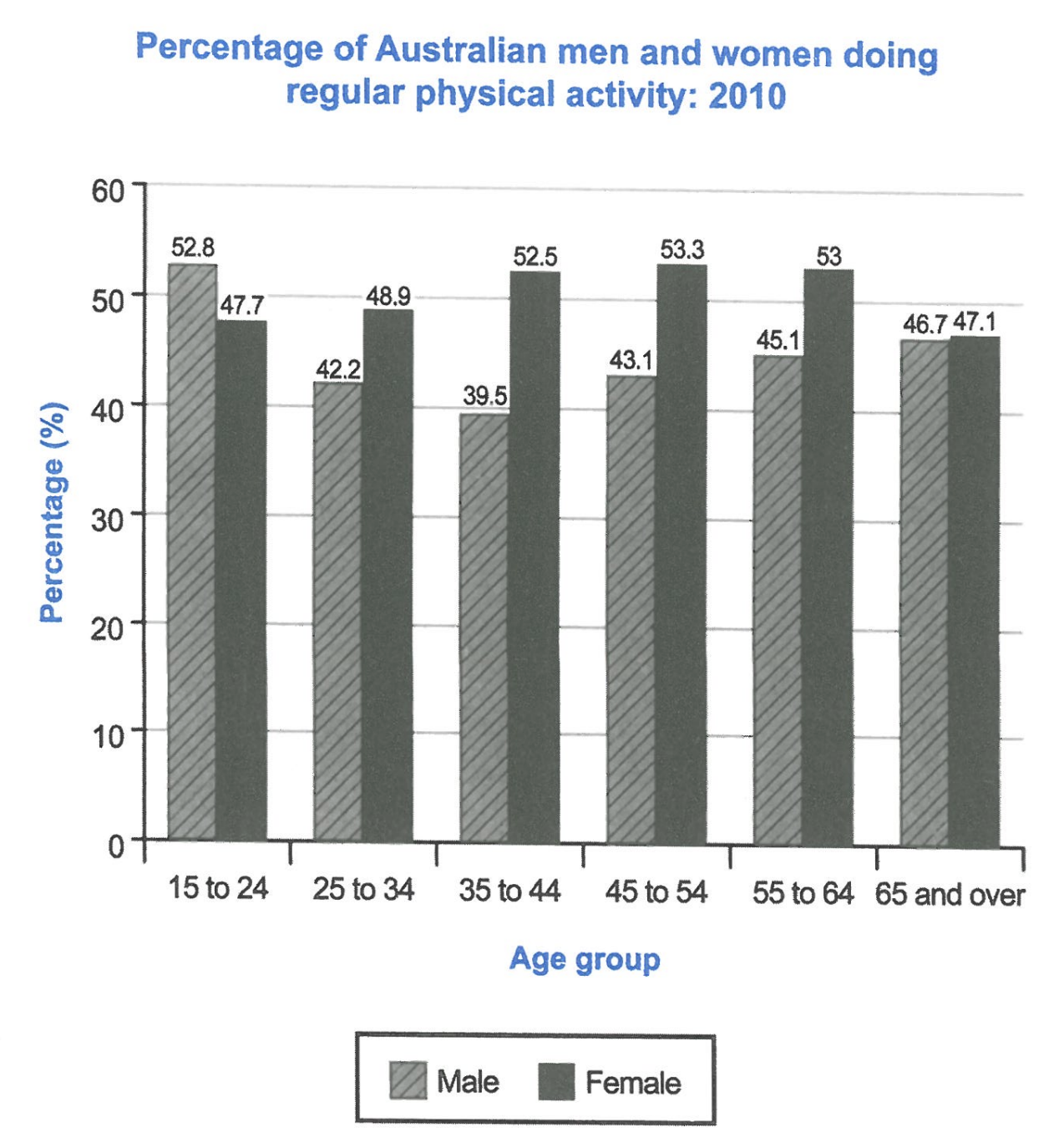
The bar chart below shows the percentage of Australian men and women in different age groups who did regular physical activity in 2010.
Summarise the information by selecting and reporting the main features, and make comparisons where relevant.
Student answer (Band 6.0)
The bar chart below illustrates the proportion of Australian men and women in different age groups who did regular physical activity in 2010.
Overall, the percentage of women who did regular physical activity was higher then men in all age groups except who aged between 15 to 24.
In detail, the proportion of men who aged between 15 and 24 accounted for 52.8%, while women 47.7%. For the group age between 25 and 34, the percentage of women were 48.9% and 42.2% for men.
The proportion of women who aged between 35 and 44 were much higher than in men in the same group age, reaching 52.2%, while 39.5% for men. Furthermore, Women also exceeded men in the next group age, between 45 to 54; the proportion of women stood at 53.3%, while 43.1% for men. Moreover, women who aged between 55 and 64 were 53%, while 45.1% for men. Finally, men and women who aged over 65 had approximately close percentages, 47.1% for women and 46.7 for men.
AI examiner evaluation
| Criterion | Band |
|---|---|
| Task Achievement / Task Response | 6.0 |
| Coherence and Cohesion | 6.0 |
| Lexical Resource | 6.0 |
| Grammatical Range and Accuracy | 5.5 |
| Overall | 6.0 |
Task Achievement / Task Response: Band 6.0
You provide a clear overview of the main comparison: women recorded higher participation in every age group except 15–24, and you support this with figures across the chart. Most values are reported accurately, including the close results among people aged 65 and over. However, the figure for women aged 35–44 is given as 52.2%, whereas the chart shows 52.5%. The overview could also identify the broader pattern more fully: men’s rate falls to a low among 35–44-year-olds before rising, while women’s rate peaks around middle age and then declines. These omissions and the one inaccurate figure leave some features less fully reported than others.
Coherence and Cohesion: Band 6.0
The response is arranged in a sensible order, with an introduction, an overview, and details that move through the age groups from youngest to oldest. This makes the comparisons easy to follow overall. Linking expressions such as “Furthermore,” “Moreover,” and “Finally” help signal progression, although their repeated use makes the connections somewhat mechanical. Some sentence references are also unclear, particularly “except who aged between 15 to 24,” and the repeated “the proportion of women who aged…” construction interrupts the flow. Use clearer references such as “the 15–24 group” and vary how you introduce comparisons. A more concise overview of the contrasting trends would also strengthen the progression between paragraphs.
Lexical Resource: Band 6.0
You use an adequate range of task-related vocabulary, including “proportion,” “percentage,” “accounted for,” and “stood at,” and the meaning is generally clear. There is some variation in how you report figures, which helps avoid relying on one verb throughout. However, several expressions are awkward or imprecise, such as “group age,” “approximately close percentages,” and “women who aged.” The phrase “much higher” is also stronger than necessary for a comparison that is better expressed neutrally. Aim for natural collocations used in data reporting, such as “age group,” “a similar proportion,” and “the rate among women.” More precise and idiomatic choices would make the comparisons sound more controlled and formal.
Grammatical Range and Accuracy: Band 5.5
You attempt a mix of simple and more complex sentence forms, and most comparisons remain understandable. Some grammatical errors recur, however. In the overview, “higher then men” should be “higher than that for men,” and “except who aged” needs a complete construction, such as “except among those aged 15–24.” There are also agreement and clause-pattern problems in “the percentage of women were” and “women who aged between 35 and 44 were.” Use “the percentage was” or “women aged…” instead. In the final sentence, “46.7 for men” needs the percent sign for parallel presentation, though this is primarily a reporting-format issue. Greater control of these sentence patterns would improve accuracy while preserving your range.
See this exact question answered at other band scores. The same prompt compared across bands.
Browse more IELTS Writing model answers or get your own writing scored by the same AI examiner.