Band 5.5 IELTS Writing Task 1 Model Answer
Overall Band Score: 5.5 · Cambridge IELTS 12 · 2026-11-22
IELTS Writing Task 1 question
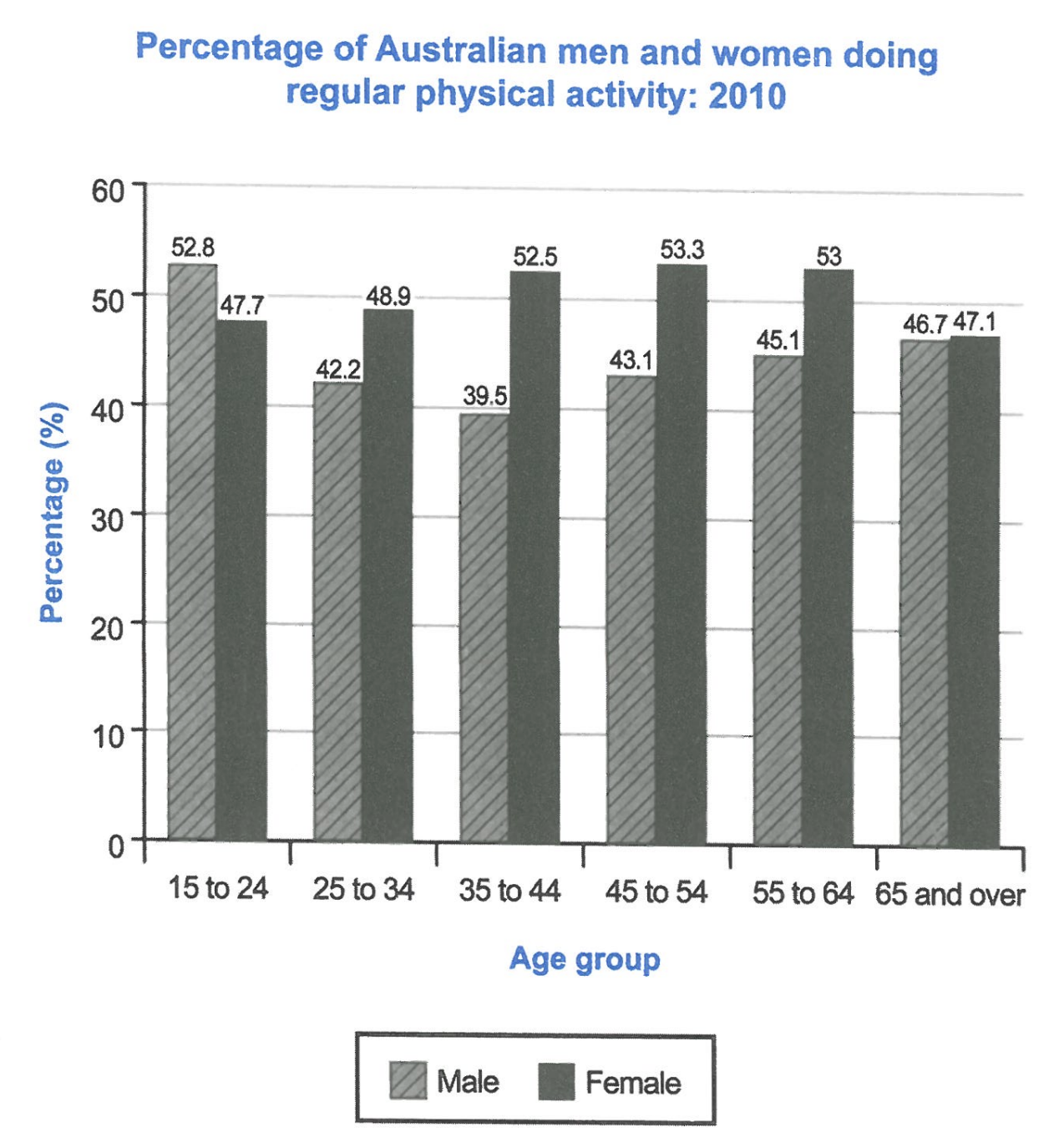
The bar chart below shows the percentage of Australian men and women in different age groups who did regular physical activity in 2010.
Summarise the information by selecting and reporting the main features, and make comparisons where relevant.
Student answer (Band 5.5)
the given chart presents informations about Australian men and women who exercise throughout different age groups in 2010.
overall, it's evident that female tend to do more physical activity than male, furthermore young guys tend to be more active physically. another notable aspect is both male and female tend to exercise when they get granny at pretty much the same rate. looking first at male group , it recorded the highest percentage with 52.8% at the age of 15 to 24, than it starts to going down eventually by the age of 35 to 44 reaching in particularly the lowest overall male physical activity by 39.5% , additionally it starts to pick up again after that age to reach 46.7% by the age of 65 and over.
turning to female group, it recorded a constant upward increase in the percentage of women who exercise reaching 53.3% as the highest rate recorded by the age of 45-54 , by comparison to the male group , woman do more physical activity, finally it starts to drop reaching 47.1% at the age of 65 and more.
AI examiner evaluation
| Criterion | Band |
|---|---|
| Task Achievement / Task Response | 6.0 |
| Coherence and Cohesion | 6.0 |
| Lexical Resource | 5.5 |
| Grammatical Range and Accuracy | 5.0 |
| Overall | 5.5 |
Task Achievement / Task Response: Band 6.0
You identify the main contrast: women were more active than men in most age groups, while men had the highest figure among 15–24-year-olds. You also report several key values accurately, including the male low of 39.5% and the female peak of 53.3%. However, the overview is partly unclear: the claim that both sexes exercise at “pretty much the same rate” among older people is not precise, since the figures are close only in the 65-and-over group, while women lead by a wider margin at 55–64. The female trend is also described as a constant rise, although it falls slightly from 53.3% to 53.0% before dropping more noticeably. Make the overview more exact and compare the groups across the age ranges to develop the summary more fully.
Coherence and Cohesion: Band 6.0
The response has a recognisable structure, moving from an introduction and overview to separate discussion of men and women. This makes the main information reasonably easy to follow. Linking expressions such as “looking first” and “turning to” help signal the shift between groups. However, the overview combines several points in a long, loosely connected sequence, and connectors such as “furthermore,” “additionally,” and “finally” sometimes make the relationships between ideas less clear. The comparison between the sexes is also repeated rather than integrated with the relevant age-group figures. Use clearer paragraph breaks and organise the body around the main trends or age-group comparisons; this would make progression more deliberate and cohesion less mechanical.
Lexical Resource: Band 5.5
You use relevant vocabulary for describing a chart, including “highest percentage,” “lowest,” “increase,” and “drop,” so the reader can understand the broad trends. There is also some attempt to vary phrasing, for example “starts to pick up again.” However, several choices are informal or imprecise for an academic report: “young guys,” “get granny,” and “do more physical activity” do not fit the task’s register or meaning well. Some word forms and collocations are also inaccurate, as in “presents informations” and “reaching in particularly.” Aim for precise, neutral terms such as “men,” “older age groups,” and “participation in regular physical activity,” and check that each phrase describes the data naturally.
Grammatical Range and Accuracy: Band 5.0
You attempt both simple and more extended sentence forms, including clauses linked with “although”-type contrasts and time expressions such as “after that age.” The overall meaning is generally recoverable, but errors in agreement, verb forms, articles, and sentence boundaries are noticeable. For example, “female tend” and “male group … it recorded” do not maintain correct agreement, while “it starts to going down” uses an incorrect verb pattern. The opening sentence also lacks a capital letter, and several long sentences are joined with commas where full stops would be clearer. Practise accurate subject–verb agreement and verb patterns, and divide the longer trend descriptions into shorter sentences while retaining some complex structures.
See this exact question answered at other band scores. The same prompt compared across bands.
Browse more IELTS Writing model answers or get your own writing scored by the same AI examiner.