Band 6.0 IELTS Writing Task 1 Model Answer
Overall Band Score: 6.0 · Cambridge IELTS 12 · 2026-11-22
IELTS Writing Task 1 question
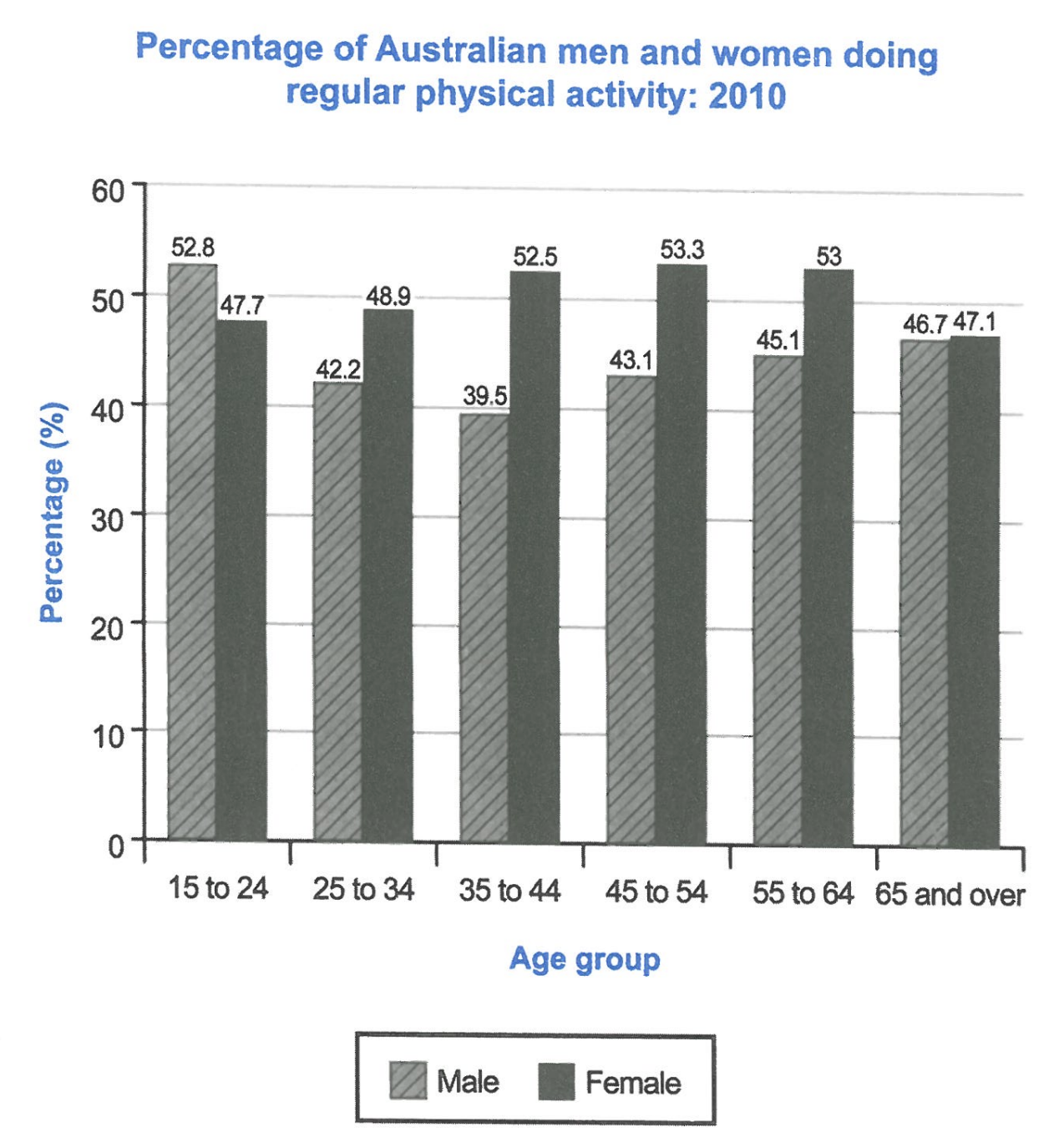
The bar chart below shows the percentage of Australian men and women in different age groups who did regular physical activity in 2010.
Summarise the information by selecting and reporting the main features, and make comparisons where relevant.
Student answer (Band 6.0)
The bar chart demonstrates the percentage of Australia men and women in different age groups which involve in regular physical activity in 2010.
It is clearly seen that the teens participate in physical activities the most and old people show less involvement. Moreover women participate more actively in physical activity after 24 years of age than that of men.
In 15 to 24 year age group males are dominant in physical activity participation and 52.8% men participate in physical activity as compared to woman only 47.7. While in age group 25 to 34 only 42.2% men did physical activity meanwhile women around 48.9. By comparing age group 35 to 44 and 55 to 64 we can saw that 39.5% and 43.1% male did regular physical activity however in women case around 52.5 and 53.5% women did regular physical activity respectively and 45.1% men and 53% women did exercise in age 55 to 64.Additionally, in age group of 65 and over 46.7% men do physical activity regularly while women participants decreased to 47.1%.
AI examiner evaluation
| Criterion | Band |
|---|---|
| Task Achievement / Task Response | 6.0 |
| Coherence and Cohesion | 6.0 |
| Lexical Resource | 5.5 |
| Grammatical Range and Accuracy | 5.5 |
| Overall | 6.0 |
Task Achievement / Task Response: Band 6.0
You identify the main contrast accurately: men have the higher participation rate among 15–24-year-olds, while women lead in the older groups. You also include several relevant figures, such as 52.8% versus 47.7% for the youngest group and 42.2% versus 48.9% for ages 25–34. However, the overview is not fully accurate: “old people show less involvement” suggests a general decline, whereas women’s rates remain around 53% through ages 35–64, and the oldest group is not the lowest for both sexes. There is also a data error: for men aged 45–54, the figure is 43.1%, but you associate it with the 35–44 group; women aged 45–54 are 53.3%, not 53.5%. A clearer overview and more precise grouping would strengthen the report.
Coherence and Cohesion: Band 6.0
The response has a recognisable progression from an introduction to an overview and then comparisons supported by figures. Linking expressions such as “Moreover,” “While,” and “Additionally” help show relationships between points. However, the body is presented as one long paragraph, and the comparisons become difficult to follow when several age groups and values are combined in the same sentence. For example, the sentence beginning “By comparing age group 35 to 44 and 55 to 64” moves between age groups and figures without making each pairing clear. Some transitions are also mechanical or imprecise, particularly “meanwhile” and “however” in the same sequence. Use separate paragraphs for the overview and details, and organise the figures in a consistent age-group order.
Lexical Resource: Band 5.5
You use relevant task vocabulary, including “percentage,” “age group,” “participation,” and “regular physical activity,” so the topic is generally clear. There is also some attempt to vary wording with “involvement” and “participants.” However, several choices are unnatural or imprecise, such as “percentage of Australia men,” “which involve in,” and “men are dominant in physical activity participation.” Repetition of “did physical activity” and “participate in physical activity” also limits flexibility. Aim for accurate collocations such as “the proportion of Australian men,” “engaged in regular exercise,” and “the rate was higher among women.” Check word forms and spelling as well: “woman” should be “women” when referring to the group.
Grammatical Range and Accuracy: Band 5.5
You attempt both simple and more complex sentences, including comparisons with “as compared to” and clauses introduced by “while” and “however.” The main meaning is usually understandable, but some grammatical errors recur. For example, “the percentage of Australia men” has an incorrect noun form, and “the teens participate” shifts from the chart’s past-time context to the present. In “we can saw,” the modal is followed by the wrong verb form; “we can see” or “we saw” would be correct. Agreement and sentence construction also need attention in “women participants decreased,” while the long comparison sentence contains unclear clause relationships and punctuation. Use past tense consistently for the 2010 data and divide complex comparisons into shorter, accurately structured sentences.
See this exact question answered at other band scores. The same prompt compared across bands.
Browse more IELTS Writing model answers or get your own writing scored by the same AI examiner.