Band 6.5 IELTS Writing Task 1 Model Answer
Overall Band Score: 6.5 · Cambridge IELTS 12 · 2026-11-22
IELTS Writing Task 1 question
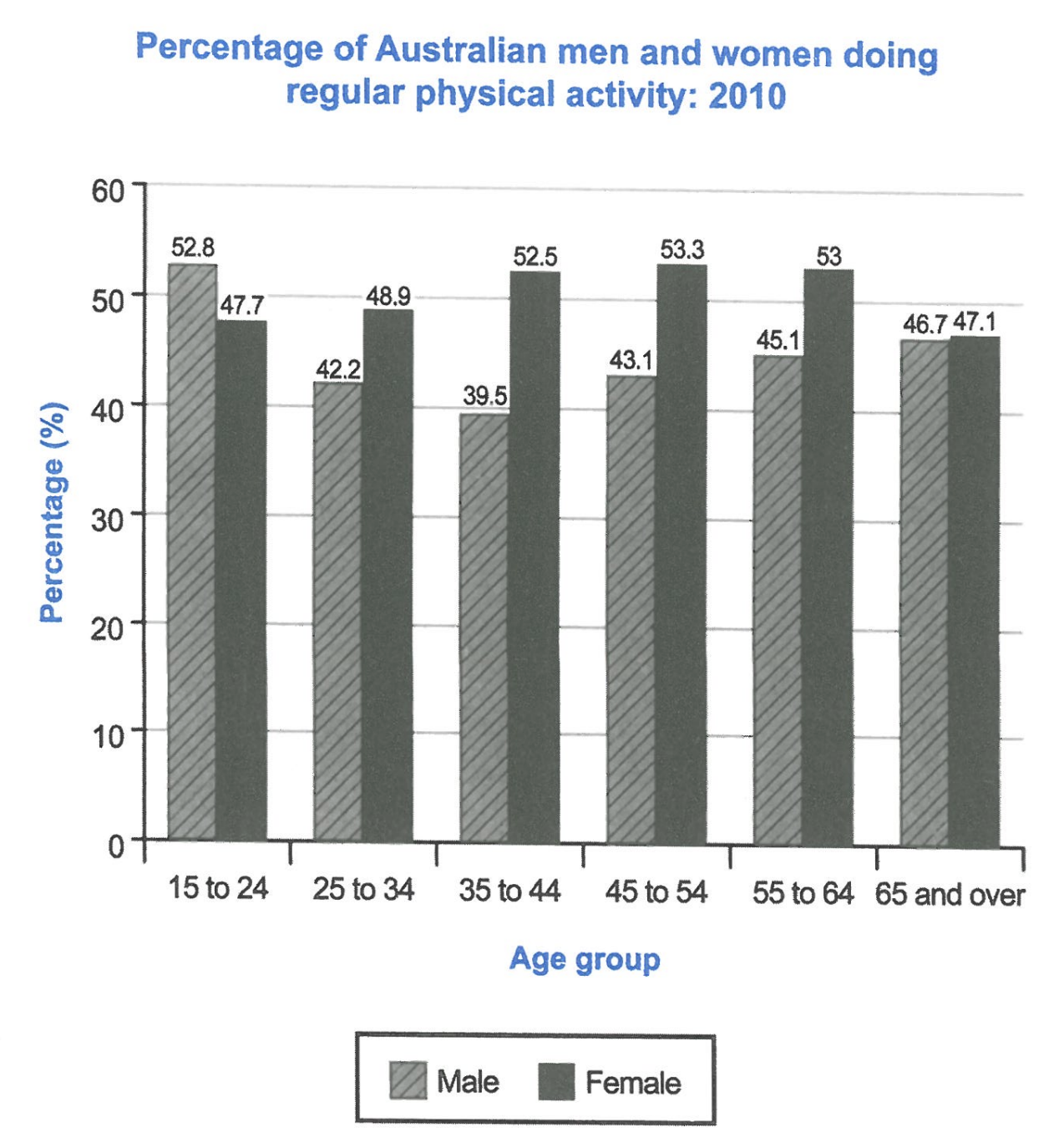
The bar chart below shows the percentage of Australian men and women in different age groups who did regular physical activity in 2010.
Summarise the information by selecting and reporting the main features, and make comparisons where relevant.
Student answer (Band 6.5)
The bar chart compares the percentage of daily excercise by males and females of australia in 2010.
Overall, it is clear that women aged 45 to 54 years are highly taking part in physical activites about the percentage of 53.3%, while the lowest percentage distribution reflects the age group of 35 to 44 years old men. In general, females showed a higher involvement in excercise as compare to men in 2010.
The data shows that only boys of 15 to 24 years old reflected the extreme participation in physical activity approximately 52.8%, which is the highest proportion of the male gender in the year of 2010 in contrast to the other age groups of men. Moreover, women aged 25 to 34 showed engagement of 48.9%, whereas men were at 42.2% that is roughly 5.7% is lower than women. 35 to 44 years old females represented the active involvement of 52.5%, contrastly men of that same age group reflected the lowest percentage about 39.5%, which is again less the women about estimated 12.5%.
However, the male of age group 15 to 24 was the only section which represented more engagement in physical activities about 52.8% than females 47.7%, that was about 5.1% higher as compared to women. Whereas, 65 and over men and women showed a slight diference of 1.5% in particiation where men were at 46.7% and women represented 47.1% of avtive engagement in excercise.
AI examiner evaluation
| Criterion | Band |
|---|---|
| Task Achievement / Task Response | 7.0 |
| Coherence and Cohesion | 6.5 |
| Lexical Resource | 6.0 |
| Grammatical Range and Accuracy | 5.5 |
| Overall | 6.5 |
Task Achievement / Task Response: Band 7.0
The response identifies the chart’s subject and gives a clear overview: women’s participation is generally higher, while men aged 15–24 are the exception and men aged 35–44 have the lowest rate. These are central features, and the figures cited for the youngest men, women aged 45–54, and the 35–44 comparison are accurate. The response also makes relevant comparisons, such as the 5.7-point gap among 25–34-year-olds. However, coverage is uneven: the 45–54 and 55–64 figures are not developed in the detail given to other groups, and the final comparison describes a “slight difference” of 1.5% even though the stated values, 46.7% and 47.1%, differ by 0.4 percentage points. More precise, balanced reporting would strengthen the account.
Coherence and Cohesion: Band 6.5
The response has a recognisable structure, with an introduction, an overview, and body paragraphs that group comparisons. Its progression from the overall pattern to specific age groups is generally understandable, and linking expressions such as “Moreover” and “However” help signal relationships. This shows a coherent overall arrangement. At times, though, the connections are mechanical or unclear: “However” introduces another comparison rather than a clear contrast with the preceding paragraph, and “Whereas” begins a fragment-like continuation. The repeated focus on the youngest men in both body paragraphs also interrupts the progression. Grouping the age ranges more systematically and using clearer references between comparisons would make cohesion more flexible and the sequence easier to follow.
Lexical Resource: Band 6.0
There is an adequate range of vocabulary for describing the chart, including “participation,” “engagement,” “proportion,” and “involvement.” The writer also attempts more formal expressions, and the intended meaning is usually clear. However, several choices are inaccurate or unnatural for this context: “daily exercise” is not stated by the chart, “highly taking part” is awkward, and “percentage distribution reflects” does not naturally describe a rate. “Boys” is also less suitable than “men” for the adult age group. Spelling errors such as “excercise,” “diference,” and “particiation” further limit control. Prefer precise, conventional chart language—for example, “the proportion who exercised regularly”—and check spelling and collocations carefully.
Grammatical Range and Accuracy: Band 5.5
The response attempts a mix of simple and complex sentences, including clauses introduced by “while,” “whereas,” and “which.” Most comparisons remain understandable, but some sentence structures are awkward or incomplete. For example, “whereas men were at 42.2% that is roughly 5.7% is lower” combines clauses without a workable grammatical connection; “which is again less the women” also lacks a clear comparative construction. There are further issues with articles and agreement in phrases such as “the male of age group” and “women aged 45 to 54 years are highly taking part.” These errors do not generally prevent understanding, but they reduce accuracy. Use shorter comparison sentences and check clause boundaries, verb forms, and comparative patterns.
See this exact question answered at other band scores. The same prompt compared across bands.
Browse more IELTS Writing model answers or get your own writing scored by the same AI examiner.