Band 7.0 IELTS Writing Task 1 Model Answer
Overall Band Score: 7.0 · Cambridge IELTS 12 · 2026-11-23
IELTS Writing Task 1 question
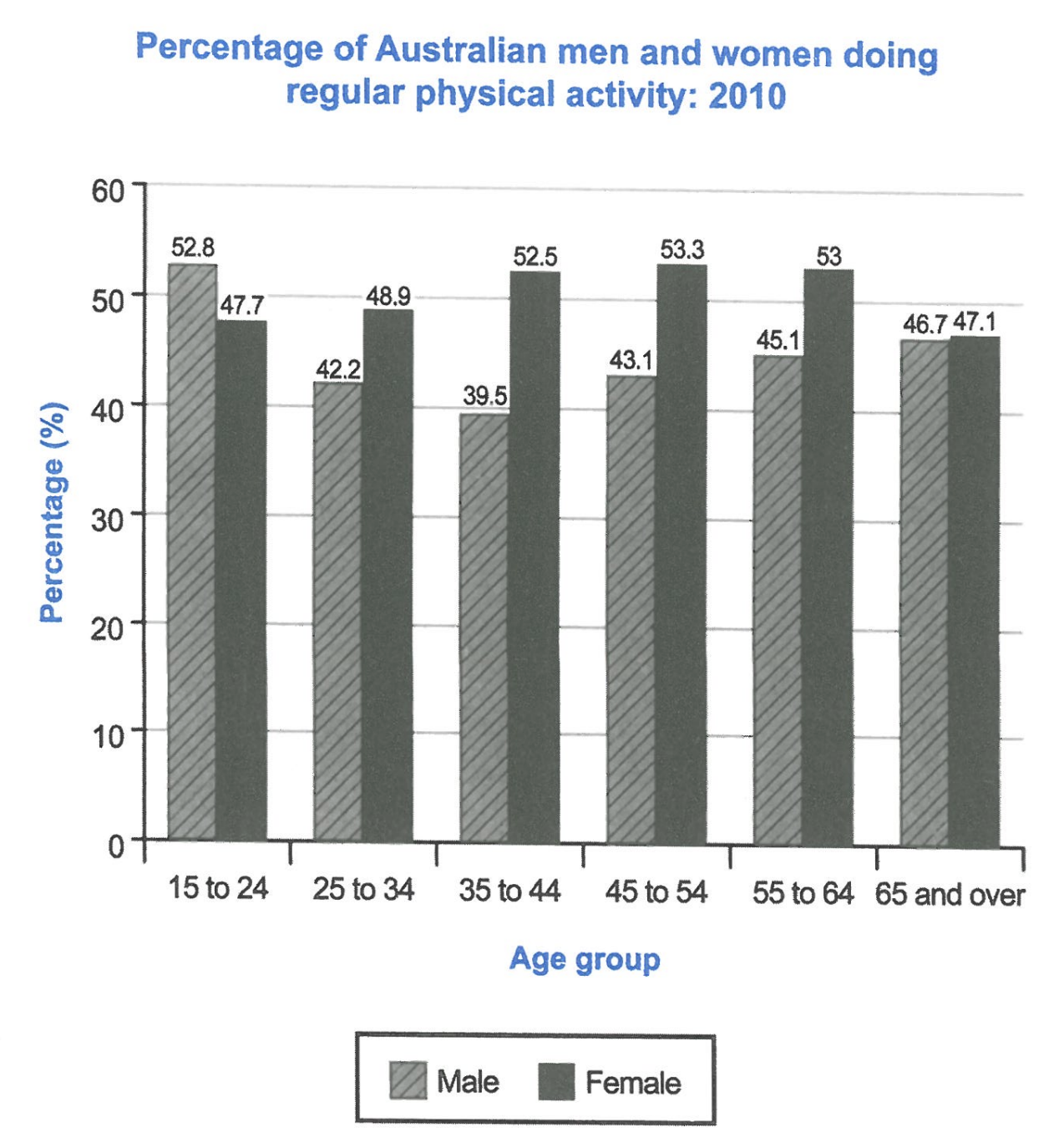
The bar chart below shows the percentage of Australian men and women in different age groups who did regular physical activity in 2010.
Summarise the information by selecting and reporting the main features, and make comparisons where relevant.
Student answer (Band 7.0)
The bar graph illustrates the percentages of Australian males and females who regularly engaged in physical activity during 2010.
Overall, it can be noted that the number of female population who exercised increased steadily as they age, although, a drop can be noticed when they reached 65 years and older.
On the other hand, we can see an inital decrease in males who did physical activities but eventually increased in small percentages as they get older. For both sexes aged 65 and over, the percentages are almost the same with 46.7% and 47.7% for male and female respectively.
Men aged 15-24 had peak physical activities which accounted for 52.8%. This number decreased to 42.2% during ages 25-34 and further down at 39.5% during 35-44 years old. This trend slowly gained percentages until it reached 46.7% at 65 years old and older.
In contrast, percentages of women who engaged in physical exercise had a steady increase as they get older, which peaked during at 45-54 years old with 53.3%. However, there was a sight drop to 47.1% during 65 years and older.
AI examiner evaluation
| Criterion | Band |
|---|---|
| Task Achievement / Task Response | 7.5 |
| Coherence and Cohesion | 7.0 |
| Lexical Resource | 6.0 |
| Grammatical Range and Accuracy | 6.5 |
| Overall | 7.0 |
Task Achievement / Task Response: Band 7.5
The response selects the main patterns and supports them with accurate figures: it identifies the male decline to 39.5% at ages 35–44 followed by a recovery, and the female peak of 53.3% at ages 45–54 before a fall. The overview also notes the near-equal figures in the oldest group. One detail needs correction: the female rate does not increase steadily throughout the age range, since it falls from 53.0% at 55–64 to 47.1% at 65 and over. Also, the overview says the oldest-group figures are 46.7% and 47.7%; the female figure is 47.1%. These are small inaccuracies within an otherwise clear, well-supported account of the key features.
Coherence and Cohesion: Band 7.0
The four-paragraph structure is appropriate: an introduction, an overview, and separate descriptions of the male and female trends. Information generally progresses logically, and contrast markers such as “On the other hand” and “In contrast” help distinguish the two series. The overview gives the reader a useful map of the main patterns before the details. Some linking and reference could be more precise, however. “This number” clearly refers to the male percentage, but “the number of female population” is an awkward reference, and the overview repeats points that are then described in the final paragraph. More concise linking and a clearer distinction between the overall summary and detailed comparisons would make the progression smoother.
Lexical Resource: Band 6.0
The vocabulary is adequate for describing the chart, with relevant terms such as “percentages,” “decreased,” “peaked,” and “in contrast.” The writer also varies expressions for physical activity, using “exercised,” “did physical activities,” and “engaged in physical exercise.” However, some choices are imprecise or unnatural, including “number of female population,” “peak physical activities,” and “gained percentages.” There is also a spelling error in “inital,” and “sight drop” is not the intended expression. These issues do not prevent understanding, but they limit precision and naturalness. Aim for standard chart-reporting collocations and use “rate” or “proportion” where appropriate rather than repeatedly referring to a number.
Grammatical Range and Accuracy: Band 6.5
The response uses a mix of simple and complex forms, including a subordinate clause in “although, a drop can be noticed…” and a relative clause in “which peaked during…”. Most meanings remain clear, but some grammatical errors persist. For example, “as they age” and “as they get older” shift into the present when describing data from 2010; “the number of female population” has an incorrect noun construction; and “peaked during at 45-54 years old” combines incompatible prepositions. The sentence beginning “For both sexes aged 65 and over” also gives an inaccurate female figure, though that is a data issue rather than a grammar error. More consistent past-tense reporting and careful checking of articles, agreement, and prepositions would improve accuracy.
See this exact question answered at other band scores. The same prompt compared across bands.
Browse more IELTS Writing model answers or get your own writing scored by the same AI examiner.