Band 5.5 IELTS Writing Task 1 Model Answer
Overall Band Score: 5.5 · Cambridge IELTS 12 · 2026-11-23
IELTS Writing Task 1 question
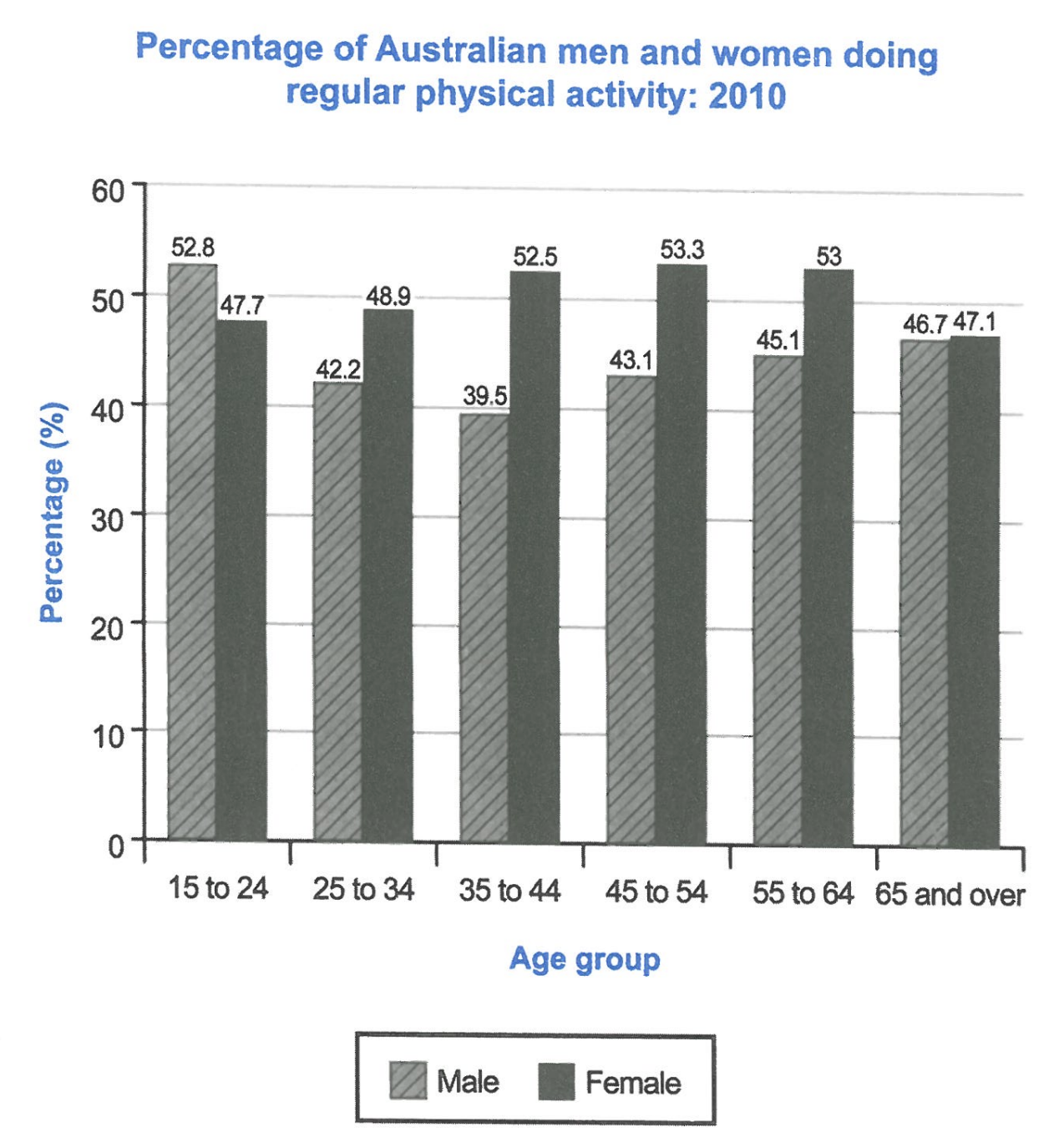
The bar chart below shows the percentage of Australian men and women in different age groups who did regular physical activity in 2010.
Summarise the information by selecting and reporting the main features, and make comparisons where relevant.
Student answer (Band 5.5)
The bar chart depicts excersice in the Australian population dividedn by gender in 2010
Overall, we can see the Australian women doing regular physical activity when they have 45 to 54 ages, however, women in 65 and over ages it is the time, where is reduce activity excercise.
On the other hand, Australian young men betwen 15 to 24 ages it is highest point with 52.8% and the lowest percentage is 35 to 44 with 39.5%. Interstingly, men has the lowest in general compare with women. The big different is 35 to 44 with 12 points of different in gender.
In conclusion, the group of the women is increasing of percenage in doing phsycal activity from 15 to 24 ages and it is decresing after 55 years old. men in 2010 has significan flutetion from 15 year to 44 years and after this drow it is increasing to 65 and over elderly men.
AI examiner evaluation
| Criterion | Band |
|---|---|
| Task Achievement / Task Response | 6.0 |
| Coherence and Cohesion | 6.0 |
| Lexical Resource | 5.0 |
| Grammatical Range and Accuracy | 5.0 |
| Overall | 5.5 |
Task Achievement / Task Response: Band 6.0
You identify several important features, including the male peak of 52.8% among 15–24-year-olds, the male low of 39.5% among 35–44-year-olds, and the substantial gender gap in that middle age group. You also recognise that women’s activity is highest around ages 45–54 and lowest among those aged 65 and over. However, the overview is not fully accurate: women’s rate rises to 53.3% at 45–54, remains almost unchanged at 55–64, and then falls; it does not simply decrease after age 55. The claim that men are “the lowest in general” is also too broad, since men exceed women in the youngest group. Develop the overall comparison more precisely and report the main trends without contradictory generalisations.
Coherence and Cohesion: Band 6.0
The response has a recognisable structure: an introduction, an overview, a paragraph about men and gender differences, and a concluding summary. This gives the reader an overall route through the information. However, the progression is sometimes unclear because the overview focuses on women, while the next paragraph shifts to men without a clear comparison framework. Phrases such as “On the other hand” and “In conclusion” are used, but the relationships they signal are not always logical or necessary. The final paragraph largely repeats earlier points rather than adding a clear synthesis. Grouping the data by gender or by shared age-group patterns, and using direct comparisons between the two series, would make the organisation more coherent and cohesion less mechanical.
Lexical Resource: Band 5.0
You use some relevant chart vocabulary, including “percentage,” “regular physical activity,” “highest point,” and “lowest,” so the topic is generally clear. However, the range is limited and several spelling and word-choice errors make parts difficult to read, such as “excersice,” “Interstingly,” “percenage,” and “flutetion.” Some expressions are also unnatural or imprecise: “the big different” and “12 points of different” do not clearly describe the gender gap, while “elderly men” is not needed for the age category. Aim for accurate, conventional language for describing data, such as “rate,” “gap,” “rose,” and “declined,” and check spelling and word forms carefully.
Grammatical Range and Accuracy: Band 5.0
You attempt both simple and more complex sentence forms, including clauses introduced by “when” and “where,” and you use past-tense language to discuss the 2010 data. However, some sentence structures are faulty and make relationships between ideas unclear. For example, “women doing regular physical activity when they have 45 to 54 ages” lacks a clear grammatical structure, and “men has the lowest” has a subject–verb agreement error. There are also problems with articles, plurals, and sentence construction in “the group of the women is increasing of percentage.” These errors do not prevent the reader from understanding every point, but they reduce clarity. Practise complete subject–verb sentences and use straightforward comparative structures before attempting longer clauses.
See this exact question answered at other band scores. The same prompt compared across bands.
Browse more IELTS Writing model answers or get your own writing scored by the same AI examiner.