Band 6.5 IELTS Writing Task 1 Model Answer
Overall Band Score: 6.5 · Cambridge IELTS 12 · 2026-11-23
IELTS Writing Task 1 question
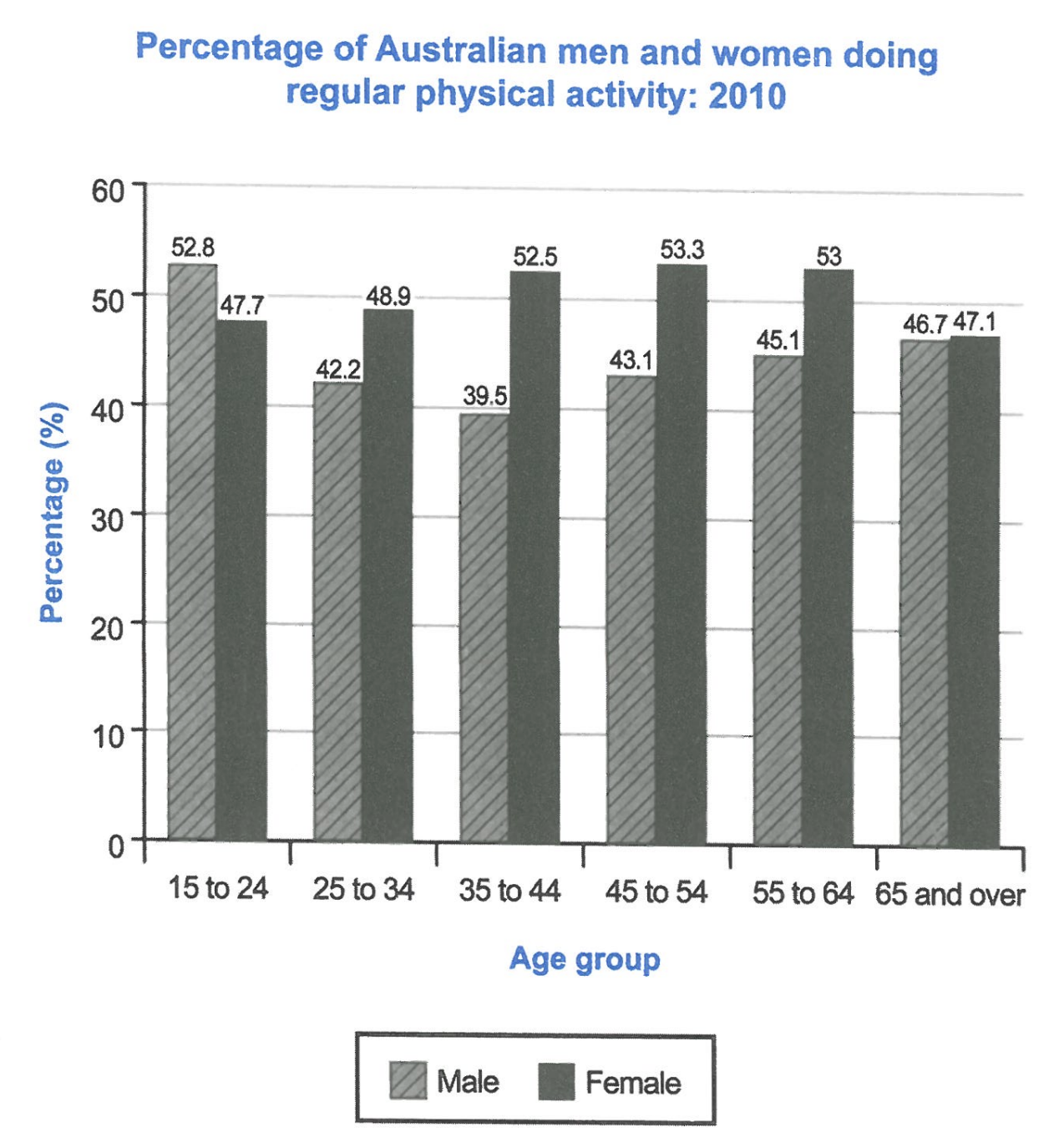
The bar chart below shows the percentage of Australian men and women in different age groups who did regular physical activity in 2010.
Summarise the information by selecting and reporting the main features, and make comparisons where relevant.
Student answer (Band 6.5)
The bar chart illustrates the proportion of Australian men and women in various age groups who took part in regular physical activity in 2010.
Overall, females were more involved in regular physical activities than males. However, in young age groups males were slightly more active in daily physical activity than females. Besides, the old age groups were approximately same in contribution of physical activity.
To commence with, Males highest point was in the first age group of 15 to 24, at 52.8%. Their lowest rate was 39.5%, in the aged 35 to 44. However, their percentage in regular activity increased gradually to 46.7 percent, in the 65 and over group. In the oldest age group males trailed females by 0.4 percentage points.
In addition, females were ahead in 5 groups out of 6 in total. The peak rate was in the age of 45 to 54, at about 53.3%. Their lowest rate was 42.2% in the age of 25 to 34. The biggest gap was in the age group of 35 to 44, where females were ahead by approximately 13% points (52.5 against 39.5). In the youngest age group females trailed males by approximately 5 percent points (47.7 against 52.8).
AI examiner evaluation
| Criterion | Band |
|---|---|
| Task Achievement / Task Response | 6.5 |
| Coherence and Cohesion | 6.5 |
| Lexical Resource | 6.0 |
| Grammatical Range and Accuracy | 6.0 |
| Overall | 6.5 |
Task Achievement / Task Response: Band 6.5
You identify the main overall pattern: women recorded higher participation in five of the six age groups, while men led among 15–24-year-olds. The figures for the male low point, female peak, and largest gender gap are accurate, and the overview also notes the near-equal rates among the oldest group. This gives the report a clear, relevant foundation. However, the overview’s claim that men were “slightly more active” in young age groups is too broad, since they led only in the youngest group; women led among 25–34-year-olds. The statement that older groups were “approximately same” is also vague, as the rates differ more noticeably in some groups. Make the overview more precise and compare the changing trends across the age groups.
Coherence and Cohesion: Band 6.5
The response is arranged in a sensible sequence: an introduction and overview are followed by separate paragraphs describing men and women. This makes the information easy to locate, and linking expressions such as “However” and “In addition” help signal contrasts. The progression is generally clear, though some connections are mechanical or imprecise. For example, “To commence with” adds little to the comparison, while “Besides” introduces an overview point without a clear relationship to the preceding sentence. The paragraph on women also repeats the youngest-group comparison already mentioned in the overview. Grouping the data around the overall gender contrast and the age-related trends, rather than repeating points, would make the progression more cohesive and flexible.
Lexical Resource: Band 6.0
You use a suitable range of chart-reporting vocabulary, including “proportion,” “peak rate,” “lowest rate,” and “trailed,” and the meaning is generally clear. There are also attempts at more formal phrasing, such as “involved in regular physical activities.” However, several choices are unnatural or imprecise: “same in contribution of physical activity” does not clearly describe similar participation rates, and “13% points” should be expressed as a percentage-point difference. “Daily physical activity” also changes the chart’s meaning, which concerns regular activity. Use standard collocations consistently, such as “participated in regular physical activity” and “the participation rate.” More precise vocabulary would improve clarity without requiring more elaborate wording.
Grammatical Range and Accuracy: Band 6.0
You use a mix of simple and more complex sentence forms, including contrast clauses beginning with “However” and a relative clause in “where females were ahead.” Most sentences communicate the intended comparisons, but some grammatical errors remain. For example, “Males highest point” needs a possessive form (“men’s highest rate”), and “in the aged 35 to 44” has an incorrect construction. The phrase “in the age of 45 to 54” also needs a more accurate grammatical pattern, such as “among those aged 45 to 54.” There are occasional article, punctuation, and sentence-boundary issues, including the extra space in “the age.” Proofreading these patterns and varying sentence structures more accurately would strengthen control.
See this exact question answered at other band scores. The same prompt compared across bands.
Browse more IELTS Writing model answers or get your own writing scored by the same AI examiner.