Band 5.5 IELTS Writing Task 1 Model Answer
Overall Band Score: 5.5 · Cambridge IELTS 12 · 2026-11-24
IELTS Writing Task 1 question
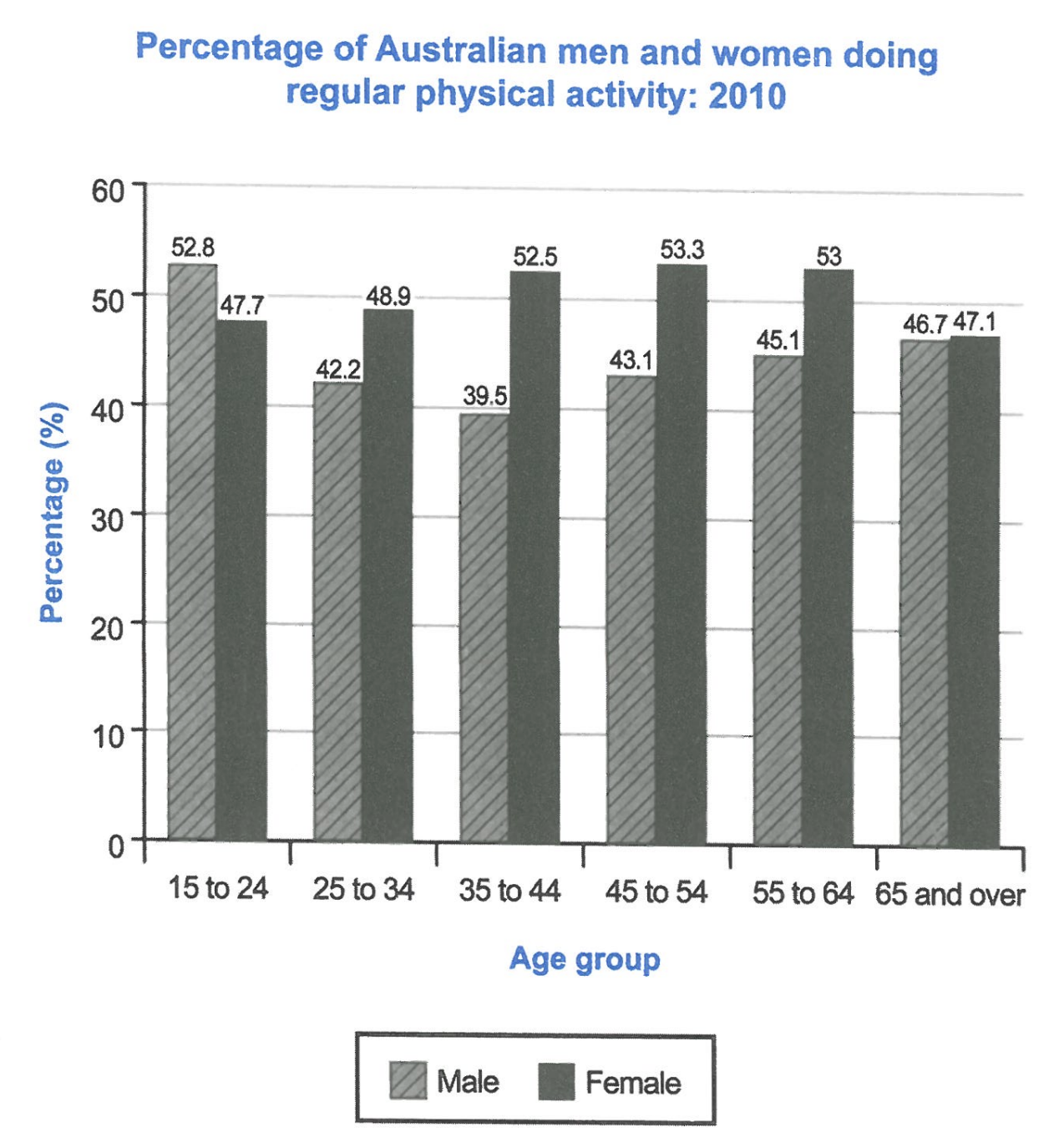
The bar chart below shows the percentage of Australian men and women in different age groups who did regular physical activity in 2010.
Summarise the information by selecting and reporting the main features, and make comparisons where relevant.
Student answer (Band 5.5)
The bar chart illustrates the percentage of maen and women from Australia in diverse age groups who did practical physical activity during the year 2010.
From the first view, we can notice that females were more active than males in that year in the majority of groups.
Firstly, the group which contain teenager individuals. It was the only one that men had a favourable percent comparing with women with about just over the half of men in that age, mean while females marked about less than the half of them. In the next group, women remained same percentage approximately like the first one, while males percent fall about ten percent of them. For the ages between thirty five and sixty four, women had fluctuated slowly among these ages, whereas men had grown up slightly from just less than fourty percent to roughly fourty five percent.
Whilst the final group was the only one who had a nearby percentage between genders, the difference was just under one percent among men and women.
In conclusion, ther were several differences in percentage between people who did regular physical activity which illustrated by seven age groups of citizens in Australia.
AI examiner evaluation
| Criterion | Band |
|---|---|
| Task Achievement / Task Response | 5.5 |
| Coherence and Cohesion | 6.0 |
| Lexical Resource | 5.5 |
| Grammatical Range and Accuracy | 5.5 |
| Overall | 5.5 |
Task Achievement / Task Response: Band 5.5
You identify the main overall comparison—that women were more active in most age groups—and correctly note that men led only among 15–24-year-olds, while the oldest group had nearly equal rates. You also describe the broad male pattern of falling and then rising. However, several key details are vague or incomplete: the female rate did not remain approximately the same in the 25–34 group; it rose from 47.7% to 48.9%, then peaked at 53.3% among 45–54-year-olds. The description of women’s figures as fluctuating “slowly” also misses this peak and slight subsequent decline. The conclusion repeats the topic rather than summarising the most important trends. More precise comparisons and a clearer overview would make the report more complete.
Coherence and Cohesion: Band 6.0
The response has a recognisable structure: an introduction, an overview, descriptions of age groups, and a concluding sentence. Sequencing phrases such as “Firstly,” “In the next group,” and “Whilst the final group” help the reader follow the age progression. However, the paragraphing and progression are not always effective: the opening overview is followed by a fragmented sentence, “Firstly, the group which contain teenager individuals,” and the final conclusion largely repeats the subject instead of drawing the trends together. Some links are mechanical or unclear, particularly “while males percent fall about ten percent of them.” Grouping the data into a clear overview followed by two comparison paragraphs, with explicit links between age bands, would improve cohesion.
Lexical Resource: Band 5.5
You use some relevant task vocabulary, including “percentage,” “age groups,” “fluctuated,” and “difference,” and the reader can generally understand the comparisons you intend. However, word choice and collocation are often imprecise, which limits clarity. For example, “practical physical activity” is not a natural way to describe the chart’s measure, “favourable percent” is unclear, and “men had grown up” does not accurately express an increase in a rate. There are also noticeable spelling errors, such as “maen,” “fourty,” and “ther.” Aim for standard chart language such as “participated in regular physical activity,” “higher proportion,” and “the rate increased,” and check spelling carefully.
Grammatical Range and Accuracy: Band 5.5
You attempt a mixture of simple and more complex sentences, including comparisons with “while” and “whereas,” and the overall meaning is usually recoverable. However, some sentence structures are incomplete or faulty. “Firstly, the group which contain teenager individuals” is a fragment, while “the group which contain” has an agreement error. In “males percent fall,” the possessive structure and verb form are incorrect; “women had fluctuated” also uses an unsuitable tense construction. The final sentence, “there were several differences … which illustrated,” has an unclear clause structure and missing grammatical elements. Practise complete sentences with accurate subject–verb agreement and past-tense reporting, and use punctuation to separate the comparisons clearly.
See this exact question answered at other band scores. The same prompt compared across bands.
Browse more IELTS Writing model answers or get your own writing scored by the same AI examiner.