Band 5.0 IELTS Writing Task 1 Model Answer
Overall Band Score: 5.0 · Cambridge IELTS 12 · 2026-11-24
IELTS Writing Task 1 question
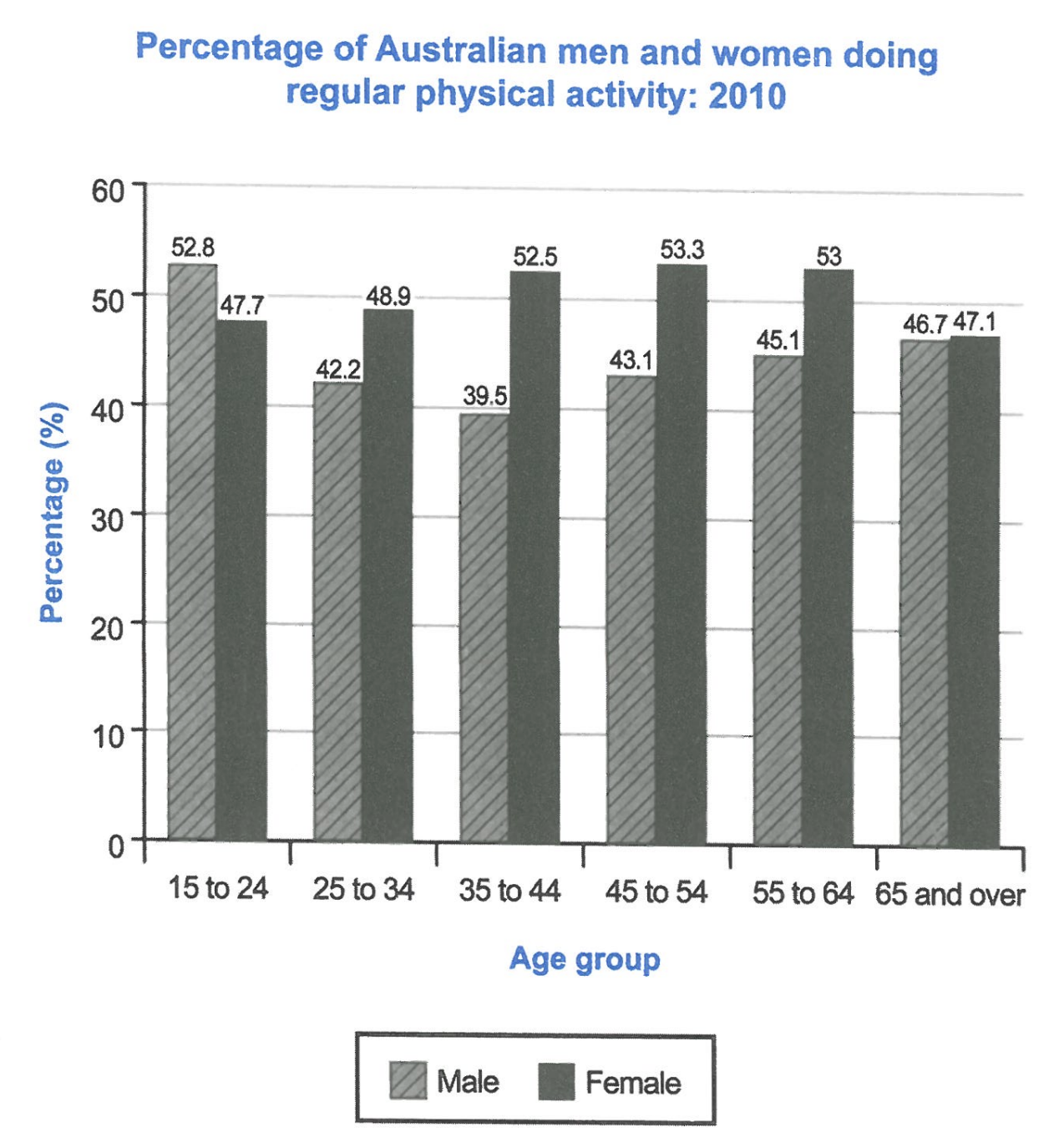
The bar chart below shows the percentage of Australian men and women in different age groups who did regular physical activity in 2010.
Summarise the information by selecting and reporting the main features, and make comparisons where relevant.
Student answer (Band 5.0)
The bar graph compares the proportion of age group of men and women of Australia who did physical activity on daily basis in 2010.
Overall, it is evident that females of 45 to 54 recorded the highest percentage whereas the men of 35 to 40 calculated at the lowest percentage.Moreover, the men and women of 65 and over was almost remained same during the period.
Looking at age group 45 to 54 of women was approximately highest but it fluctuated and reached the peak value it recorded at 53.3%.In contrast, the males of 35 to 44 were not more interested in physical activities and they were roughly 39.5%.
Furthermore, both age group of 15 to 24 of male and female became more active and there was slighlty differance between these groups.Conversary, the male and female of 65 and over were stood at stable position in all over the year.
AI examiner evaluation
| Criterion | Band |
|---|---|
| Task Achievement / Task Response | 4.5 |
| Coherence and Cohesion | 5.5 |
| Lexical Resource | 5.5 |
| Grammatical Range and Accuracy | 5.0 |
| Overall | 5.0 |
Task Achievement / Task Response: Band 4.5
You identify a relevant high point for women (53.3% among 45–54-year-olds) and the male low point (39.5% among 35–44-year-olds), and you attempt an overall comparison. However, the overview is incomplete and includes inaccuracies: the 65-and-over figures are close, but they are not described as stable over time, since the chart shows one year only. The claim that both youngest groups “became more active” is also unsupported, as the chart gives no change over time. Several important patterns are omitted, including women’s higher participation in every age group except 15–24, and the rise in male activity after its low point. The response is also one word below the required minimum. Select accurate comparisons and describe the chart’s cross-sectional data rather than changes over time.
Coherence and Cohesion: Band 5.5
The response has a recognisable structure: an introduction, an overview, and two paragraphs presenting selected details. Linking expressions such as “Overall,” “In contrast,” and “Furthermore” help signal relationships between points. However, progression is limited because the details are not organised into a clear comparison of the two sexes across age groups. Some links are inaccurate or confusing: “Moreover” introduces a claim about the oldest group without clarifying its relevance, while “Conversary” does not establish a clear contrast. The final sentence repeats the idea that the oldest groups are similar rather than adding a useful comparison. Group the figures by meaningful patterns and use references that make clear which age group and sex each statement concerns.
Lexical Resource: Band 5.5
You use some task-relevant vocabulary, including “proportion,” “percentage,” “peak value,” and “fluctuated,” and the reader can generally identify the topic. However, word choice and collocation are often inaccurate or unnatural, as in “calculated at the lowest percentage,” “not more interested,” and “stood at stable position.” “On daily basis” also changes the chart’s meaning: it reports regular activity, not necessarily daily activity. Spelling errors such as “slighlty,” “differance,” and “Conversary” further reduce precision. Aim for straightforward, accurate reporting language rather than forcing less suitable expressions; for example, use “recorded,” “participation rate,” and “was similar” where appropriate.
Grammatical Range and Accuracy: Band 5.0
You attempt both simple and more complex sentences, including a contrast introduced by “whereas” and a sentence beginning “Looking at age group 45 to 54.” However, control is inconsistent, and errors in agreement, verb forms, articles, and sentence construction sometimes make the meaning difficult to follow. For example, “the men and women … was almost remained same” combines incompatible verb forms and has incorrect agreement, while “the males … were not more interested” does not form a clear comparison. Several sentences also run together without adequate spacing after full stops. Practise building accurate comparison sentences with a clear subject and verb, such as “The figures for men and women aged 65 and over were similar.”
See this exact question answered at other band scores. The same prompt compared across bands.
Browse more IELTS Writing model answers or get your own writing scored by the same AI examiner.