Band 6.0 IELTS Writing Task 1 Model Answer
Overall Band Score: 6.0 · Cambridge IELTS 12 · 2026-11-24
IELTS Writing Task 1 question
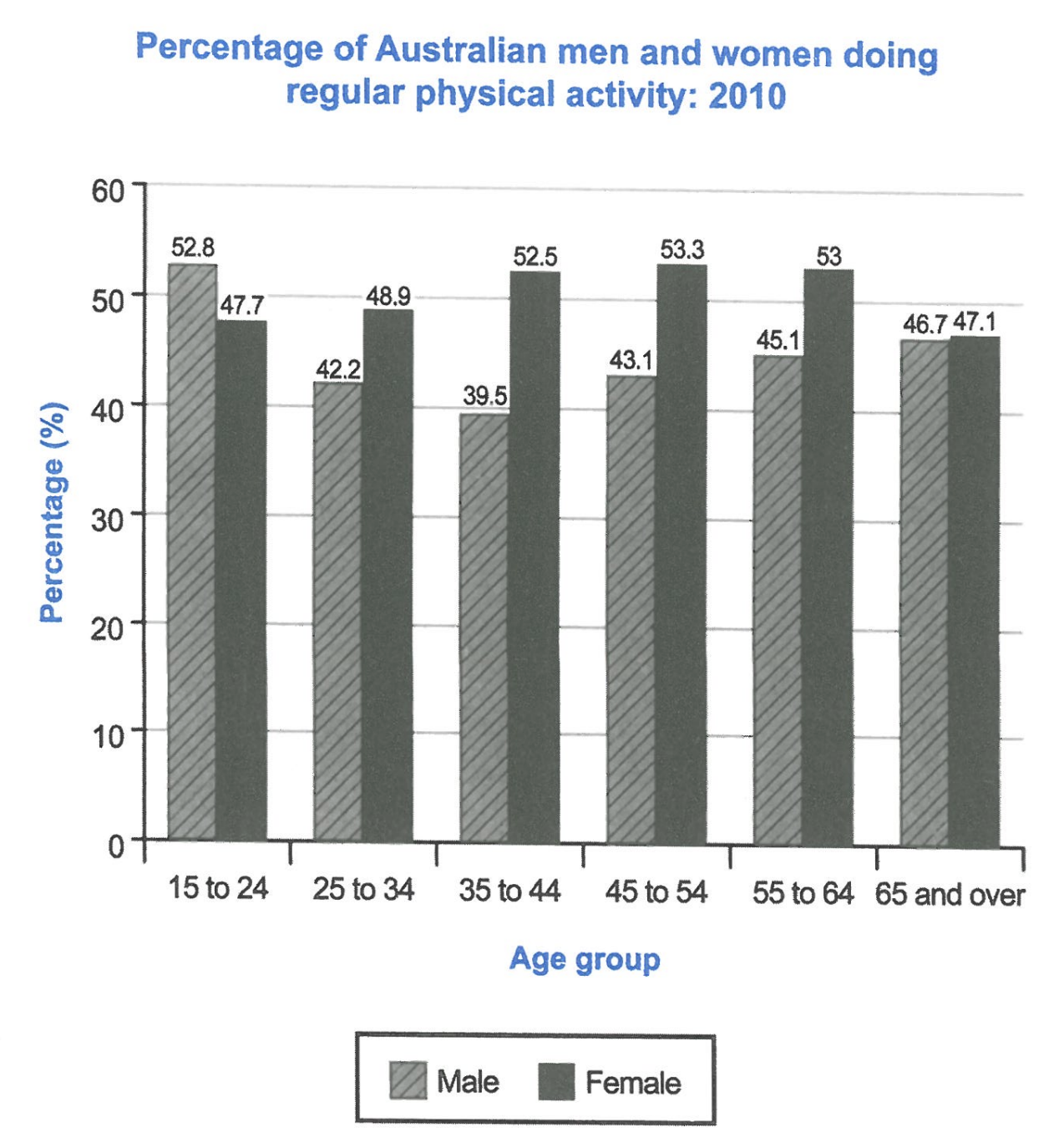
The bar chart below shows the percentage of Australian men and women in different age groups who did regular physical activity in 2010.
Summarise the information by selecting and reporting the main features, and make comparisons where relevant.
Student answer (Band 6.0)
The bar chart depicts the percentage of Australians in several age groups who regulary takes part in physical activity in the year 2010.
Overall, the percentage of females that were physically active exceeds the male in different age groups except the age of 65 and over where there was almost no difference between male and female adopting physical activities.
The percentage of Australian men remains at the top during the age 15 to 24 and after that the trend moves downward till age 35 to 44, the percentage drops from 52.8% to 39.5% whereas the opposite trend follows in the Australian women where the percentage of age 15 to 24 rises from 47.7% to 52.5% of age 35 to 44.
Then the Australian men's percentage started to rose during age 45 to 54 from 43.1% to 46.7% in the age group 65 and over. The Australian women's physical active percentage remains almost same from age 45 to 64 and then drops to 46.7% in the age group 64 and over.
AI examiner evaluation
| Criterion | Band |
|---|---|
| Task Achievement / Task Response | 6.0 |
| Coherence and Cohesion | 6.0 |
| Lexical Resource | 6.0 |
| Grammatical Range and Accuracy | 5.5 |
| Overall | 6.0 |
Task Achievement / Task Response: Band 6.0
You identify the main contrast: men have the highest activity rate in the youngest group, while women are higher in the other age groups, and you describe the male decline to ages 35–44 followed by a recovery. These are relevant features and the figures for those trends are mostly accurate. However, the overview says there is almost no difference only among people aged 65 and over, although women are also higher in every other group; it would be clearer to state that women lead in all groups except the youngest. There is also a data error at the end: the female rate for the oldest group is 47.1%, not 46.7%. The account covers the chart, but some comparisons and the overall pattern need more precise development.
Coherence and Cohesion: Band 6.0
The response has a clear overall shape, moving from an introduction and overview to details about men and then women. The sequence of age groups is generally easy to follow, and phrases such as “after that” and “Then” help signal changes. However, the overview’s comparison is not expressed clearly, and the final sentence repeats the age-group trend without making the comparison between the sexes explicit. Some linking is mechanical, while phrases such as “the opposite trend follows” leave the relationship between the figures slightly vague. Organise the detail into clearer comparisons—for example, describe the youngest group first, then contrast the middle and older groups—and use precise references to avoid ambiguity.
Lexical Resource: Band 6.0
You use an adequate range of chart vocabulary, including “percentage,” “trend,” “drops,” “rises,” and “remains almost same,” so the reader can understand the main changes. There are also attempts at more formal phrasing, such as “depicts” and “physically active.” However, several word choices and collocations are inaccurate or awkward: “the percentage of females … exceeds the male” compares a percentage with a person/group, and “adopting physical activities” is unnatural in this context. “Physical active percentage” is also an incorrect word form, and “regulary” is misspelled. Choose standard reporting expressions such as “the proportion of women was higher” and “participated in regular physical activity” to make the description more precise and natural.
Grammatical Range and Accuracy: Band 5.5
You attempt a mix of simple and complex sentences, including a contrast introduced by “whereas” and a time clause beginning “after that.” The main meaning is usually clear, but some grammatical errors remain. In the opening, “Australians … who regulary takes” has a subject–verb agreement problem; the plural subject requires “take.” In “the trend moves downward till age 35 to 44,” the age-group construction needs a clearer preposition, such as “until the 35–44 age group.” The phrase “started to rose” should be “started to rise,” and “the percentage of age 15 to 24” needs a grammatical subject such as “the percentage among women aged 15–24.” More consistent control of verb forms, agreement, and sentence construction would improve accuracy.
See this exact question answered at other band scores. The same prompt compared across bands.
Browse more IELTS Writing model answers or get your own writing scored by the same AI examiner.