Band 6.0 IELTS Writing Task 1 Model Answer
Overall Band Score: 6.0 · Cambridge IELTS 12 · 2026-11-24
IELTS Writing Task 1 question
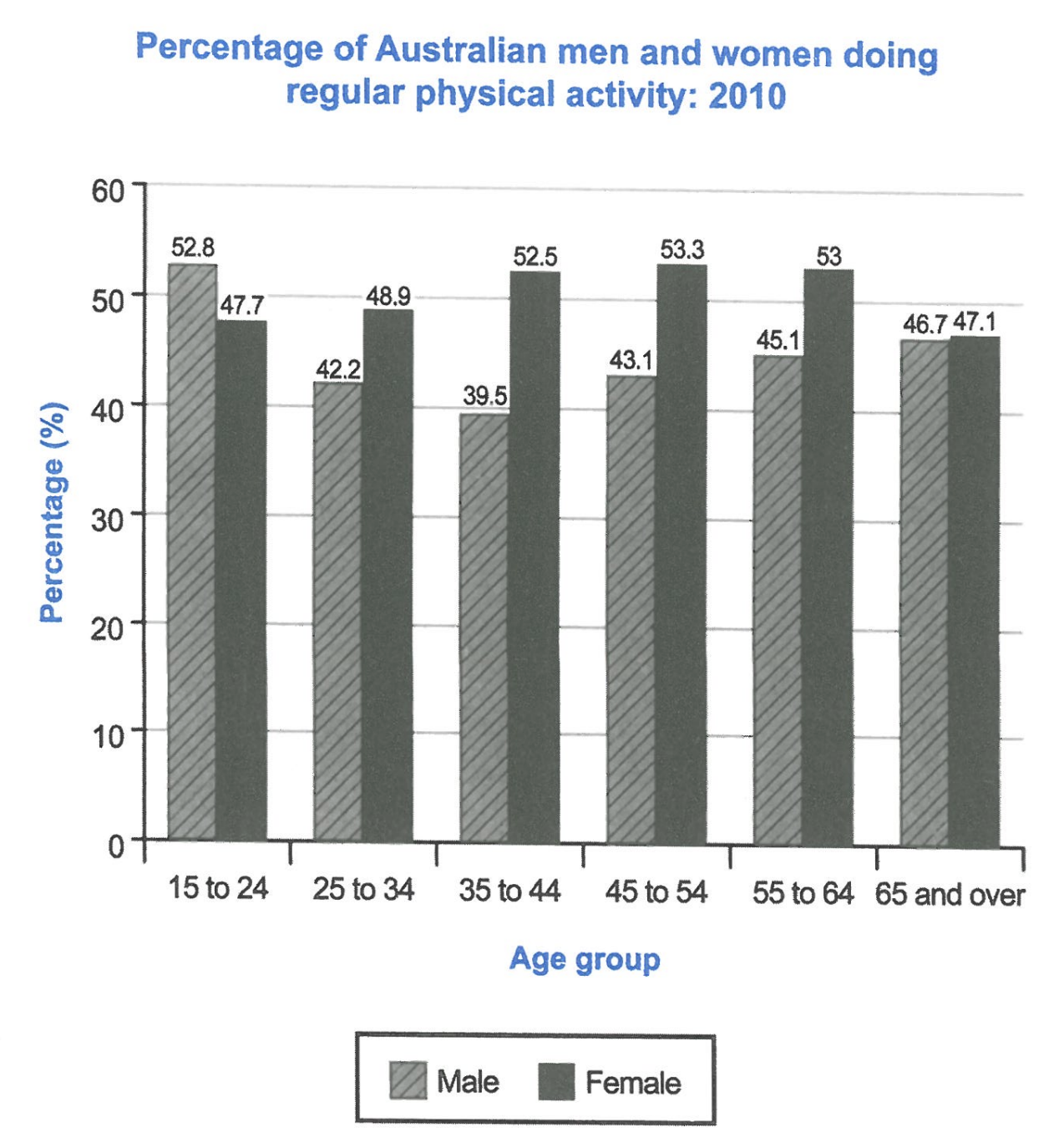
The bar chart below shows the percentage of Australian men and women in different age groups who did regular physical activity in 2010.
Summarise the information by selecting and reporting the main features, and make comparisons where relevant.
Student answer (Band 6.0)
The bar chart demonstrates the percentage of Australian men and women in various age groups who performs regular activity in the year 2010. Overall, it can be seen males were leading in the age of 15 to 24 while women were lower, meanwhile, at every age women were more likely to be more than men. The gap between 35 to 44 was widest among both sexes and smallest at 65 or above.
Among 15 to 24, it can be noticed that man were exercised regularly compared with 47.7% of women. However, the pattern was reversed in the age of 25 to 34, where, man contributed just 42.2% and 48.9% by women respectively. Male participation was lowest at the age of 35 to 44 as it can be seen just 39.5% of males were exercising whereas, women got 52.5%, determining the largest difference of points.
Female participation in the 45 to 54, peaked at 53.3% and became the highest percentage point, and remain almost high at the age of 55 to 64. The corresponding figures for man were 43.1% and 45.1% respectively. In the oldest age, both rates came to nearly equal, with 46.7% for men and 47.1% for women.
AI examiner evaluation
| Criterion | Band |
|---|---|
| Task Achievement / Task Response | 6.0 |
| Coherence and Cohesion | 6.0 |
| Lexical Resource | 5.5 |
| Grammatical Range and Accuracy | 5.5 |
| Overall | 6.0 |
Task Achievement / Task Response: Band 6.0
You identify the main age-related pattern and include several accurate figures, such as men’s low of 39.5% at ages 35–44 and women’s peak of 53.3% at 45–54. However, the overview contains a contradiction: it says men led only at 15–24, then claims women were higher “at every age,” although men were higher in the youngest group. The statement that the gap was widest at 35–44 and smallest among those 65 and over is accurate, but the overview would be clearer if it stated these trends consistently. Some comparisons are also underdeveloped: for example, the female figures at 55–64 are described only as remaining “almost high.” A precise overview and fuller comparison of the overall patterns would strengthen the response.
Coherence and Cohesion: Band 6.0
The response has a clear overall arrangement: an introduction and overview are followed by paragraphs covering the younger and older age groups. This makes the information reasonably easy to follow, and transitions such as “However” and “In the oldest age” help signal comparisons. Cohesion is sometimes faulty or mechanical, though. The overview’s “meanwhile” joins ideas that conflict, and “at every age” is unclear in relation to the preceding statement about men leading at 15–24. Some sentence links also feel awkward, such as “where, man contributed just 42.2% and 48.9% by women respectively.” Grouping the figures more systematically and using clear comparative links would make the progression smoother.
Lexical Resource: Band 5.5
You use a reasonable range of task-related vocabulary, including “percentage,” “participation,” “peaked,” “reversed,” and “corresponding figures.” These choices help convey the chart’s trends. However, several word choices or collocations are inaccurate or unnatural, including “men were leading,” “man contributed,” and “women got 52.5%.” “The gap between 35 to 44” is also imprecise because it does not specify the age group or the difference between the sexes. These expressions do not prevent the reader from understanding the data, but they reduce precision and naturalness. Prefer standard chart language such as “the proportion of men,” “stood at,” and “the largest gender gap.”
Grammatical Range and Accuracy: Band 5.5
You attempt a mix of simple and complex sentences, using clauses introduced by “while,” “where,” and “as.” The main comparisons are generally understandable, but some grammatical errors remain. For example, “who performs” does not agree with the plural subject, and “it can be seen males were leading” needs a clearer clause structure. In “Female participation … peaked … and became …, and remain,” the verb forms do not remain consistent. Articles and number are also sometimes inaccurate, as in “man were exercised” and “the age of 25 to 34.” These errors rarely obscure the intended meaning, but checking agreement, tense consistency, and sentence construction would improve control.
See this exact question answered at other band scores. The same prompt compared across bands.
Browse more IELTS Writing model answers or get your own writing scored by the same AI examiner.