Band 6.0 IELTS Writing Task 1 Model Answer
Overall Band Score: 6.0 · Cambridge IELTS 12 · 2026-11-25
IELTS Writing Task 1 question
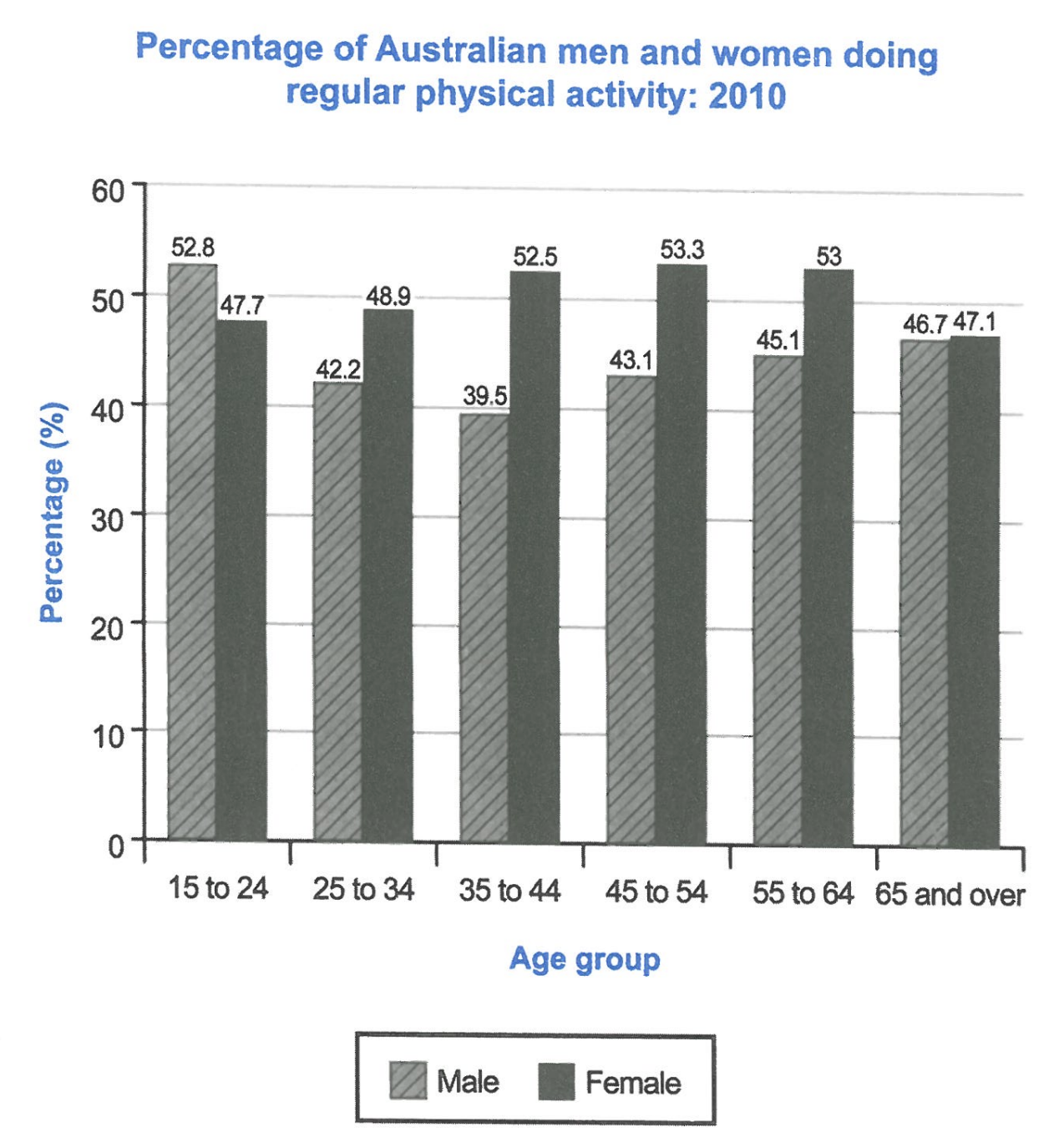
The bar chart below shows the percentage of Australian men and women in different age groups who did regular physical activity in 2010.
Summarise the information by selecting and reporting the main features, and make comparisons where relevant.
Student answer (Band 6.0)
The bar chart illustrates the percentages of Australian men and women across six age groups who took part in physical activity in 2010. Overall, the women groups in all ages remained the same except the younger group.While males groups fluctutae continuosly and reached to its peak in youngest group. However, the aged 65 and over group both genders were approximately equally participate in physical activity. In the aged 15-24, male reached to its highest rather than female with the percentages of 52.8% and 47.7% respectively. Whereas, this trend reversed in the aged 25-35, 42.2% of male took part in physical activity and female went up, at 48.9%. The age gap becomes widened among the ages of 35-44, 52.5% women took part in physical activity and it reched to its peak in the 45-54 aged group which comprises 53.3%. However, male in the aged group 45-54 more participate in physical activity, at 43.1% compared to female, at 39.5%. In contrast, both gender equally participated in physical activity with the percentage of 46.7% and 47.1% respectively.
AI examiner evaluation
| Criterion | Band |
|---|---|
| Task Achievement / Task Response | 6.0 |
| Coherence and Cohesion | 5.5 |
| Lexical Resource | 6.0 |
| Grammatical Range and Accuracy | 5.5 |
| Overall | 6.0 |
Task Achievement / Task Response: Band 6.0
You identify the chart’s subject and include several relevant figures, including the male peak of 52.8% among 15–24-year-olds and the female peak of 53.3% among 45–54-year-olds. However, some key comparisons are misreported or unclear. The overview says women’s participation “remained the same,” although it varies from 47.7% to 53.3%. More importantly, the 35–44 comparison is reversed: 52.5% is the female figure, while the male figure is 39.5%. The 45–54 comparison is also reversed: women are at 53.3% and men at 43.1%. Your statement that the oldest groups are approximately equal is broadly accurate. A more precise overview and careful checking of each gender’s figures would make the main features clearer and more fully supported.
Coherence and Cohesion: Band 5.5
The response has a recognisable structure: an introduction, an overview, and a paragraph of age-group details. This gives the reader a basic route through the information, and expressions such as “Whereas” and “In contrast” attempt to signal comparisons. However, progression is weakened by unclear or inaccurate links. For example, “this trend reversed” is followed by a comparison that is difficult to interpret, and “However” introduces the 45–54 figures without making the intended contrast clear. The overview also combines several points in a long, awkward sequence. Grouping the data into clearer comparisons—such as the youngest group, the middle-age groups, and the oldest group—and using linking words only when their relationship is accurate would improve cohesion.
Lexical Resource: Band 6.0
You use a reasonable range of task-related vocabulary, including “percentages,” “age groups,” “reversed,” “peak,” and “compared to,” so the chart is generally understandable. There are also attempts to describe change, such as “went up” and “fluctuate.” Some choices are inaccurate or unnatural, however: “the women groups … remained the same” does not describe the changing figures, and “more participate in physical activity” is not a natural way to compare rates. Spelling errors such as “fluctutae,” “continuosly,” and “reched” also reduce accuracy. Aim for precise reporting verbs and collocations, for example “the proportion of women varied” and “men recorded a higher participation rate.”
Grammatical Range and Accuracy: Band 5.5
You attempt a mix of sentence forms, including comparisons and subordinate clauses, as in “Whereas this trend reversed…” and “which comprises 53.3%.” The main meaning is usually recoverable, but some grammatical errors make relationships harder to follow. For example, “the aged 65 and over group both genders were approximately equally participate” has problems with sentence structure and verb form; “both genders participated at similar rates” would be clearer. There are also issues with articles, agreement, and phrasing in “the women groups” and “male reached to its highest.” Several sentences are joined or punctuated awkwardly, particularly around “However” and “In contrast.” More consistently controlled clauses and accurate past-tense reporting would strengthen the response.
See this exact question answered at other band scores. The same prompt compared across bands.
Browse more IELTS Writing model answers or get your own writing scored by the same AI examiner.