Band 5.5 IELTS Writing Task 1 Model Answer
Overall Band Score: 5.5 · Cambridge IELTS 12 · 2026-11-25
IELTS Writing Task 1 question
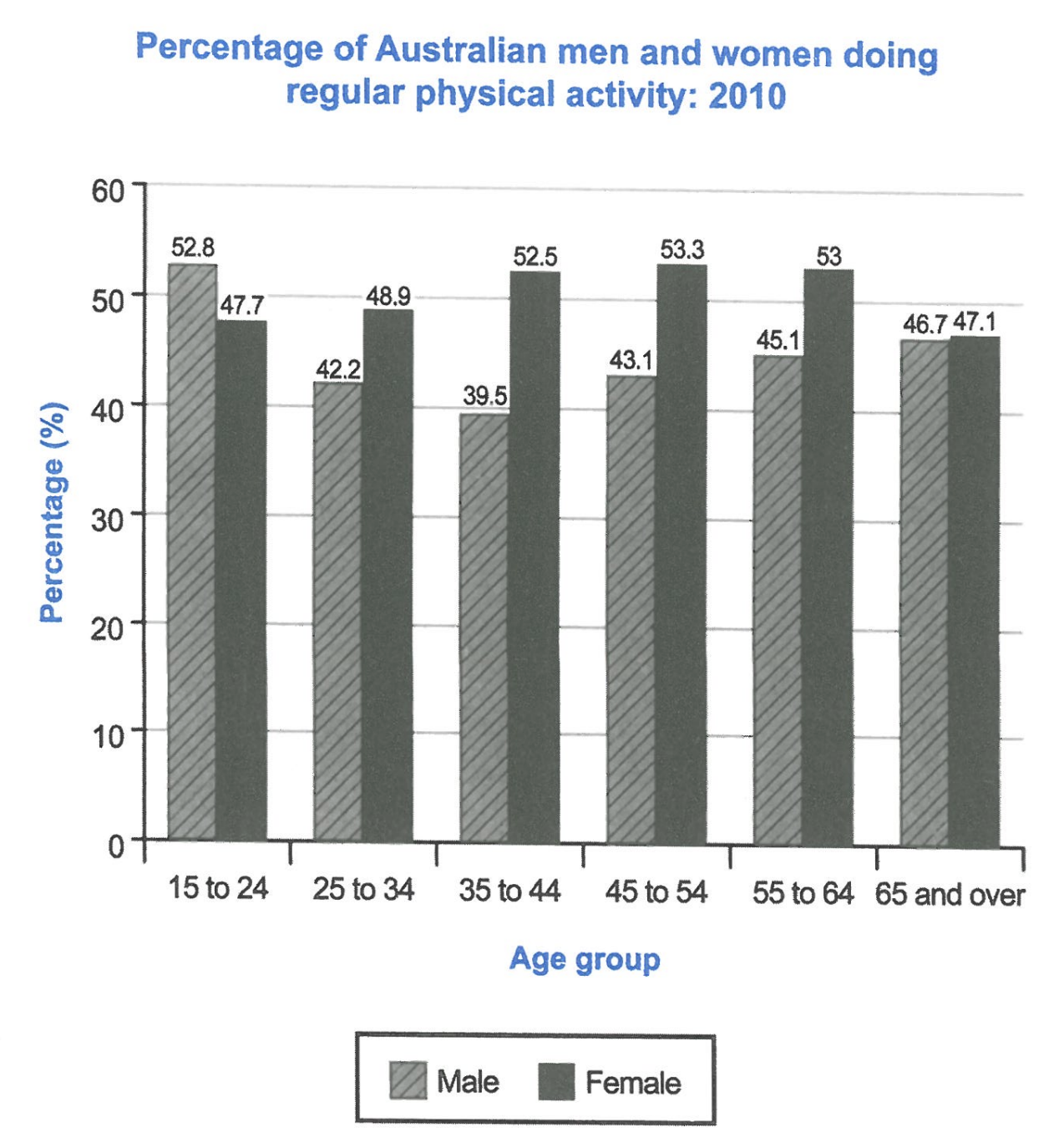
The bar chart below shows the percentage of Australian men and women in different age groups who did regular physical activity in 2010.
Summarise the information by selecting and reporting the main features, and make comparisons where relevant.
Student answer (Band 5.5)
The chart represents the number of Australian men and women in different age groups who did regular physical activity in 2010.
overall, women participation were higher then men except younger age. male involvment sharply deceased in middle ages. in oldest age, both gender showed equal participation.
52.8 percent male participated in physical activity thoes aged (15-24) compared to women who represented 47.7. the figure declined to 42.2 for male aged(25-34), then 39.5 for age group 35-44 and steadily increased to 43.1 for aged 45-54. in stark contrast, after rising 48.9, women women followed similar trends and remained at almost 52.3 and 53 in middle ages 35 to 64.
turning to older ages, both gender recoded indentical paterns. women stood at 46.7, wheras, male showed neligible higher then women at just 47.1.
AI examiner evaluation
| Criterion | Band |
|---|---|
| Task Achievement / Task Response | 5.0 |
| Coherence and Cohesion | 5.5 |
| Lexical Resource | 5.5 |
| Grammatical Range and Accuracy | 5.0 |
| Overall | 5.5 |
Task Achievement / Task Response: Band 5.0
You identify the chart’s subject and report several relevant figures, including the male peak of 52.8% among 15–24-year-olds and the female peak of 53.3% among 45–54-year-olds. However, the overview is only partly accurate: women exceeded men in every age group except the youngest, but participation was not equal in the oldest group (47.1% for women versus 46.7% for men). Some figures are also misreported: women recorded 52.5%, not “almost 52.3%,” at ages 35–44. The response contains 115 words, below the required 150, so the main features are not developed sufficiently. Include a fuller comparison of the trends and check the figures carefully.
Coherence and Cohesion: Band 5.5
The response has a basic structure: an introduction, an overview, and paragraphs describing the age groups. Sequencing phrases such as “in stark contrast” and “turning to older ages” help signal shifts between the male and female data. However, progression is not always clear because the overview combines several claims without explaining the comparisons, and the final paragraph reverses the figures for the oldest group. The middle-age comparison is also compressed into a confusing sentence, with “women women” repeated and the age range not clearly linked to each figure. Use one paragraph for the overall trends and organise the details consistently by age group or by gender, with clear references to each series.
Lexical Resource: Band 5.5
You use some task-relevant vocabulary, including “declined,” “increased,” “participation,” and “in stark contrast,” showing an attempt to describe trends rather than simply list numbers. However, the range is limited and several word-choice, form, and spelling errors make parts difficult to interpret: “male involvment,” “thoes aged,” “recoded indentical paterns,” and “negligible higher” are unclear or inaccurate. “Number” is also imprecise for percentages, and “women participation” is not a natural collocation. Aim for accurate, standard chart language such as “the proportion of men” and “the figure for women,” and proofread spelling and repeated words. More precise vocabulary would make your comparisons easier to follow.
Grammatical Range and Accuracy: Band 5.0
You attempt both simple statements and longer comparisons, for example, “the figure declined to 42.2 for male aged (25-34), then 39.5 … and steadily increased.” This shows some effort to connect related information, but the range is limited and errors occur frequently. Agreement is faulty in “women participation were higher,” and the overview lacks a clear verb in “male involvement sharply deceased in middle ages.” Other problems include missing or incorrect articles and forms in “for male aged” and “both gender showed,” as well as punctuation and capitalisation errors. These issues sometimes make relationships between figures unclear. Practise accurate comparative sentence patterns and check subject–verb agreement, plurals, and sentence boundaries.
See this exact question answered at other band scores. The same prompt compared across bands.
Browse more IELTS Writing model answers or get your own writing scored by the same AI examiner.