Band 6.0 IELTS Writing Task 1 Model Answer
Overall Band Score: 6.0 · Cambridge IELTS 12 · 2026-11-25
IELTS Writing Task 1 question
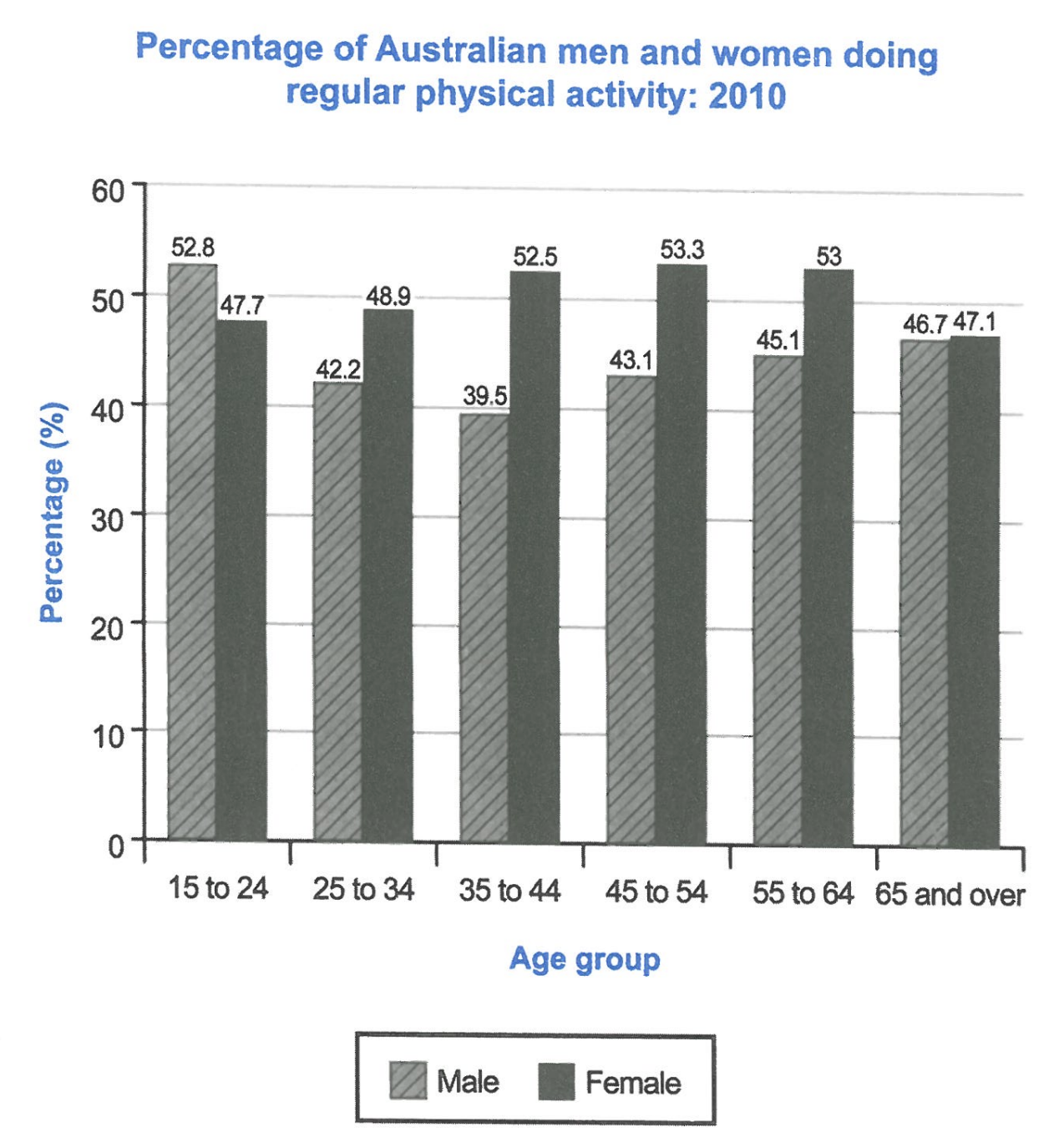
The bar chart below shows the percentage of Australian men and women in different age groups who did regular physical activity in 2010.
Summarise the information by selecting and reporting the main features, and make comparisons where relevant.
Student answer (Band 6.0)
The bar chart illustrates difference between Australian males and females who did daily physical activity in 2010.
Overall, it is clearly evident that women were domineting category in the most of age group. However, in 15 to 24 agegroup had larger number of boys physically active than girls.
In age group 15 to 24, 52.8% of boys did physical activity while 47.7% of girls did it. In contrast, 42.2% of men angaged in physical activity which was 6.7% lower than women. In addition, females who did physical activity was 52.5% which was 13% higher than meles.
The 53% women of age 45 to 54 did regular physical activity which was the highest. In same age group's 43.1% men did it.In the age 55 to 64, 45.1% and 53% males and females did regular exersize, respectively. Surprizingly, 65 and above them had nearly similer ratio in between two gender for regular physical activity.
AI examiner evaluation
| Criterion | Band |
|---|---|
| Task Achievement / Task Response | 6.0 |
| Coherence and Cohesion | 6.0 |
| Lexical Resource | 5.5 |
| Grammatical Range and Accuracy | 5.5 |
| Overall | 6.0 |
Task Achievement / Task Response: Band 6.0
You identify the main pattern: women recorded higher activity in most age groups, while males led among 15–24-year-olds. Several figures are reported accurately, including 52.8% versus 47.7% for the youngest group and 43.1% versus 53.3% for ages 45–54. However, some comparisons are unclear or inaccurate: for ages 25–34, the female figure is 48.9%, not 52.5%; 52.5% belongs to ages 35–44, where the male rate is 39.5%. The claim that this is “13% higher” is also not a clear comparison. The overview is relevant, but the 35–44 figures and the overall age trends need more precise coverage to make the summary fully clear and balanced.
Coherence and Cohesion: Band 6.0
The response has a recognisable structure, moving from an introduction and overview to age-specific details, and linking phrases such as “Overall,” “In contrast,” and “In addition” help signal relationships. The sequence is generally understandable, but the body does not consistently group or compare the data clearly. For example, the sentence beginning “In contrast, 42.2% of men…” shifts to the 25–34 group without naming that age range, so readers must infer the reference. The following sentence then gives the 35–44 female figure without identifying the group. Use one paragraph for the younger groups and another for older groups, and name each age band when introducing its figures. This would make progression clearer and reduce reliance on connectors alone.
Lexical Resource: Band 5.5
You use relevant vocabulary for describing the chart, including “percentage,” “age group,” “physically active,” and “regular physical activity.” There is also some attempt at varied phrasing, such as “In contrast” and “Surprisingly.” However, spelling and word-choice errors are noticeable, including “domineting,” “angaged,” “meles,” “exersize,” and “similer.” Some expressions are also imprecise for a statistical chart: “larger number of boys” suggests counts rather than percentages, and “dominating category” is not a natural way to describe the female rates. Choose accurate terms such as “higher proportion” and “participation rate,” and check spelling carefully. These improvements would make the comparisons more precise and natural.
Grammatical Range and Accuracy: Band 5.5
You attempt both simple and more complex sentence forms, including a contrast clause in “However, in 15 to 24 agegroup…” and a relative clause in “which was 6.7% lower than women.” The main meaning is usually recoverable, but some grammatical errors affect clarity. For example, “In age group 15 to 24” needs an article or a more natural preposition, and “females who did physical activity was 52.5%” has subject–verb agreement and sentence-structure problems. “In same age group's 43.1% men did it” also has an incorrect possessive construction. Practise accurate comparison patterns, such as “The rate for women was…” and “Among those aged…,” while retaining your attempts at complex sentences.
See this exact question answered at other band scores. The same prompt compared across bands.
Browse more IELTS Writing model answers or get your own writing scored by the same AI examiner.