Band 5.5 IELTS Writing Task 1 Model Answer
Overall Band Score: 5.5 · Cambridge IELTS 12 · 2026-11-25
IELTS Writing Task 1 question
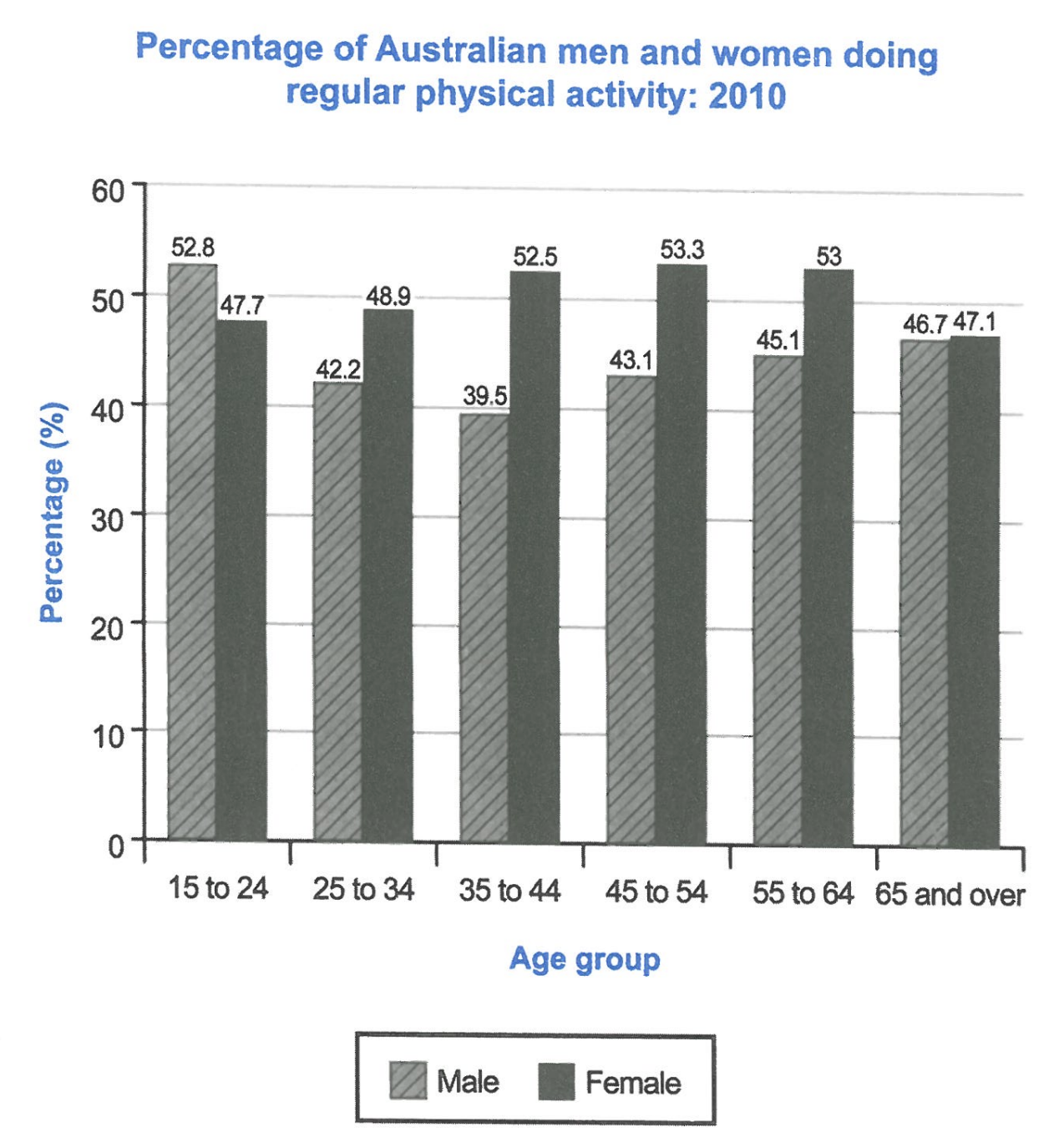
The bar chart below shows the percentage of Australian men and women in different age groups who did regular physical activity in 2010.
Summarise the information by selecting and reporting the main features, and make comparisons where relevant.
Student answer (Band 5.5)
The chart ilustrates the percentage of Australian men and women in differnet age group from 15 to over 65 who were involved in regular physical activity in 2010.
The percentage of regular physical activity has shown veritically from 0 to 60 in the chart while age group of men and women has shown horizontally from 15 to over 65. The block darker in color represents female while the block with dashes represents male.
In the age group of 15 to 24 the male were dominent and surpased the females by taking 52.8 percent while the female stands at 47.7 percent. Now comes the 25 to 34 age group here is the interesting part here the females takes the lead and dominates with the 48.9 percent while mens stands at 42.2 percent. Now comes the 35 to 44 age group here's female still dominates the male and were involved in higher numbers in physical activity as compared to men. Now comes the 55 to 64 age group still the females are in dominating position as they out par the males by getting 53 percent while males got 45.1 percent. Now comes the 65 and over age group here is the close call and male precisely close to female but female takes the lead and got 47.1 percent while male got 46.7 percent.
In the end we can conclude that in 2010 more females were involved in physical activity as compared to men as the out smart in percnetage. They were only behind in 15 to 24 age group othen than that they were ahead of males in all age groups.
AI examiner evaluation
| Criterion | Band |
|---|---|
| Task Achievement / Task Response | 5.5 |
| Coherence and Cohesion | 5.5 |
| Lexical Resource | 5.5 |
| Grammatical Range and Accuracy | 5.0 |
| Overall | 5.5 |
Task Achievement / Task Response: Band 5.5
You identify the chart’s subject and report several accurate comparisons, including the male lead among 15–24-year-olds and the female figures of 48.9% and 53% in two age groups. However, coverage is incomplete: you omit the 45–54 group and give no figure for women aged 35–44, despite describing their lead. The overview is also too broad: women were higher in every group except the youngest, but the claim that more women were active overall is not directly established by these age-specific percentages. The opening description of the axes and bar styles takes space without summarising the main patterns. Include all age groups selectively and state the key trend clearly, supported by the chart’s figures.
Coherence and Cohesion: Band 5.5
The response has a recognisable introduction, a body paragraph and a concluding statement, and the age-group comparisons give it some organisation. However, progression is weakened by repeatedly beginning comparisons with “Now comes,” which makes the account sound like a list rather than a connected summary. The sequence also jumps from 35–44 to 55–64, leaving a gap in the chart’s progression. Some linking is awkward or unclear, particularly “In the end we can conclude,” and the final paragraph repeats the earlier claim that women led in most groups. Group the figures into meaningful patterns—for example, the youngest group versus the remaining groups—and use concise transitions to show how the trends relate.
Lexical Resource: Band 5.5
You use relevant chart vocabulary such as “percentage,” “age group,” “dominates,” and “lead,” so the topic is generally understandable. However, the range is limited and several choices are inaccurate or informal for an academic report: “block darker in color,” “out par,” and “close call” do not describe the data precisely. Repetition of “dominates” and “Now comes” also limits flexibility. Spelling errors, including “ilustrates,” “differnet,” “veritically,” and “percnetage,” are noticeable and reduce the accuracy of the presentation. Use standard terms such as “bar,” “higher proportion,” and “exceeded,” and check spelling carefully. More precise vocabulary would make comparisons clearer and more appropriately formal.
Grammatical Range and Accuracy: Band 5.0
The response attempts both simple and longer sentences, but control is inconsistent, and errors occur often enough to make some sentences awkward or difficult to follow. For example, “The percentage of regular physical activity has shown veritically” has an unsuitable verb construction, while “the male were dominent” has a subject–verb agreement error. In “the female takes the lead … while mens stands,” agreement and sentence structure are also faulty. Several sentences run together through repeated clauses, with punctuation that does not clearly separate ideas. Practise accurate past-tense reporting and agreement, and use shorter, well-punctuated comparisons before attempting more complex structures.
See this exact question answered at other band scores. The same prompt compared across bands.
Browse more IELTS Writing model answers or get your own writing scored by the same AI examiner.