Band 6.0 IELTS Writing Task 1 Model Answer
Overall Band Score: 6.0 · Cambridge IELTS 12 · 2026-11-25
IELTS Writing Task 1 question
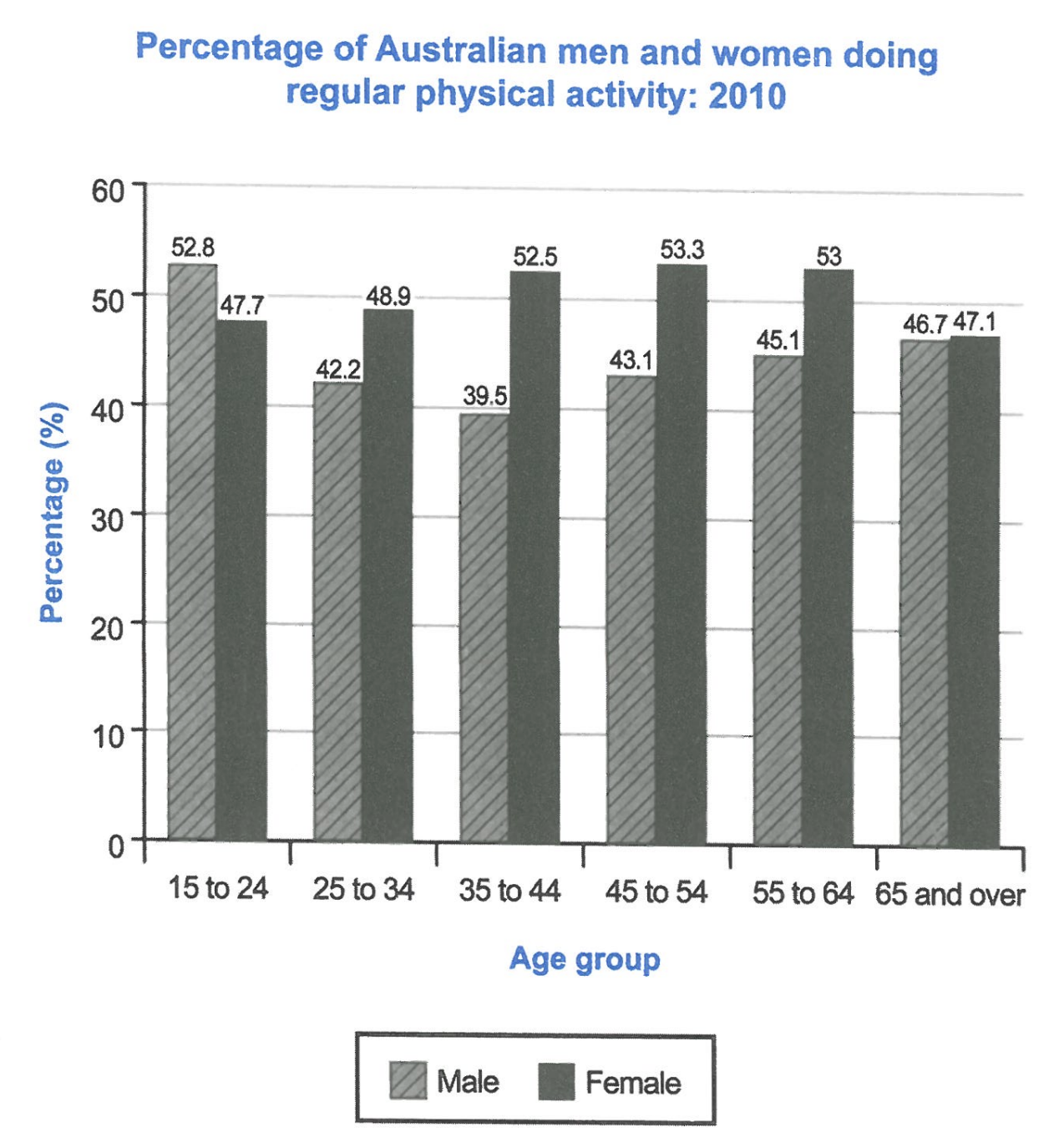
The bar chart below shows the percentage of Australian men and women in different age groups who did regular physical activity in 2010.
Summarise the information by selecting and reporting the main features, and make comparisons where relevant.
Student answer (Band 6.0)
The chart illustrates the six age groups of Australian men and women who took part in regular physical activity in 2010.
Overall, we can see that women dominates the men in every age group expect the first one in which men have higher rates of physical activity than women. From the graph we are sure that womens in Australia are more interested in exercise than men.
Among these, if we look at the age group of 15 to 24 mens have higher ratio roughly 52.8% then women who have only 47.7'% but, the percentage of women doing physical exercise rose to 48.9% in age group of 25 to 34 whereas, men ahve only 42.2%. Morever, in the age group of 35 to 44 women ratio constantly increases and become 52.5% on the other hand, mens remain at 39.5%.
In addition, at the age group of 45 to 54 female have highest percentage of physical exercise throughout the year lays at 53.3% but, mens have lower percent at 43.1%. Furthermore, in the age group of 55 to 64 53 % women involve in physical activity while men have only 45.1% contribution. At 65 and over both have roughly similar oercentage in physical exercise.
AI examiner evaluation
| Criterion | Band |
|---|---|
| Task Achievement / Task Response | 6.0 |
| Coherence and Cohesion | 6.0 |
| Lexical Resource | 5.5 |
| Grammatical Range and Accuracy | 5.5 |
| Overall | 6.0 |
Task Achievement / Task Response: Band 6.0
You identify the main contrast accurately: men lead only in the youngest group, while women have higher participation in the other five. Several figures are also reported correctly, including 52.8% versus 47.7% for ages 15–24 and 53.3% versus 43.1% for ages 45–54. The overview is relevant, but the claim that women are “more interested in exercise” goes beyond what the chart measures; it shows participation rates, not motivation. Some key patterns are not fully explained: women peak at 45–54 and then decline slightly, while men fall to a low at 35–44 before rising. The final comparison is also vague: at 65 and over the figures are 46.7% for men and 47.1% for women. Highlighting these trends would make the summary more complete and precise.
Coherence and Cohesion: Band 6.0
The response has a clear overall arrangement: an introduction, an overview, and paragraphs describing the age-group figures. The sequence from younger to older groups helps the reader follow the data, and linking expressions such as “In addition” and “Furthermore” show how details relate. However, the repeated “but” and “whereas” constructions sometimes make the comparisons feel mechanical, and several long sentences contain multiple figures and contrasts without clear punctuation. For example, the sentence beginning “Among these, if we look at the age group of 15 to 24” is difficult to follow. The final sentence introduces the oldest group but does not state the actual comparison. Use shorter, more controlled comparisons and connect the overview directly to the main trends.
Lexical Resource: Band 5.5
You use a reasonable range of task-related vocabulary, including “regular physical activity,” “percentage,” “higher rates,” and “rose.” This is enough to communicate the broad comparisons, but some word choices and collocations are inaccurate or imprecise. “Women dominates the men” is not a natural way to describe the data, and “women are more interested in exercise” claims more than the chart supports. Phrases such as “women ratio” and “men have only 45.1% contribution” are also awkward; use “the proportion of women” and “the male participation rate.” Spelling slips such as “ahve,” “Morever,” and “oercentage” reduce accuracy. Aim for precise chart language and check spelling before finishing.
Grammatical Range and Accuracy: Band 5.5
You attempt both simple and more complex sentences, using contrast clauses such as “whereas” and “on the other hand,” and the main comparisons are generally understandable. Some grammatical errors remain, particularly with subject–verb agreement, articles, and sentence construction. For example, “women dominates” should be “women dominate,” while “mens have higher ratio” needs a possessive or article structure such as “men have a higher rate.” The sentence beginning “Among these, if we look…” is not well formed, and punctuation around “but” and “whereas” is often incorrect. There are also inconsistent plural forms in references to men and women. Build comparisons with complete, parallel clauses and review agreement and punctuation to make the complex sentences more controlled.
See this exact question answered at other band scores. The same prompt compared across bands.
Browse more IELTS Writing model answers or get your own writing scored by the same AI examiner.