Band 5.0 IELTS Writing Task 1 Model Answer
Overall Band Score: 5.0 · Cambridge IELTS 12 · 2026-11-27
IELTS Writing Task 1 question
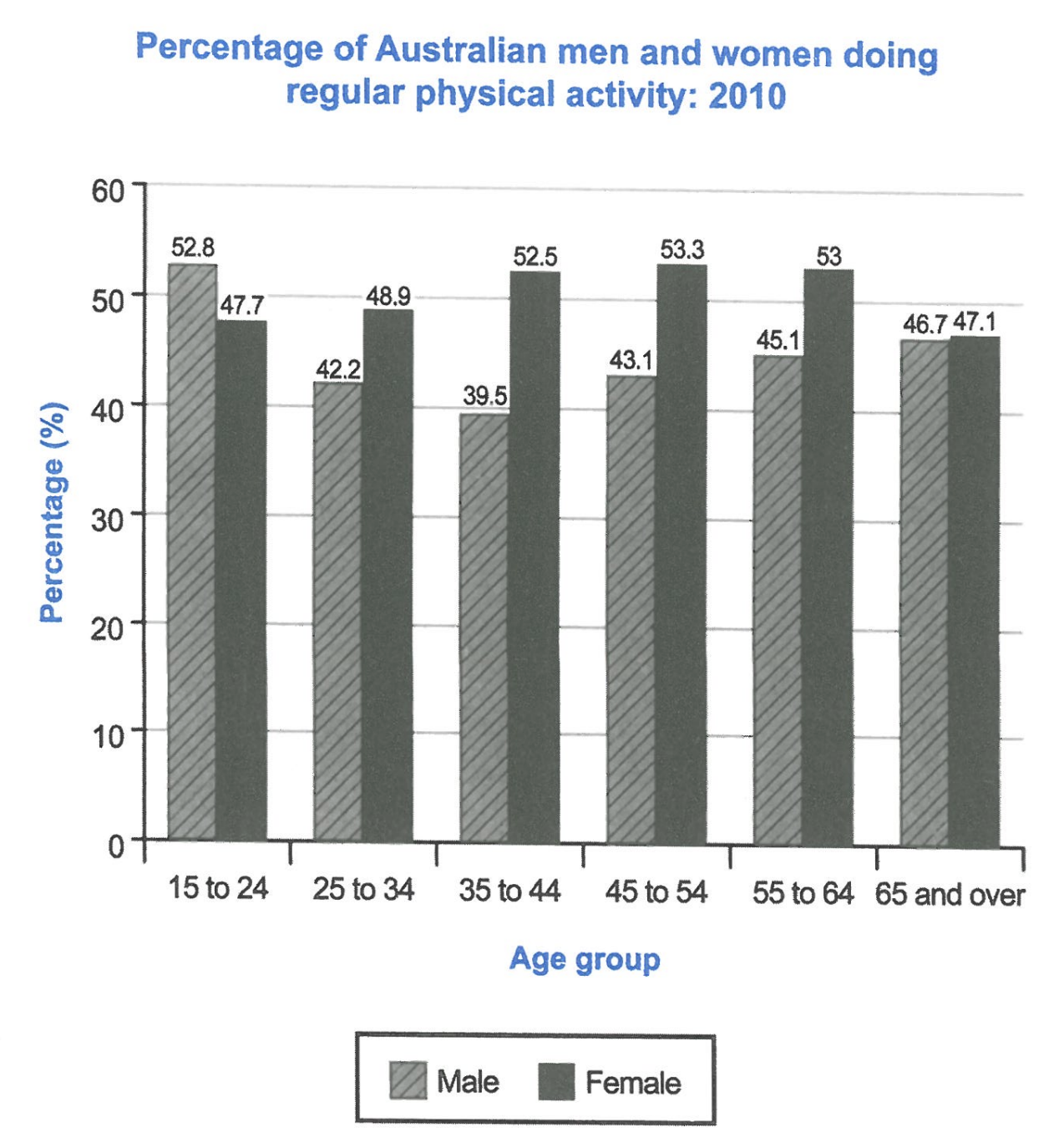
The bar chart below shows the percentage of Australian men and women in different age groups who did regular physical activity in 2010.
Summarise the information by selecting and reporting the main features, and make comparisons where relevant.
Student answer (Band 5.0)
The chart illustrates the percantage of australian men and women in diffferent age groups who did regular physical activity in 2010. Hence, the percantage of men are increasing then women in between 15 to 24 age group. But as changing in age group the percantage of men are getting decreasing and women percantage are increasing in regular physical activity.
Firestly the men are regular in physical activity on the age group of 15 to 24, but some how after that age the men are not doing regular physical ativity. But on the other side the women more engage in doing regular physical activity.
The main feature of the percantage of australian men and women doing regular physical activity in 2010 was that women are more active in doing physical activity while men percantage are decreasing the highest percantage of women was in 45 to 54 age. Therefore after 65 and above the men and women are similar to equal in physical activity the percentage of men was 46.7 and women was 47.1.
AI examiner evaluation
| Criterion | Band |
|---|---|
| Task Achievement / Task Response | 5.5 |
| Coherence and Cohesion | 4.5 |
| Lexical Resource | 5.0 |
| Grammatical Range and Accuracy | 5.0 |
| Overall | 5.0 |
Task Achievement / Task Response: Band 5.5
You identify the chart’s subject and make a relevant overall comparison: women were generally more active, while the male figure fell after the youngest group and later rose. You also accurately report the near-equal figures for people aged 65 and over, and identify the female peak in the 45–54 group. However, the overview is unclear in places, especially “the percantage of men are increasing then women,” and the claim that men’s percentages are “decreasing” does not capture the full pattern: the male rate rises again after ages 35–44. Several key comparisons are omitted, including the female figures being higher from ages 25–34 to 65 and over. Develop the overview with the main trends and support it with more accurate comparisons across the age groups.
Coherence and Cohesion: Band 4.5
The response has separate paragraphs and attempts to organise information with “Firstly,” “But on the other side,” and “Therefore.” These signals show an effort to guide the reader, and the final sentence gives a specific comparison. However, the progression is difficult to follow because the first paragraph combines an unclear overview with a confusing comparison, while the second repeats the general point that women are more active without adding data. Some linking words do not express the relationship accurately, and references such as “after that age” are vague. A clearer structure would be an introduction, a concise overview, and two data-focused paragraphs grouped by the male and female trends. Use fewer, more precise transitions to connect comparisons.
Lexical Resource: Band 5.0
You use relevant task vocabulary, including “age group,” “regular physical activity,” “percentage,” and “main feature,” so the topic is generally understandable. However, the range is limited and several phrases are inaccurate or repetitive, such as “men are regular in physical activity” and “women more engage in doing regular physical activity.” Repeated use of “percentage” and “physical activity” also makes the description less precise. There are noticeable spelling errors, including “percantage,” “diffferent,” “Firestly,” and “ativity,” which reduce the accuracy of the writing. Build a small set of natural chart-description expressions, such as “the proportion who exercised regularly,” “rose,” “fell,” and “reached a peak,” and check spelling before submitting.
Grammatical Range and Accuracy: Band 5.0
You attempt both simple and longer sentences, and the final comparison using “while” communicates that the two figures were close. However, control is inconsistent, and several sentence patterns are faulty. For example, “the percantage of men are increasing” has subject–verb disagreement, while “the percantage of men are decreasing the highest percantage of women was…” joins separate ideas without correct punctuation or a clear grammatical link. Phrases such as “as changing in age group” and “after 65 and above” also show problems with sentence construction and prepositions. Practise writing short, accurate comparisons first, then combine them using structures such as “whereas” or “while.” Check agreement, articles, and sentence boundaries carefully.
See this exact question answered at other band scores. The same prompt compared across bands.
Browse more IELTS Writing model answers or get your own writing scored by the same AI examiner.