Band 6.5 IELTS Writing Task 1 Model Answer
Overall Band Score: 6.5 · Cambridge IELTS 12 · 2026-11-27
IELTS Writing Task 1 question
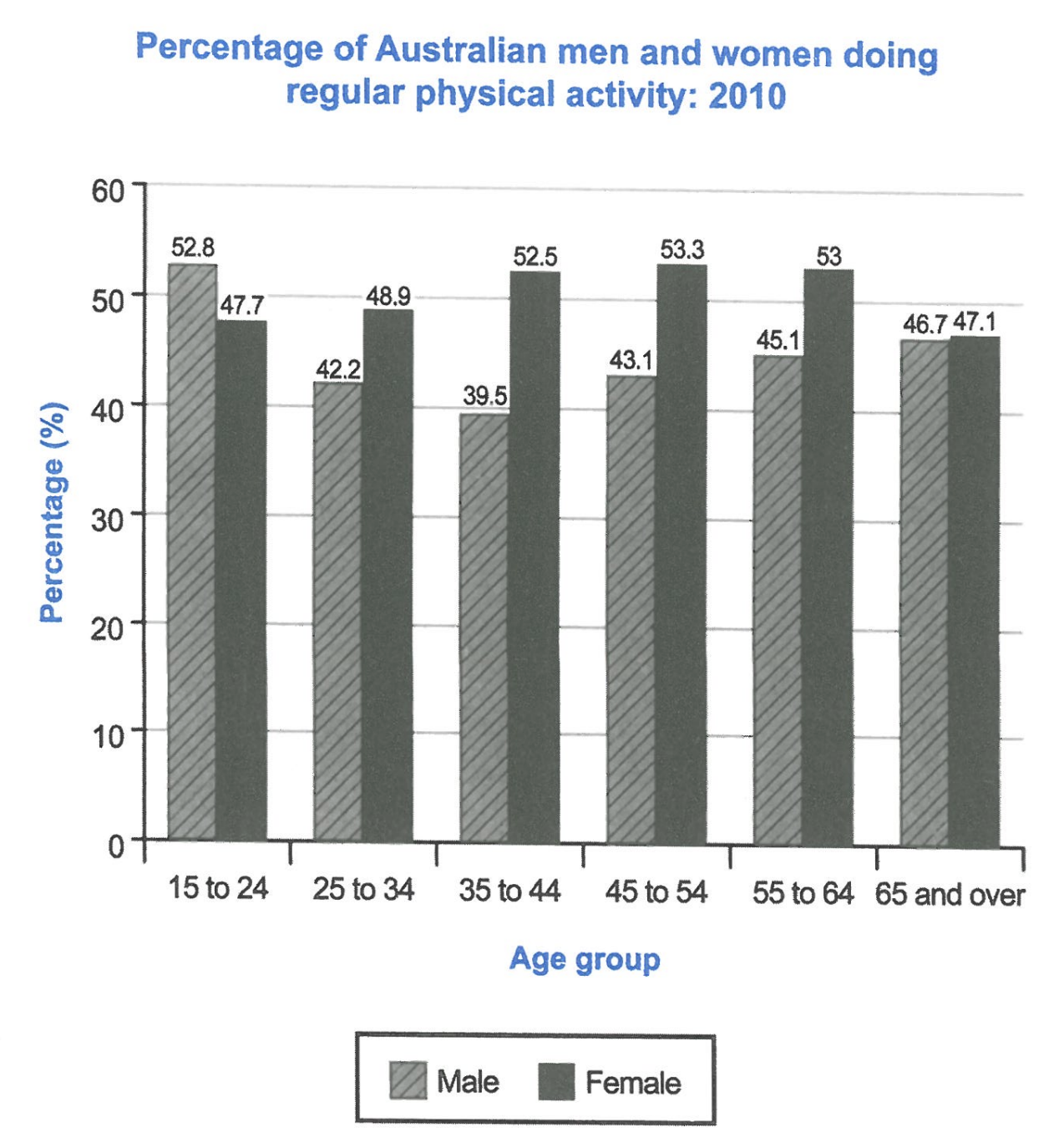
The bar chart below shows the percentage of Australian men and women in different age groups who did regular physical activity in 2010.
Summarise the information by selecting and reporting the main features, and make comparisons where relevant.
Student answer (Band 6.5)
The bar chart shows the rate of physical activity among Australian men and women of different ages during 2010.
Overall, it can be seen that men tend to exercise less as they grey older. While, women started to be engaged in more physical activities as they grew with age. Interestingly, men were the most active during their teen age and women the most during mid-age (over their 40s).
Men of 15 to 24 age group, were the most active at 52.8% of physical activity. Physical activity fell among men among 35 to 44 age group to 39.5%. From 45 to 54 age, they started being more active at 43.1%, rising to 46.7% by 65 and over age group.
Women on the other hand, were most active as they grew older till they reached close to retirement age. The rate of physical activity slightly rose among 15 to 24 age group from 47.7% to 48.9% among 25 to 34 age group. It then peaked at 53.3% among the 45 to 54 age group, before starting to slightly fall to 47.1 among the 65 and over age group.
AI examiner evaluation
| Criterion | Band |
|---|---|
| Task Achievement / Task Response | 6.0 |
| Coherence and Cohesion | 7.0 |
| Lexical Resource | 6.0 |
| Grammatical Range and Accuracy | 6.0 |
| Overall | 6.5 |
Task Achievement / Task Response: Band 6.0
You identify the chart’s subject and give a relevant overview, noting that men’s activity falls to a low in the 35–44 group before rising, while women’s rate generally increases to a midlife peak and then declines. Several figures are accurate, including the male low of 39.5% and the female peak of 53.3%. However, the overview overgeneralises: men do not steadily become less active with age, and women’s activity does not rise continuously, since it falls from 53.0% at ages 55–64 to 47.1% among those 65 and over. The comparison between the sexes is also underdeveloped; for example, women exceed men in every group except 15–24. Include this key contrast and report the 55–64 female figure to make the summary more complete and precise.
Coherence and Cohesion: Band 7.0
The response is organised clearly into an introduction, an overview and separate paragraphs for men and women. The sequence within each sex’s paragraph is easy to follow, and linking expressions such as “Overall,” “On the other hand,” and “before” help signal relationships between points. This logical progression makes the information accessible. To strengthen cohesion further, connect the two series more directly rather than treating them almost entirely in isolation; a comparison such as women’s higher rates from ages 25–34 onward would help unify the account. Some transitions are also slightly awkward, particularly “While” at the start of a sentence after a full stop. More precise links between the overview and the detailed figures would make the progression feel less repetitive.
Lexical Resource: Band 6.0
You use an adequate range of topic vocabulary, including “rate,” “peaked,” “fell,” “rising,” and “slightly,” to describe changes in the data. These choices generally communicate the trends clearly. However, some expressions are inaccurate or unnatural for a chart summary: “as they grey older,” “teen age,” and “grew with age” are not suitable collocations, while “rate of physical activity” is repeated frequently. “Close to retirement age” is also an imprecise description of the 45–54 group. Aim for concise, conventional reporting language such as “as they grew older,” “youngest age group,” and “participation rate.” Greater precision in these phrases, alongside more varied but accurate trend vocabulary, would improve control without making the writing sound forced.
Grammatical Range and Accuracy: Band 6.0
You use a mix of simple statements and more complex structures, including “before starting to slightly fall” and “While, women started…,” and most of the meaning remains clear. Some grammatical errors persist, however. In “men tend to exercise less as they grey older,” the comparative construction is faulty; write “as they grow older.” The sentence beginning “While” is incomplete as punctuated, and the comma in “Men of 15 to 24 age group, were…” incorrectly separates the subject from its verb. There are also missing or awkward articles and prepositions in phrases such as “among 35 to 44 age group” and “by 65 and over age group.” Review sentence boundaries and use consistent patterns such as “among men aged 35–44” to improve accuracy.
See this exact question answered at other band scores. The same prompt compared across bands.
Browse more IELTS Writing model answers or get your own writing scored by the same AI examiner.