Band 6.0 IELTS Writing Task 1 Model Answer
Overall Band Score: 6.0 · Cambridge IELTS 12 · 2026-11-27
IELTS Writing Task 1 question
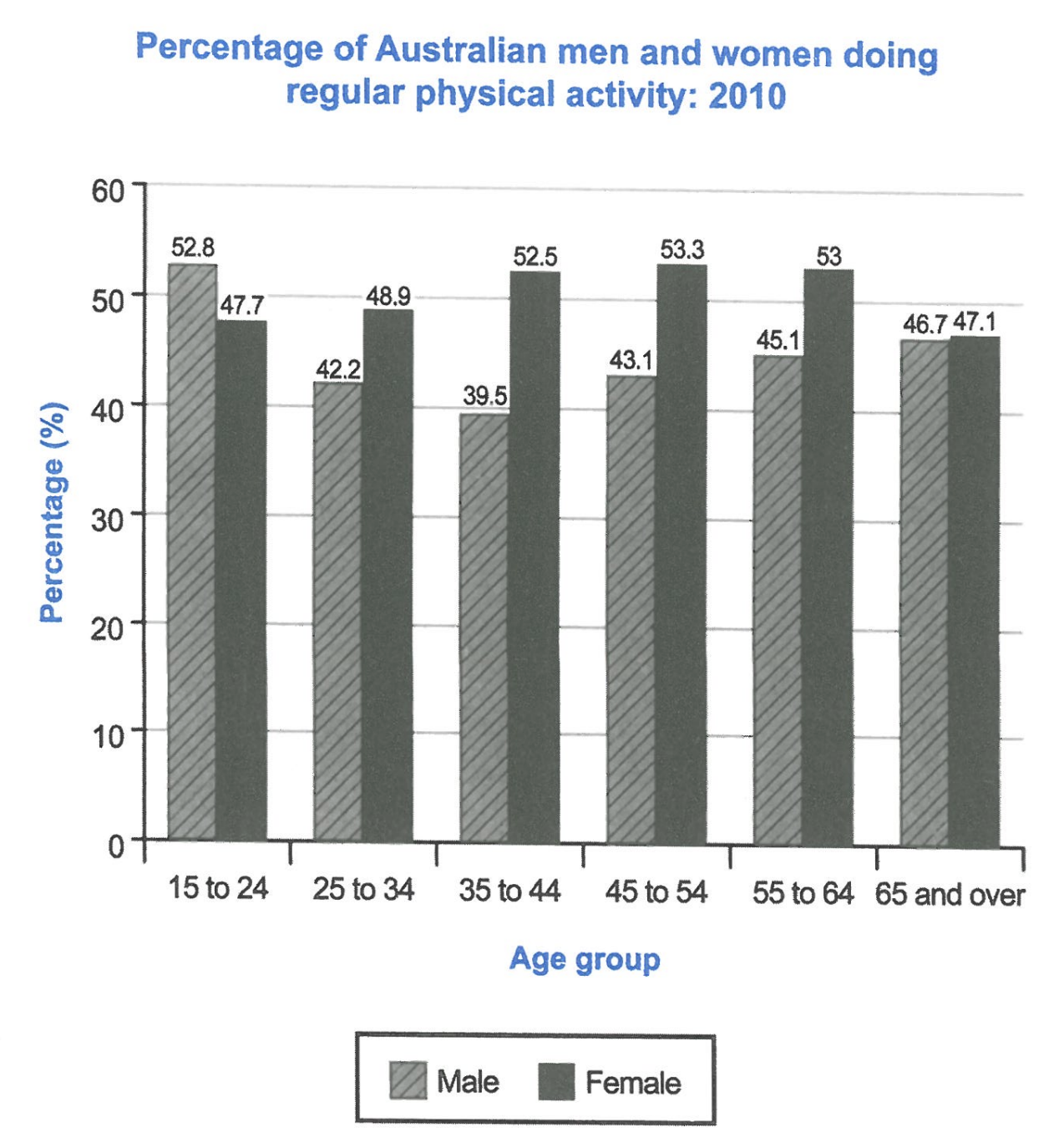
The bar chart below shows the percentage of Australian men and women in different age groups who did regular physical activity in 2010.
Summarise the information by selecting and reporting the main features, and make comparisons where relevant.
Student answer (Band 6.0)
The bar chart illustrates the percentage of Australian men and women in different age groups who did regular physical activity in 2010.
It is clearly visible that males of age group 15 to 24 and females of age group 45 to 54 are the most regular. Similarly, the percentage of male and female of age group 65 and over is almost similar both being near 50%. The male figure for age group 35 to 44 is at 39.5 % which is the least for male category among all age groups. Furthermore, the female figure for age group 65 and over is the least among all among the females.
With overall observation, it can be clearly seen that females were physically more active that males in 2010 which corresponds to all age groups except the category of 15 to 24 years. The maximum surge can be seen in the age grouop 45 to 54 for female.
In conclusion, females seem to be more regular in physical activity compared to male in 2010.
AI examiner evaluation
| Criterion | Band |
|---|---|
| Task Achievement / Task Response | 6.0 |
| Coherence and Cohesion | 5.5 |
| Lexical Resource | 6.0 |
| Grammatical Range and Accuracy | 6.0 |
| Overall | 6.0 |
Task Achievement / Task Response: Band 6.0
You identify several relevant features, including the male peak among 15–24-year-olds, the female peak among 45–54-year-olds, and the lowest male figure of 39.5% for ages 35–44. Your broad comparison that women were more active in every group except the youngest is also accurate. However, the overview is not fully precise: the figures for people aged 65 and over are about 47%, rather than “near 50%,” and the female low is shared by the youngest and oldest groups, not just the oldest. “Maximum surge” is unclear and does not describe a change over time in this single-year chart. A clearer overview of the contrasting age patterns and key figures would make the main features more complete.
Coherence and Cohesion: Band 5.5
The response has a recognisable structure: an introduction, a paragraph of selected observations, a broader comparison, and a concluding sentence. This makes the information generally easy to follow. However, the progression is somewhat repetitive: the final sentence repeats the claim that women were more active, while “With overall observation” introduces a point that could be integrated into a concise overview. Some links are mechanical or unclear, particularly “Similarly,” which connects the youngest-group peaks to the 65-and-over comparison without showing how they are similar. Organising the body around the overall gender pattern and then the age-group extremes would create a clearer progression, with more precise referencing between comparisons.
Lexical Resource: Band 6.0
You use an adequate range of task-related vocabulary, including “percentage,” “age group,” “physically more active,” and “regular physical activity.” These choices make the topic clear, and the chart is introduced appropriately. Some expressions are imprecise or unnatural for describing data: “most regular” is less clear than “highest participation rate,” and “maximum surge” suggests a change over time rather than a comparison between age groups. There are also word-form and spelling slips, such as “grouop,” and the phrase “least among all among the females” is repetitive. More precise terms for peaks, lows, and differences would help you report the chart more naturally and accurately.
Grammatical Range and Accuracy: Band 6.0
You use a mix of simple and more complex sentence forms, and most of your meaning remains clear. For example, the sentence beginning “With overall observation” attempts to combine a general comparison with an exception. Some grammatical errors remain: “females were physically more active that males” needs “than,” while “the percentage of male and female … is almost similar both being near 50%” has awkward agreement and sentence construction. The phrase “males of age group” also needs a more natural grammatical form, such as “men in the 15–24 age group.” Review comparative structures, articles, and sentence boundaries; more controlled complex sentences would improve accuracy without sacrificing range.
See this exact question answered at other band scores. The same prompt compared across bands.
Browse more IELTS Writing model answers or get your own writing scored by the same AI examiner.