Band 5.5 IELTS Writing Task 1 Model Answer
Overall Band Score: 5.5 · Cambridge IELTS 12 · 2026-11-27
IELTS Writing Task 1 question
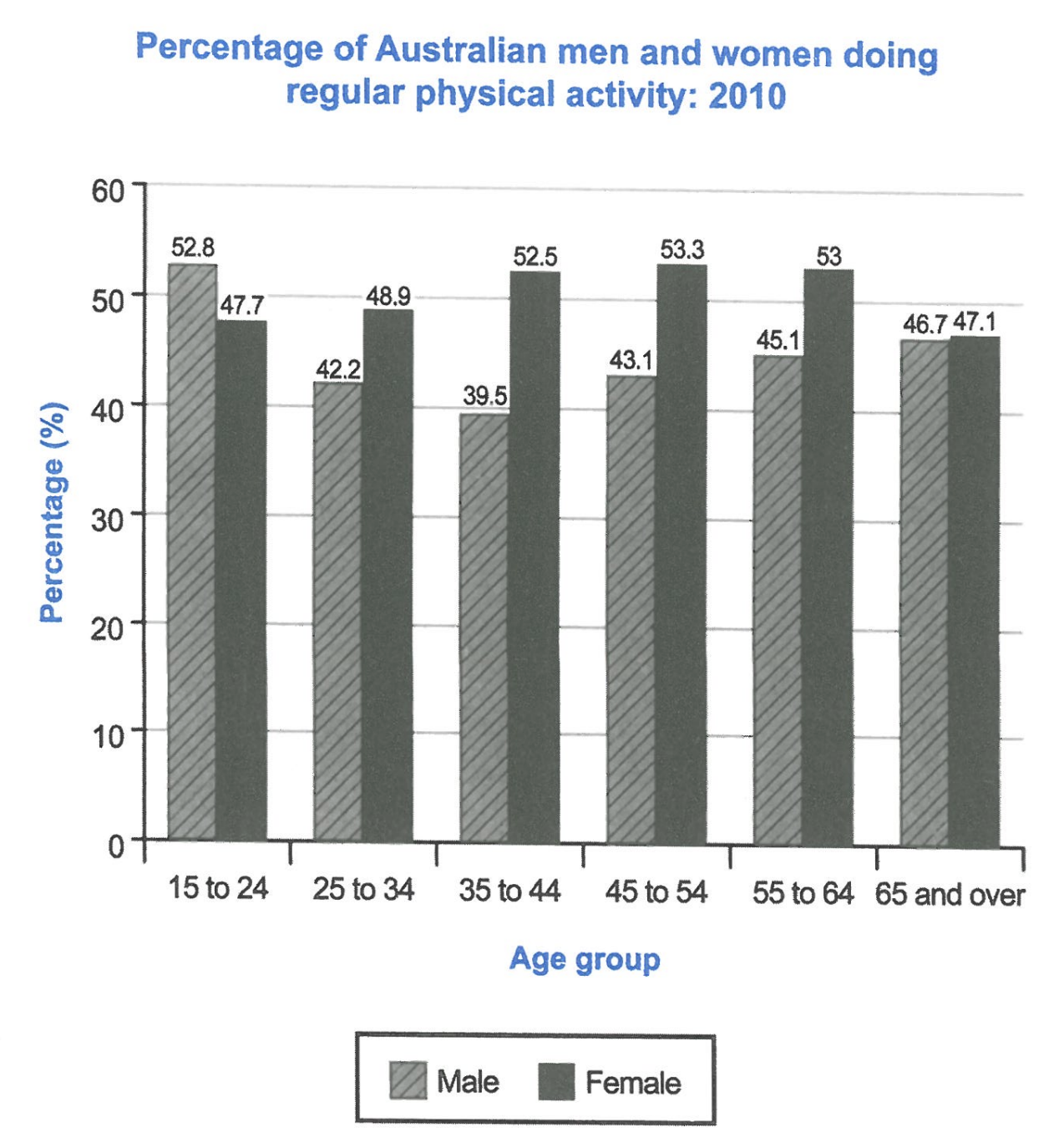
The bar chart below shows the percentage of Australian men and women in different age groups who did regular physical activity in 2010.
Summarise the information by selecting and reporting the main features, and make comparisons where relevant.
Student answer (Band 5.5)
Given bar chart compares the percentage of Australian male and female persons who did physical activities on daily bases in 2010.
Overall, looking at the chart, it clearly shows that the large number of female did regular physical activity and compared to the women, men did less excercise in every age groups apart from the group of age between 15 to 24.
Firstly, the man of age between 15 to 24 and the women of the group of age between 35 to 64 is constant. Around 52-53% of men and women of these age groups did regular physical activity. Moreover, 47% of the men and women of age 65 and over did physical excersise regularly.
By contrast, the men of age between 35 to 44 did less physical activity. Only 39.5% men of these age group did regular physical activity. Beyond them about 42 to 45% of men did regular physical activity.
AI examiner evaluation
| Criterion | Band |
|---|---|
| Task Achievement / Task Response | 5.5 |
| Coherence and Cohesion | 5.5 |
| Lexical Resource | 5.5 |
| Grammatical Range and Accuracy | 5.5 |
| Overall | 5.5 |
Task Achievement / Task Response: Band 5.5
You identify the broad comparison between the sexes and include several relevant figures, such as 39.5% for men aged 35–44 and roughly 52–53% for women aged 35–64. However, the overview is not fully accurate: women did not exceed men in every age group except 15–24; men were also slightly higher among those aged 65 and over (46.7% versus 47.1%? In fact, women were marginally higher there). The main issue is that the claim that men did less in every group apart from the youngest is broadly correct, but the chart’s key pattern—that women peaked around 45–54 while men reached their low at 35–44 and then recovered—is not clearly summarised. Some descriptions are also unclear, particularly “is constant.” Select and explain the main trends more precisely.
Coherence and Cohesion: Band 5.5
The response has a recognisable structure: an introduction, an overview, and two detail paragraphs. This gives the reader a basic route through the information, and transitions such as “Overall,” “Firstly,” and “By contrast” signal the intended relationships. However, progression is limited because the details are grouped inconsistently: the first detail paragraph combines the youngest men with women aged 35–64, then adds the oldest group, without explaining why these figures belong together. “Beyond them” is also an unclear reference, and the final paragraph ends without a concluding comparison. Organise the body around clear patterns—for example, women’s figures across age groups and men’s changes over time—and use linking phrases only where they accurately show the relationship between points.
Lexical Resource: Band 5.5
You use enough topic vocabulary to communicate the subject, including “percentage,” “age groups,” “regular physical activity,” and “compared to.” However, the range is limited and several word choices or collocations are inaccurate or awkward, which makes parts of the report less clear. For example, “daily bases” does not match the chart’s measure of regular activity, while “the man of age” and “the large number of female” are unnatural ways to describe the groups. There are also spelling errors in “excercise” and “excersise.” Aim for precise, consistent terms such as “men,” “women,” “proportion,” and “participated in regular physical activity,” and avoid adding a daily frequency that the chart does not specify.
Grammatical Range and Accuracy: Band 5.5
You attempt both simple and more complex sentence forms, and the main message is generally understandable. However, errors in agreement, articles, plurals, and sentence construction occur often enough to make some statements awkward or unclear. For instance, “the large number of female did” has incorrect agreement and number, while “men did less … in every age groups” has a plural mismatch. The sentence beginning “Firstly, the man of age…” is also difficult to follow, and “Only 39.5% men” is missing a determiner or suitable construction. Work on forming accurate comparisons and checking subject–verb agreement, for example: “The proportion of men was lowest among those aged 35–44.” More consistent control of these patterns would make the report easier to read.
See this exact question answered at other band scores. The same prompt compared across bands.
Browse more IELTS Writing model answers or get your own writing scored by the same AI examiner.