Band 5.5 IELTS Writing Task 1 Model Answer
Overall Band Score: 5.5 · Cambridge IELTS 12 · 2026-11-27
IELTS Writing Task 1 question
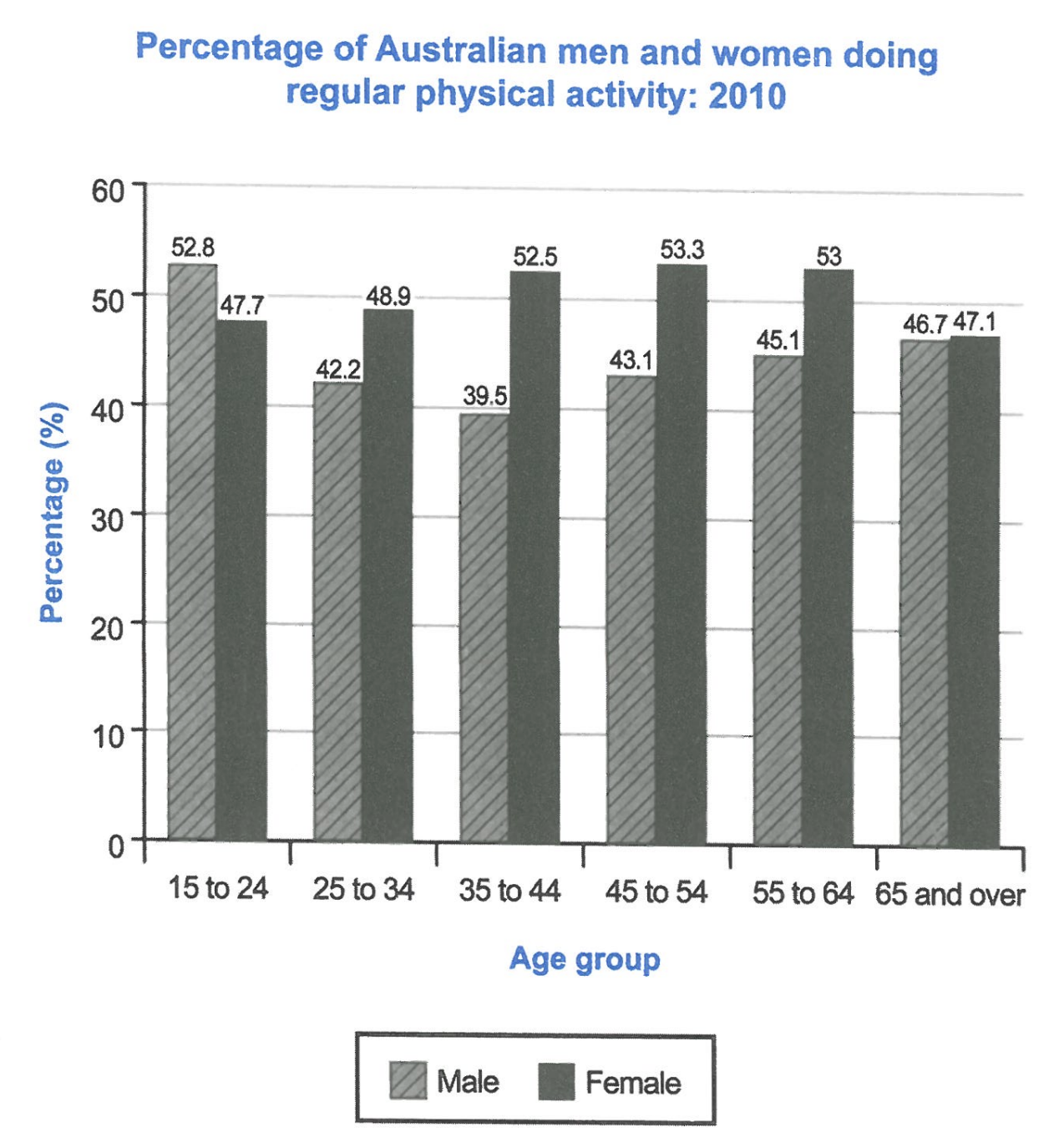
The bar chart below shows the percentage of Australian men and women in different age groups who did regular physical activity in 2010.
Summarise the information by selecting and reporting the main features, and make comparisons where relevant.
Student answer (Band 5.5)
The bar chart represents data of age groups who do exercise related to physically in the Australia in 2010.
Overall, the highest ratio of percentage was in female because they were doing activities daily between 25 and 65 and over age. however, the 15 to 24 age of male was highest in physical activities.
Although, women ratio around 53% in 35 to 64 age groups.In contrast,mens had not same this type of data
According to chart ,mens mostly did excersie in 14 to 24 age.then 25 to 34 this time mens decreased around at 42.2.then next 39.5.while 45 to 54 age rose at 43.1 and next would going increased at 46.1.
While we talk about womens they always did excersie more than men in every age group instead of1 5 to 24 group. this group is very good for everything. in 65 and over age group decreased compare to the others.
AI examiner evaluation
| Criterion | Band |
|---|---|
| Task Achievement / Task Response | 5.5 |
| Coherence and Cohesion | 5.5 |
| Lexical Resource | 5.0 |
| Grammatical Range and Accuracy | 5.0 |
| Overall | 5.5 |
Task Achievement / Task Response: Band 5.5
You identify several important patterns: women recorded higher activity in most age groups, while men were highest among 15–24-year-olds, and women’s figures were around 53% from 35 to 64. However, the overview is not fully accurate: women were also higher in the 15–24 group? In fact, men were higher there, so your exception is correct, but the claim that women were higher “between 25 and 65 and over” is imprecise. Some figures are misreported: men aged 65 and over were at 46.7%, not 46.1%, and the chart shows regular activity, not necessarily daily exercise. The response selects relevant features, but comparisons and trends are underdeveloped, and some statements such as “very good for everything” do not describe the data clearly. Report the key figures accurately and give a concise, precise overview.
Coherence and Cohesion: Band 5.5
The response has a basic structure, with an overview followed by discussion of men and women, and phrases such as “In contrast” and “While we talk about womens” show an attempt to connect ideas. However, progression is uneven: the overview repeats points that are revisited later, and the paragraph beginning “Although” is an incomplete, disconnected fragment. Several transitions are inaccurate or awkward, including “then next” and “While we talk about,” while punctuation and spacing make relationships between ideas harder to follow. The final paragraph also shifts into an unclear comment about the 15–24 group. Organise the body by comparing the two sexes within age ranges, and use clear linking phrases to show rises, falls, and contrasts rather than listing figures in sequence.
Lexical Resource: Band 5.0
You use some task-related vocabulary, including “percentage,” “age groups,” “decreased,” and “increased,” so the reader can recognise the topic and some trends. However, the range is limited and several expressions are inaccurate or unnatural, such as “exercise related to physically,” “highest ratio of percentage,” and “mens mostly did excersie.” Spelling errors such as “excersie” and “womens” are noticeable, and “very good for everything” is vague and unsuitable for describing chart data. These choices sometimes make the intended comparison difficult to understand. Build a small set of precise chart terms—such as “proportion,” “participation rate,” “peaked,” and “declined”—and check spelling and collocations before finishing.
Grammatical Range and Accuracy: Band 5.0
You attempt both simple statements and longer comparisons, but the range is limited and longer sentences are often faulty. For example, “Overall, the highest ratio of percentage was in female because they were doing activities daily” has problems with article use, sentence construction, and tense; “Although, women ratio around 53%” is not a complete sentence. There are also errors in agreement and sentence boundaries, as in “mens had not same this type of data” and “then 25 to 34 this time mens decreased.” These errors frequently interrupt the flow and can obscure the intended meaning. Practise complete subject–verb sentences, accurate past-tense reporting, and controlled clauses with “while” or “whereas.” Use full stops to separate each comparison.
See this exact question answered at other band scores. The same prompt compared across bands.
Browse more IELTS Writing model answers or get your own writing scored by the same AI examiner.