Band 5.5 IELTS Writing Task 1 Model Answer
Overall Band Score: 5.5 · Cambridge IELTS 12 · 2026-11-27
IELTS Writing Task 1 question
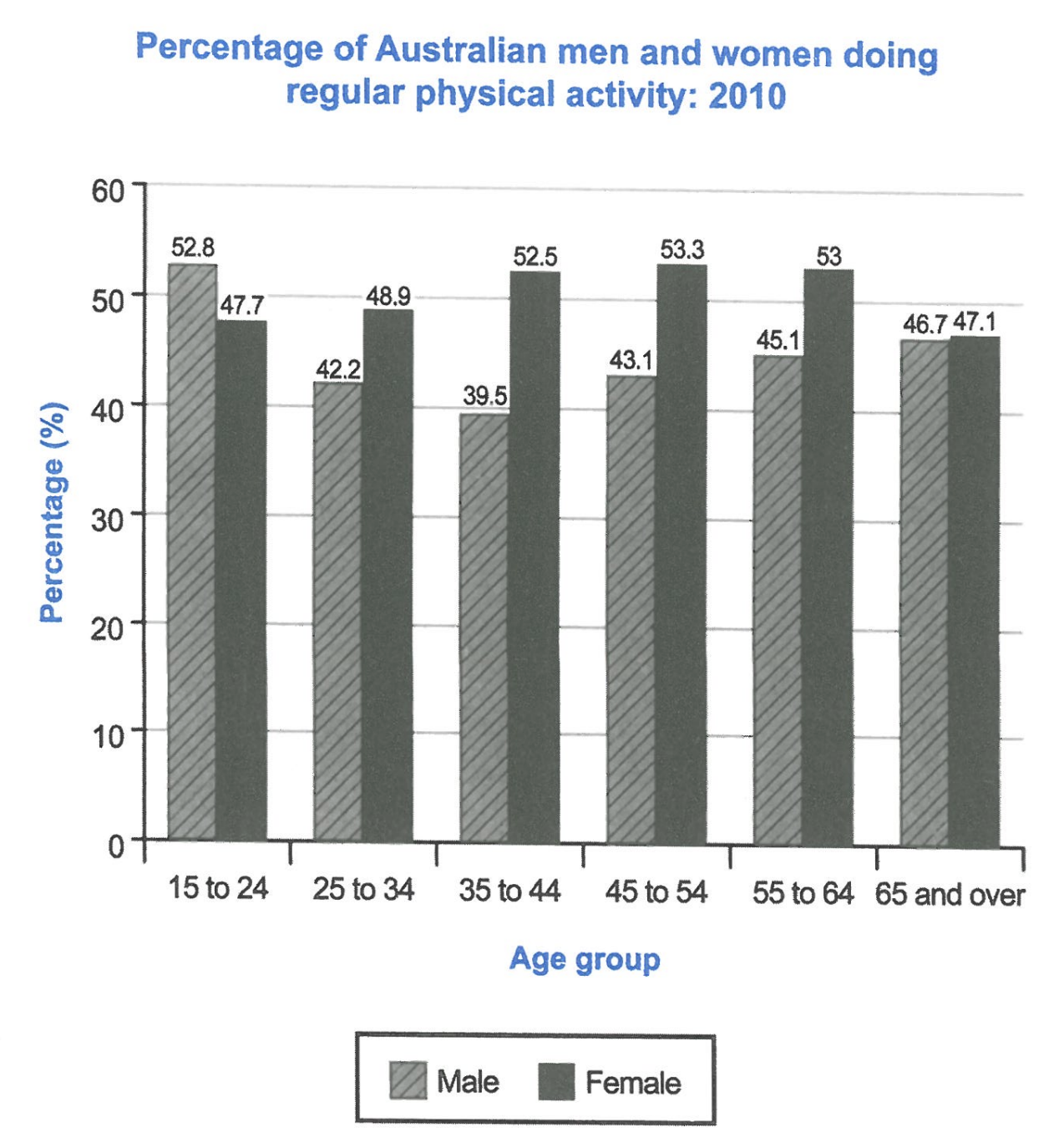
The bar chart below shows the percentage of Australian men and women in different age groups who did regular physical activity in 2010.
Summarise the information by selecting and reporting the main features, and make comparisons where relevant.
Student answer (Band 5.5)
This graph bar illustrates the ratio of Australian men and women in various age group who did daily physical activity in 2010. Overall, women did more exersice rather than a men nevertheless younger men did more workout than younger women.
In Australia 52.8% of men in between 15 to 24 age did a workout whereas women ratio is slightly low 47.7%. The age group from 25 to 34 men gradually decrease to 42.2% meanwhile women went little high 48.9%. The people of 35 to 44 age is almost same men percentage went down 39.5% and women rise steadily. People whose age was 45 to 54 both rose up men were 43.1% and women were 53.3%. Again from 55 to 64 age women was higher than men which is 53% and men percentage also went up which is 45.1%. At last people who was over 65% both gender was almost same men were 46.7% and women were 47.1%
AI examiner evaluation
| Criterion | Band |
|---|---|
| Task Achievement / Task Response | 5.5 |
| Coherence and Cohesion | 6.0 |
| Lexical Resource | 5.5 |
| Grammatical Range and Accuracy | 5.0 |
| Overall | 5.5 |
Task Achievement / Task Response: Band 5.5
You report the figures for all six age groups and identify the main contrast: men lead in the youngest group, while women are higher in the others. The specific values for 15–24 and 25–34, and the near-equal figures for those aged 65 and over, are accurate. However, the overview is not fully precise: women do not simply do more activity overall, since men are higher among 15–24-year-olds. Also, the statement that the 35–44 group is “almost same” is unclear, and the rise in women’s rate at that age is not supported with its figure. A clearer overview of the overall patterns—women peaking around middle age while men fall and then recover—would make the key features more complete and developed.
Coherence and Cohesion: Band 6.0
The response follows the age groups in chart order, which makes the comparisons generally easy to follow, and words such as “whereas,” “meanwhile” and “at last” help connect information. The opening overview also gives the reader a broad direction before the details. However, most of the report is presented as one long paragraph, and the repeated sequence of “The age group…” and “People…” makes the progression somewhat mechanical. Some links are not fully clear, particularly “The people of 35 to 44 age is almost same,” because it does not specify which figures are being compared. Use a separate overview and detail paragraph, and group the trends—for example, the male decline and recovery—rather than describing every category in the same pattern.
Lexical Resource: Band 5.5
You use enough chart-related vocabulary to communicate the main comparisons, including “percentage,” “age group,” “gradually decrease,” and “rose steadily.” However, several choices are informal or imprecise for an academic report: “did a workout” and “did more workout” suggest a single exercise session rather than regular physical activity, while “ratio” is not the right term for the percentages shown. There are also noticeable spelling and word-form problems, such as “exersice,” and repeated use of “people” and “went up.” These do not prevent the reader from understanding the general message, but they limit precision. Prefer neutral reporting language such as “the proportion who exercised regularly” and vary verbs like “declined,” “increased” and “reached a peak.”
Grammatical Range and Accuracy: Band 5.0
You attempt to connect comparisons in longer sentences, for example, “The age group from 25 to 34 men gradually decrease to 42.2% meanwhile women went little high 48.9%.” This shows an effort to use more than simple statements, but the structures are often faulty, and the reader has to work to identify the subject and relationship between clauses. Errors include “various age group,” “a men,” “men gradually decrease,” and “women was higher”; these involve number, articles, agreement and verb form. Punctuation is also needed before connectors such as “whereas” and “meanwhile,” and several sentences run together. Build accuracy with clear patterns such as “The proportion of men fell to…, whereas the figure for women rose to…,” checking agreement and tense in each clause.
See this exact question answered at other band scores. The same prompt compared across bands.
Browse more IELTS Writing model answers or get your own writing scored by the same AI examiner.