Band 6.5 IELTS Writing Task 1 Model Answer
Overall Band Score: 6.5 · Cambridge IELTS 12 · 2026-11-27
IELTS Writing Task 1 question
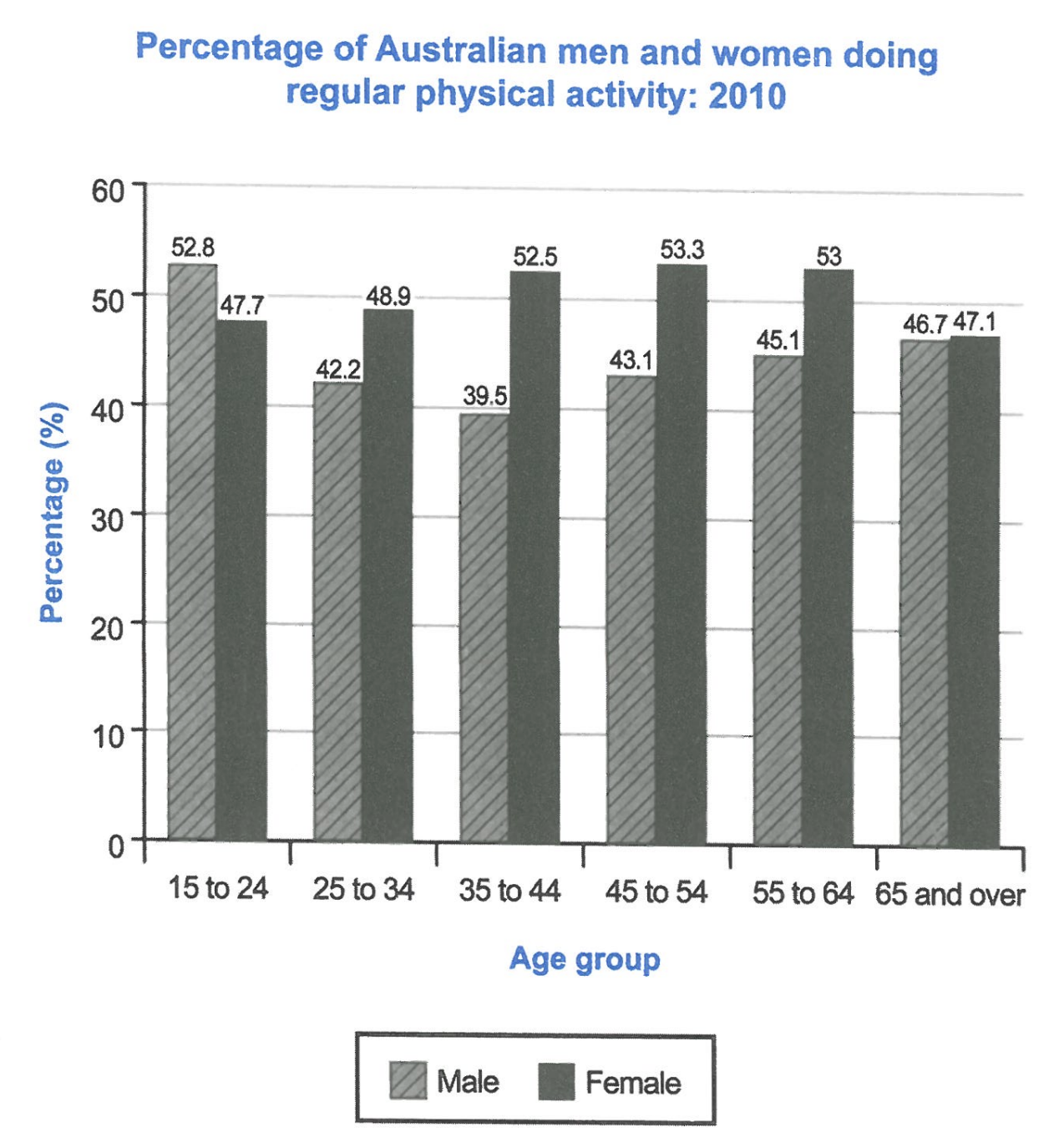
The bar chart below shows the percentage of Australian men and women in different age groups who did regular physical activity in 2010.
Summarise the information by selecting and reporting the main features, and make comparisons where relevant.
Student answer (Band 6.5)
The bar chart illustrates the percentage of different age groups of Australian male and female who did daily physical exercises in the year 2010.
Overall, the ratio of women compared to men doing physical exercises is higher in the age groups above 25 whereas men in the age group 15 to 24 has the only largest number in the given bar chart relative to women.
The highest peak of physical activity done by women happens at the age group 45 to 54 which is around 53.3% while the lowest physical activity by men happens in the age group 35 to 44 which is around 39.5%. The overall trend is dominated by women except the age group 65 and over where both genders have almost similar level of physical activity.
In the age group 15 to 24, men dominates the chart by 5% than women, and the highest percentage of men doing physical activities also comes in this age bracket that is 52.8% whereas women in this age group contributes to 47.7%.
AI examiner evaluation
| Criterion | Band |
|---|---|
| Task Achievement / Task Response | 6.5 |
| Coherence and Cohesion | 6.0 |
| Lexical Resource | 6.5 |
| Grammatical Range and Accuracy | 6.5 |
| Overall | 6.5 |
Task Achievement / Task Response: Band 6.5
You identify the main contrast accurately: men lead in the youngest group, while women have higher participation in the older groups, and you correctly report the female peak (53.3%) and male low (39.5%). The overview also notes the near-equal figures for those aged 65 and over. These are relevant, well-selected features. However, the comparison that women lead in all groups “above 25” is too broad: the 25–34 group is included, but the chart shows women at 48.9% versus men at 42.2%, so the wording is broadly correct; the age boundary would be clearer as “25 and over.” More importantly, the response gives little account of how the figures change across the middle and older groups, and the final paragraph repeats the youngest-group comparison. A fuller summary of those patterns would make the coverage more complete.
Coherence and Cohesion: Band 6.0
The response has a clear overall arrangement: an introduction, an overview, and paragraphs reporting key details. The reader can follow the main comparison, and phrases such as “Overall” and “In the age group 15 to 24” help signal the focus. However, the progression is somewhat uneven: the final paragraph returns to the youngest group after the preceding paragraph has already discussed the main extremes and overall pattern. This creates repetition rather than developing the account across the age groups. Some references are also imprecise, such as “the overall trend is dominated by women,” which does not specify the age range. Organise the detail paragraph around the remaining age groups and use explicit comparisons to connect the figures; this would make cohesion more consistent and less dependent on basic signposting.
Lexical Resource: Band 6.5
You use an adequate range of task-related vocabulary, including “percentage,” “highest peak,” “lowest,” “age bracket,” and “physical activity,” so the chart is generally easy to understand. There is also some attempt at more formal reporting language. However, several choices are unnatural or imprecise for describing data: “ratio of women compared to men” is better expressed as a comparison of percentages, and “men dominates the chart by 5%” is not a natural collocation. “Daily physical exercises” also changes the chart’s wording, which refers to regular activity. These choices do not prevent understanding, but they limit precision and naturalness. Prefer concise chart language such as “participation rate,” “higher than,” and “regular physical activity,” and avoid describing a percentage-point difference simply as “by 5%.”
Grammatical Range and Accuracy: Band 6.5
You use a mix of simple and more complex sentence forms, including a relative clause in “where both genders have almost similar level” and a contrast introduced by “whereas.” Most sentences communicate the intended comparisons, and errors rarely obstruct meaning. Some agreement and article errors remain: “Australian male and female” should be “Australian men and women,” “men … has” should be “men … have,” and “men dominates” should be “men dominate.” There are also awkward constructions such as “the ratio of women compared to men … is higher,” where the sentence structure does not clearly express the comparison. Continue checking subject–verb agreement and singular/plural forms, and build comparisons with a clear structure, for example, “the proportion of women was higher than that of men.”
See this exact question answered at other band scores. The same prompt compared across bands.
Browse more IELTS Writing model answers or get your own writing scored by the same AI examiner.