Band 6.5 IELTS Writing Task 1 Model Answer
Overall Band Score: 6.5 · Cambridge IELTS 12 · 2026-11-28
IELTS Writing Task 1 question
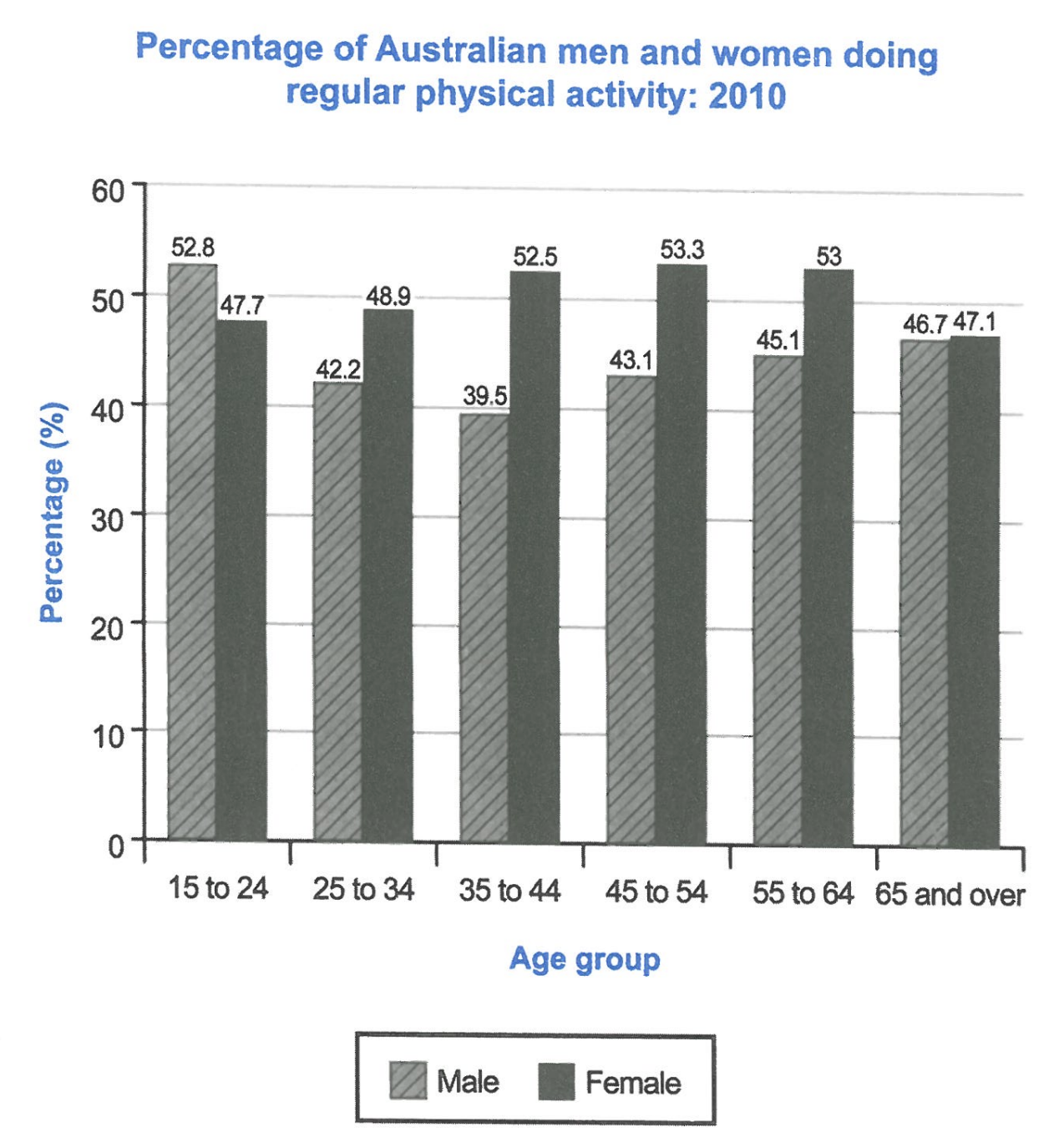
The bar chart below shows the percentage of Australian men and women in different age groups who did regular physical activity in 2010.
Summarise the information by selecting and reporting the main features, and make comparisons where relevant.
Student answer (Band 6.5)
The bar chart illustrates the pecentage of people in different age groups involved in regular physical acitivity in 2010. Women's involvement in physical activity is almost consistent across all age groups whearas men's involvement vary considerably.
52.8% of males and 47.7% of females between the age group of 15 and 24 were involved in physical activity. Men's interest over the next two age groups decreased to 42.2% and 39.5%, respectively. On the contrary, women's involvement increased to just under a half (48.9%) between 25 and 34 age group and just over half (52.5%) between 35 and 44 age group. Between the age of 45 and 54 men's interest rose in workout (43.1%), peaking upto 46.7% in the age group of 65 and over. Women's intereset remained consistent in the age groups of 45 to 54 and 55 to 64 averaging about just over half (53%). Women participation decreased in the last age group to 46.7% which is approximately the same as the men in that age group.
Overall, Men's particpation is the most in the first and the last age group and women's participation peaks in the age group of 45 to 54.
AI examiner evaluation
| Criterion | Band |
|---|---|
| Task Achievement / Task Response | 6.5 |
| Coherence and Cohesion | 6.5 |
| Lexical Resource | 6.0 |
| Grammatical Range and Accuracy | 6.0 |
| Overall | 6.5 |
Task Achievement / Task Response: Band 6.5
You identify the main contrast—that female participation is relatively steady while male participation varies—and support it with several accurate figures. The account of men falling from 52.8% to 39.5% before rising, and women reaching around 53% in middle age, captures important patterns. However, the overview is not fully precise: women peak at 53.3% among 45–54-year-olds, while the final figure for women is 47.1%, not 46.7%. The claim that men’s participation is highest in both the first and last groups is also misleading, since the first group is the male peak but the last is not. A more exact overview and clearer comparison of the overall gender pattern would strengthen the response further.
Coherence and Cohesion: Band 6.5
The response has a recognisable structure, moving from an opening summary to age-group details and then a concluding overview. Comparisons are generally easy to follow, and connectors such as “On the contrary” and “Between the age of 45 and 54” help signal shifts. However, the final overview repeats and partly conflicts with the opening, rather than synthesising the data accurately. Some linking is also mechanical, and the long middle paragraph combines several age groups and comparisons, making the progression less controlled. Grouping the male and female trends more systematically, then ending with a concise, consistent overview, would make the organisation clearer and cohesion more flexible.
Lexical Resource: Band 6.0
You use a reasonable range of vocabulary for describing trends, including “decreased,” “increased,” “peaking,” and “remained consistent.” This allows you to report the main movements without relying entirely on basic terms. Some choices are imprecise or unnatural for a chart, however: “men’s interest” and “women’s involvement” suggest motivation rather than the proportion participating, while “rose in workout” is not a natural collocation. There are also spelling errors, including “pecentage,” “acitivity,” “whearas,” “intereset,” and “particpation.” These do not prevent understanding, but they reduce accuracy and polish. Prefer consistent terms such as “participation rate” and check spelling carefully.
Grammatical Range and Accuracy: Band 6.0
You attempt both simple and more complex sentences, including comparisons across age groups, and the main meaning is usually clear. Some grammatical errors remain. For example, “men’s involvement vary” has a subject–verb agreement error, and “between the age group of 15 and 24” is an awkwardly formed age-range phrase. In “peaking upto 46.7%,” the construction and punctuation are not well controlled; the sentence also does not clearly state the relevant age group. Articles and prepositions are sometimes missing or misused in phrases such as “between 25 and 34 age group.” These issues rarely obstruct the message, but more accurate agreement and sentence construction would improve control.
See this exact question answered at other band scores. The same prompt compared across bands.
Browse more IELTS Writing model answers or get your own writing scored by the same AI examiner.