Band 4.5 IELTS Writing Task 1 Model Answer
Overall Band Score: 4.5 · Cambridge IELTS 12 · 2026-11-28
IELTS Writing Task 1 question
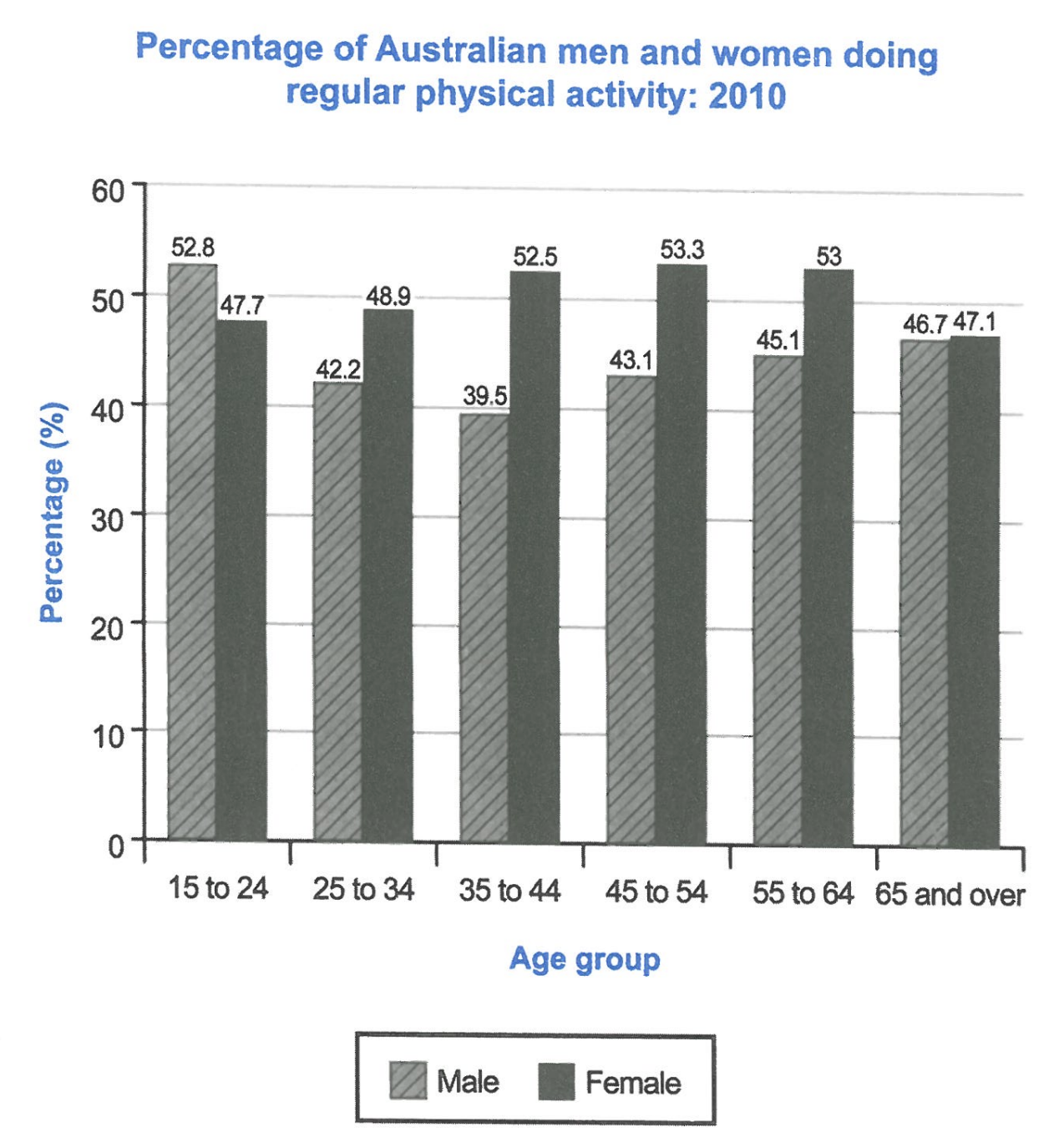
The bar chart below shows the percentage of Australian men and women in different age groups who did regular physical activity in 2010.
Summarise the information by selecting and reporting the main features, and make comparisons where relevant.
Student answer (Band 4.5)
The given task is a pictorial representation of the regular physical activity done by male and female of different age group belonging to a nation in the year 2010. Although, image has several pertinent points, the most significant factor is the percentage of fitness of different gender is equilibrium at the age of 65 and above.
To commence with, the percentage of male is 52.8% which is higher than females with 47.7% at the age group of 15 to 24. Moving further, at the age range of 25 to 34
AI examiner evaluation
| Criterion | Band |
|---|---|
| Task Achievement / Task Response | 3.5 |
| Coherence and Cohesion | 4.5 |
| Lexical Resource | 5.5 |
| Grammatical Range and Accuracy | 5.0 |
| Overall | 4.5 |
Task Achievement / Task Response: Band 3.5
The response identifies the chart’s subject and reports the first age group accurately: men were at 52.8%, compared with 47.7% for women. It also notes that the figures are close among people aged 65 and over, although “in equilibrium” is imprecise and the actual values are 46.7% and 47.1%. However, the response stops partway through the 25–34 comparison and gives no overview of the main pattern across the age groups. Most of the chart is therefore not summarised, and the task’s minimum length is not met: the response is 60 words short. To improve, complete the comparisons and highlight the key trends, including women’s higher activity rates in most age groups and the male low point at 35–44.
Coherence and Cohesion: Band 4.5
There is a basic attempt to organise the response: an opening statement is followed by a paragraph beginning “To commence with,” and “Moving further” signals a transition to another age group. These markers show some awareness of sequencing. However, the progression is not sustained because the response ends in the middle of a comparison, and there is no concluding overview to bring the information together. The opening also mixes a general introduction with a claimed main feature, rather than clearly separating an overview from detailed figures. Develop a complete sequence—introduction, overview, then grouped comparisons—and use transitions to show how the figures change across age groups.
Lexical Resource: Band 5.5
The response uses some task-related vocabulary, including “percentage,” “age group,” and “higher than,” so the chart’s subject is generally understandable. It also attempts more formal phrasing, such as “pertinent points” and “significant factor.” However, several choices are unnatural or imprecise: “pictorial representation” is cumbersome for a bar chart, “percentage of fitness” does not accurately describe the measure, and “in equilibrium” is not a natural way to say the figures are similar. “Male and female” would also be clearer as “men and women” when referring to people. Aim for precise chart language and familiar collocations, such as “the proportion who exercised regularly” and “the figures were almost equal.”
Grammatical Range and Accuracy: Band 5.0
The response attempts both a longer introductory sentence and comparison structures, including “which is higher than females,” and the main figures remain understandable. However, control is uneven. In “the percentage of male is 52.8%,” the singular noun phrase does not agree naturally with the intended plural group; “the percentage of men” would be clearer. The opening sentence also has awkward article and number choices in “male and female of different age group,” while “Although, image has” has faulty punctuation and omits an article. The final sentence is incomplete, leaving the comparison unfinished. Use complete sentences with consistent plural forms and articles, and check punctuation after introductory clauses.
See this exact question answered at other band scores. The same prompt compared across bands.
Browse more IELTS Writing model answers or get your own writing scored by the same AI examiner.