Band 5.5 IELTS Writing Task 1 Model Answer
Overall Band Score: 5.5 · Cambridge IELTS 12 · 2026-11-28
IELTS Writing Task 1 question
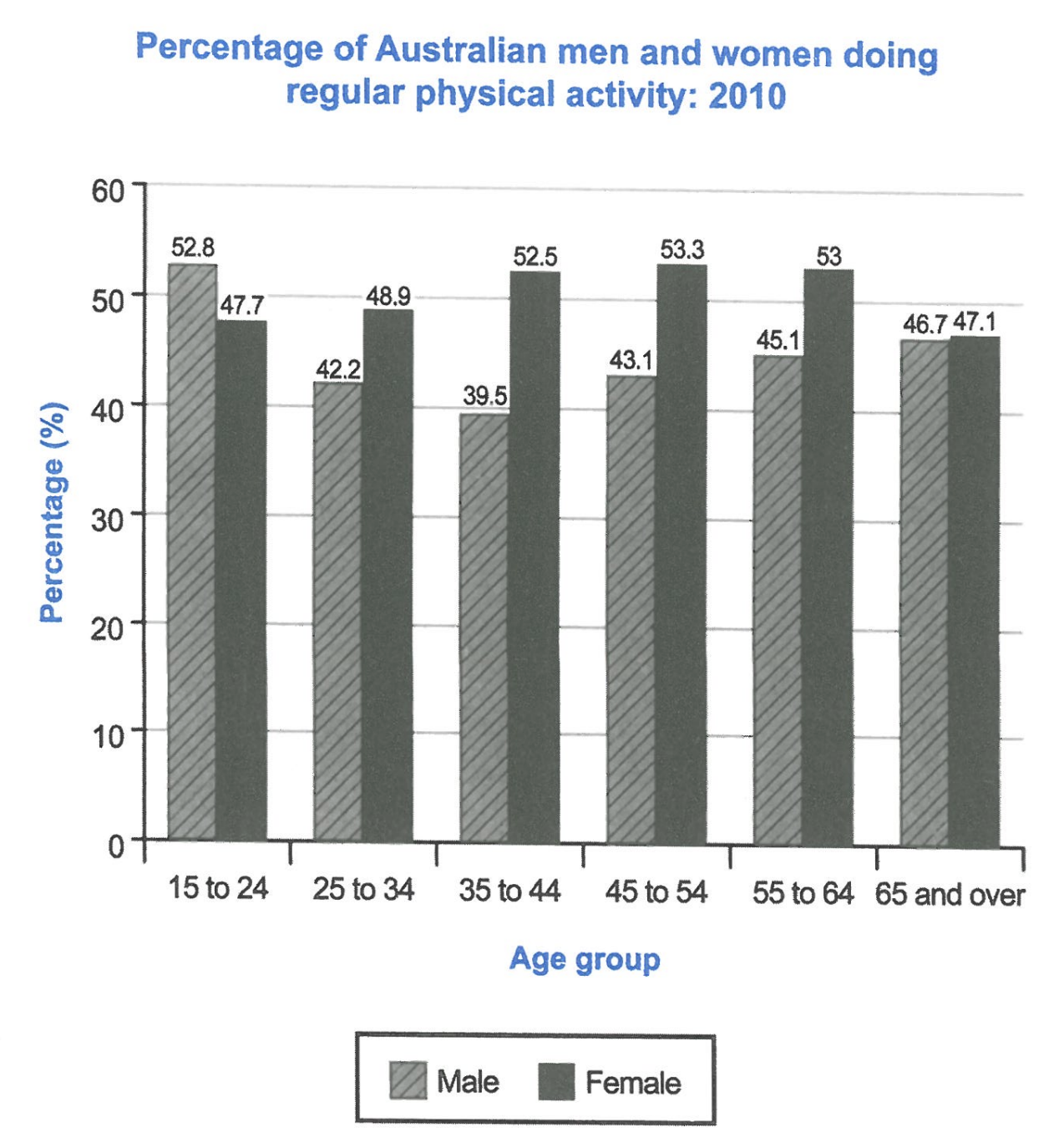
The bar chart below shows the percentage of Australian men and women in different age groups who did regular physical activity in 2010.
Summarise the information by selecting and reporting the main features, and make comparisons where relevant.
Student answer (Band 5.5)
The given pictorial representation is percentage of physical activity done on daily basis by different gender of multiple age groups belonging to a nation in 2010. Although, the image has several pertinent points, the most significant factor is the older age group ranging 65 and over has a similar percentage of people in fitness.
To commence with, the age group between 15 and 24 has somewhat neaby percentage of physical activity males has 52.8%, while female following by 47.7%. Moving on further, the next group of folks has male enthusiast of 42.2%, whereas female fitness freaks are 48.9%. It is evident that, in the age group of 35to 44 males daily activities has recorded the lowest to 39.5%, whereas females fitness percentage rose to 52.5%.
Analyzing the data further, it is clear that in age range of 45 to 54, males are bit more active than the previous age group a slight increase has been observed by 43.1%, perhaps the females recorded with highest percentage by 53.3%. Continuing to next set of age 55 to 64, it is observed that both the genders are inclined towards fitness, males scoring to 45.1% and females leading by 53%. However, it is surprising that people aging from 65 and over has a equivalent physical fitness, males being at 46.7% and females at 47.1%.
AI examiner evaluation
| Criterion | Band |
|---|---|
| Task Achievement / Task Response | 5.5 |
| Coherence and Cohesion | 6.0 |
| Lexical Resource | 5.5 |
| Grammatical Range and Accuracy | 5.5 |
| Overall | 5.5 |
Task Achievement / Task Response: Band 5.5
You report the figures for all six age groups accurately, and the comparison between men and women is generally clear. You also identify the male low point at 35–44 and the female peak at 45–54. However, the overview is limited: saying the oldest group has a “similar percentage” is accurate, but it does not summarise the broader pattern that men lead only among the youngest adults, while women lead in every other group. Some descriptions, such as “both the genders are inclined towards fitness,” are vague rather than analytical. To strengthen the response, give a concise overview of the main contrasts and trends before detailing the figures, and make sure each selected feature clearly helps summarise the chart.
Coherence and Cohesion: Band 6.0
The response has a clear overall arrangement: an introduction and overview are followed by two paragraphs describing the age groups in sequence. Linking phrases such as “Moving on further” and “Analyzing the data further” help signal progression, and the reader can follow the comparisons. However, several transitions feel mechanical, and the repeated pattern of introducing each age group and listing two figures makes the report read more like a sequence of notes than a synthesis. The overview is also attached to the introduction without clearly setting out the main trends. Use more purposeful grouping—for example, contrast the youngest group with the remaining groups—and vary references to men and women to make the progression smoother.
Lexical Resource: Band 5.5
You use a range of vocabulary related to the topic, including “percentage,” “age range,” “recorded,” and “increase,” and the intended meaning is usually understandable. However, several choices are inaccurate or too informal for an academic chart report. “Fitness freaks” and “folks” are conversational, while “physical activity done on daily basis” and “inclined towards fitness” are awkward or imprecise collocations. There are also spelling and word-form slips, such as “neaby” and “aging,” that reduce control. Aim for precise, neutral reporting language and avoid decorative synonyms that do not fit the data. Terms such as “participation in regular physical activity” and “the proportion of women” would be more natural and consistent.
Grammatical Range and Accuracy: Band 5.5
You attempt both simple and more complex sentences, including comparisons with “whereas” and clauses introduced by “that.” The meaning is generally recoverable, but errors in sentence construction and agreement occur often enough to make some statements awkward. For example, “the age group … has male enthusiast of 42.2%” does not form a clear grammatical comparison, and “males daily activities has recorded” has problems with possession and subject–verb agreement. In “a slight increase has been observed by 43.1%,” the structure does not clearly express who or what increased. Work on complete sentence patterns, accurate singular and plural agreement, and punctuation around introductory clauses. Clearer structures will let your comparisons come through more reliably.
See this exact question answered at other band scores. The same prompt compared across bands.
Browse more IELTS Writing model answers or get your own writing scored by the same AI examiner.