Band 6.0 IELTS Writing Task 1 Model Answer
Overall Band Score: 6.0 · Cambridge IELTS 12 · 2026-11-05
IELTS Writing Task 1 question
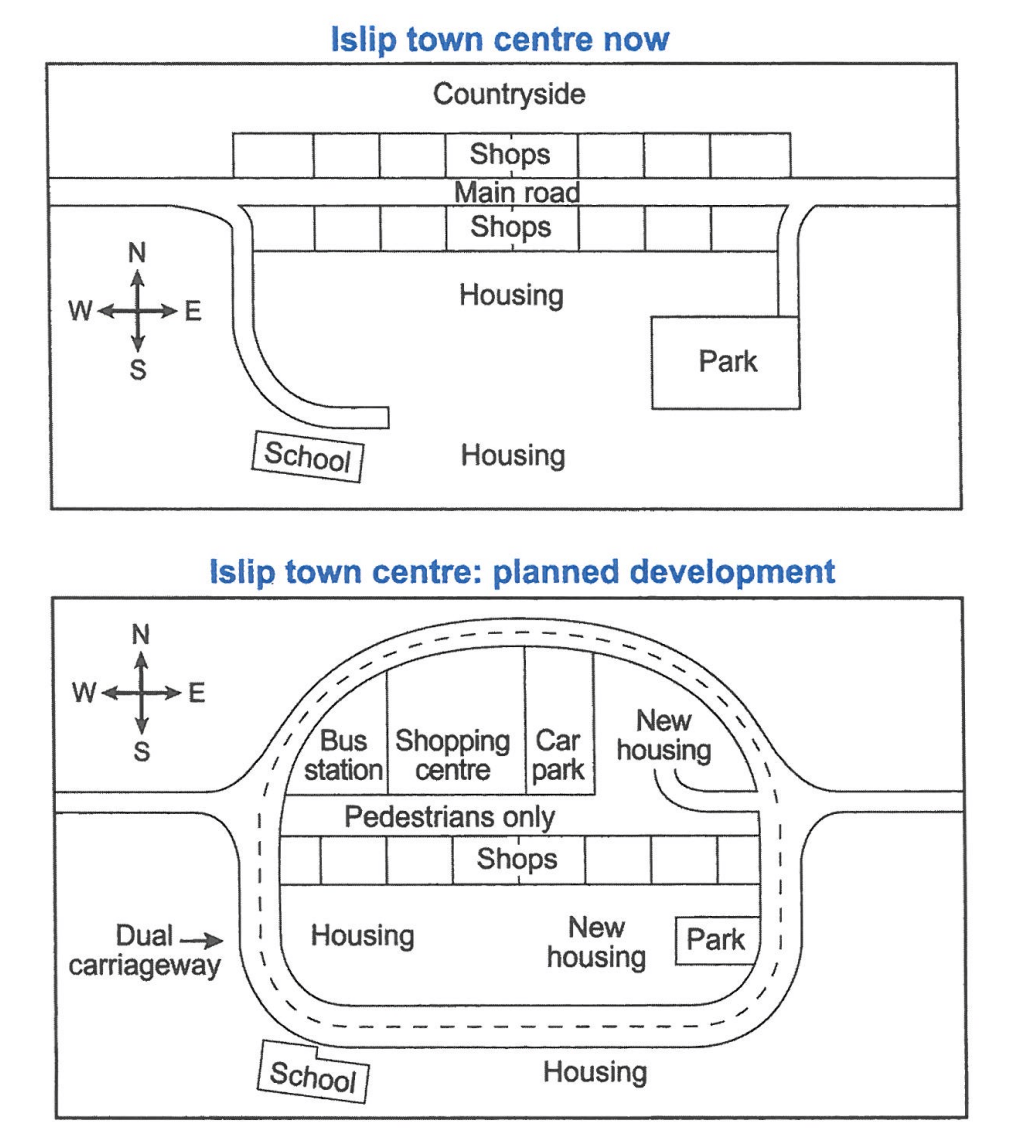
The maps below show the centre of a small town called Islip as it is now, and plans for its development.
Summarise the information by selecting and reporting the main features, and make comparisons where relevant.
Student answer (Band 6.0)
The two maps illustrates the current layout of the centre of a small town of Islip and future plans for its development.
Overall, The town has a main road with shops on both sides of the road, which will be replaced with new facilities and housing. The town centre will be sorrounded by a ring road.
At present, the main road enter the town from the west ends at the west with shops on both sides. it has two connecting roads one at the start that bends in west to the school, at south-west, and another access road in the east that curves to the park, at south-east. The housing is in the middle and countryside is that top-middle of the town.
In future, a carriageway will enter the town from west and leaves to the east in the shape of a ring road. The main road will be replaced into a pedestrian zone, and shops on north-west will be replaced with a bus station, shopping centre and car park. The new housing will be build next to these amenities and in south-east next to the park.
AI examiner evaluation
| Criterion | Band |
|---|---|
| Task Achievement / Task Response | 6.0 |
| Coherence and Cohesion | 6.5 |
| Lexical Resource | 6.0 |
| Grammatical Range and Accuracy | 5.5 |
| Overall | 6.0 |
Task Achievement / Task Response: Band 6.0
You identify the main transformation: the existing road becomes pedestrian-only, northern shops give way to new facilities, and a ring road is planned. The overview also captures the broad shift in the town centre. However, some details are inaccurate or incomplete. The current main road is described as entering from the west and ending there, although it runs east–west through the centre; the western side road curves towards the school, rather than bending west. The future description omits the bus station, shopping centre and car park’s west-to-east arrangement, and does not explain that the southern shops remain or that the school and some housing stay outside the loop. Develop these comparisons more precisely to make the account more complete.
Coherence and Cohesion: Band 6.5
The response has a clear four-part structure: introduction, overview, present layout and planned changes. This gives the reader a sensible progression, and phrases such as “At present” and “In future” help distinguish the two maps. The overview also provides a useful organising summary before the details. To make the progression more consistently clear, group features by location and compare what changes with what remains, rather than listing several roads and facilities in long sentences. For example, the final paragraph could move from the northern facilities to the southern area and then mention the school outside the loop. Some references, such as “these amenities,” are understandable but could be more explicit.
Lexical Resource: Band 6.0
You use a suitable range of map vocabulary, including “layout,” “connecting roads,” “pedestrian zone,” “carriageway” and “ring road.” These terms communicate the main changes, and the response generally remains understandable. Some choices are imprecise or awkward: “enter the town” and “leaves to the east” do not describe the road’s route as naturally as “runs through” and “continues east”; “access road” is less specific than “side road.” There are also spelling errors in “sorrounded” and “build,” and “amenities” is rather general when the facilities can be named. Aim for precise location and movement vocabulary, and check spelling and collocations during revision.
Grammatical Range and Accuracy: Band 5.5
You attempt both simple and more complex sentences, including the overview clause “which will be replaced with new facilities and housing” and the description of roads that “bends” and “curves.” Meaning is usually recoverable, but some grammatical errors recur. Subject–verb agreement is incorrect in “The two maps illustrates” and “the main road enter”; the road “ends at the west” is also an unclear construction. The future passive form “will be build” should be “will be built,” and the sentence beginning “it has” needs a capital letter. Capitalisation after the overview’s “Overall,” is also inconsistent. Review agreement, passive forms and sentence punctuation, while retaining your attempts at varied structures.
See this exact question answered at other band scores. The same prompt compared across bands.
Browse more IELTS Writing model answers or get your own writing scored by the same AI examiner.