Band 6.5 IELTS Writing Task 1 Model Answer
Overall Band Score: 6.5 · Cambridge IELTS 12 · 2026-11-05
IELTS Writing Task 1 question
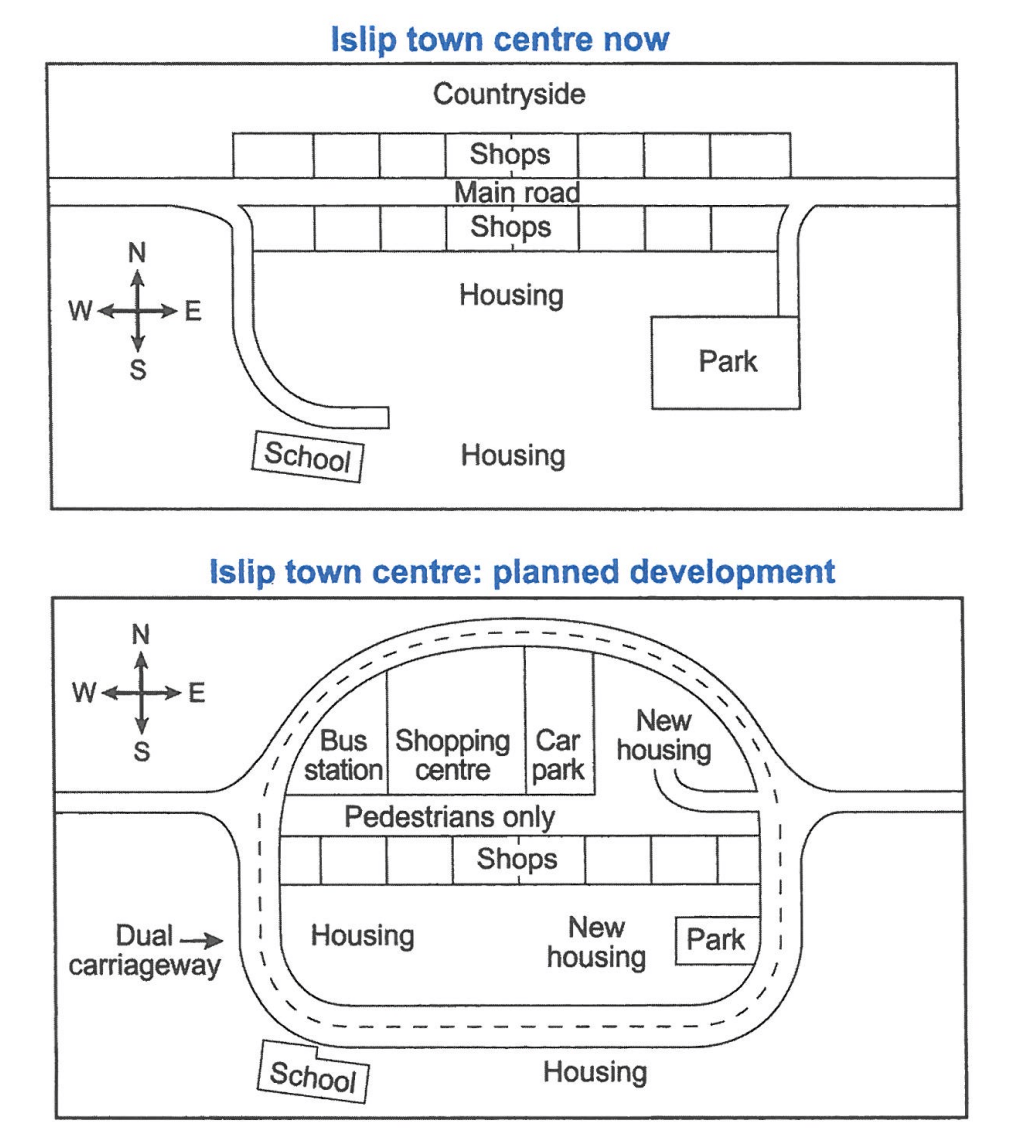
The maps below show the centre of a small town called Islip as it is now, and plans for its development.
Summarise the information by selecting and reporting the main features, and make comparisons where relevant.
Student answer (Band 6.5)
The two maps display the centre of the small town of Islip at present and changes that are planned for its development.
Overall, the town will be redeveloped into a mostly pedestrian area surrounded by a ring road. The northren shops will be replaced by new facilities, and more housing will be built.
At present, the town has a main road that enters from the west and ends in the east with, shops on both sides of it. The two connecting roads leaves the main road, one leads to the school in the south-west and the other give access to the park in the south-east. Housing lies to the south of the shops in the centre, and south of the town, and the countryside lies to the north.
Development plan will include a dual carriageway that enters the town from the west, forms a ring road around the centre and leaves to the east. The main road will be become a pedestrian-only street, and the shops to the north- of it will be replaced by a bus station, a shopping centre and a car park. New housing will be build in the north-east and south-east next to the park.
AI examiner evaluation
| Criterion | Band |
|---|---|
| Task Achievement / Task Response | 7.0 |
| Coherence and Cohesion | 7.0 |
| Lexical Resource | 6.5 |
| Grammatical Range and Accuracy | 6.0 |
| Overall | 6.5 |
Task Achievement / Task Response: Band 7.0
You provide a clear overview of the main changes, identifying the pedestrian-only centre, the surrounding ring road and the replacement of the northern shops with new facilities. You also compare the current and planned layouts and include several accurate locations, such as the school and park. This gives the response a clear focus and addresses the task. However, some details are over-generalised or incomplete: the plan retains the southern shops, and the southern area includes existing housing, new housing and a reduced park, not simply new housing beside the park. The school and housing to its south also remain outside the carriageway loop. Including these distinctions would make the key features more fully supported and precise.
Coherence and Cohesion: Band 7.0
The response is organised into a clear introduction, overview, description of the current map and account of the proposed development. This creates a logical progression, and linking expressions such as “Overall,” “At present” and “Development plan” help signal each stage. The reader can follow the comparison without difficulty. To strengthen cohesion further, connect related details more smoothly and avoid presenting the planned changes as a list. For example, explain how the southern shops and the areas around them relate to the pedestrian street and the ring road. A few transitions between the current and future layouts could also be more precise, but the overall organisation is clear and effective.
Lexical Resource: Band 6.5
You use a suitable range of map vocabulary, including “redeveloped,” “pedestrian-only,” “dual carriageway,” “ring road” and “access,” and these choices communicate the main changes clearly. There is some flexibility in describing locations and movement, although a few word choices and spelling slips reduce precision. “The two connecting roads leaves” is a grammatical issue, but “ends in the east” is an imprecise description of the main road, which runs across the town. “Northren” is misspelled, and “will be build” uses the wrong word form. To show more control, use exact spatial language such as “runs east–west” and “to the northeast of the car park,” and check spelling and collocations carefully.
Grammatical Range and Accuracy: Band 6.0
You use a mix of simple and more complex structures, including the overview sentence beginning “Overall” and clauses describing where roads lead. Most meanings remain clear, but some grammatical errors recur. In “the two connecting roads leaves,” the plural subject requires “leave”; “the other give access” should be “gives access.” The future construction “will be become” contains an unnecessary “be,” while “will be build” needs the past participle “built.” There is also an awkward comma in “in the east with, shops.” These errors do not prevent understanding, but they show that control is not yet consistent. Proofread verb agreement and future forms, and practise combining accurate clauses with varied sentence structures.
See this exact question answered at other band scores. The same prompt compared across bands.
Browse more IELTS Writing model answers or get your own writing scored by the same AI examiner.