Band 5.0 IELTS Writing Task 1 Model Answer
Overall Band Score: 5.0 · Cambridge IELTS 12 · 2026-11-08
IELTS Writing Task 1 question
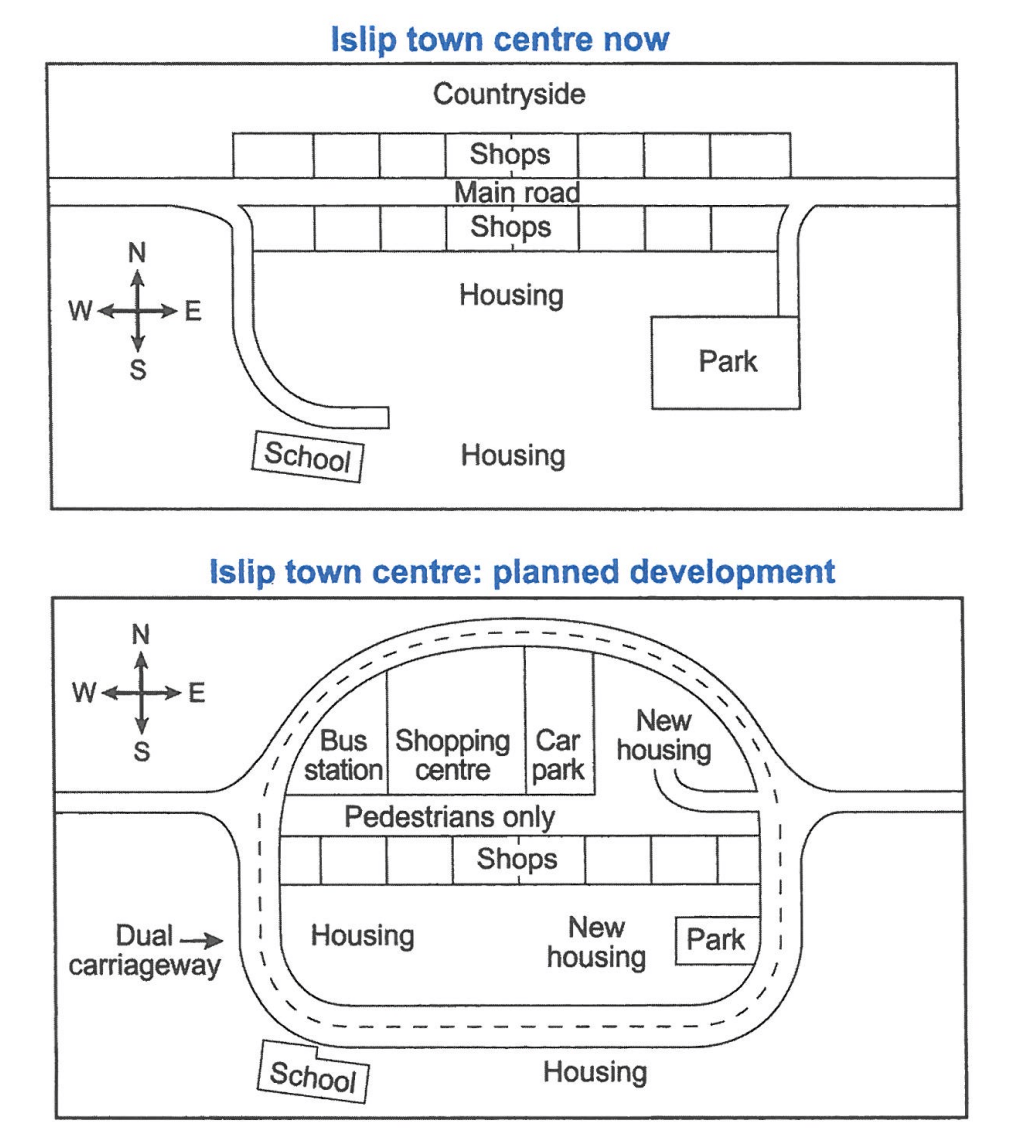
The maps below show the centre of a small town called Islip as it is now, and plans for its development.
Summarise the information by selecting and reporting the main features, and make comparisons where relevant.
Student answer (Band 5.0)
The map below shows the centre of a small town called Islip as it is now, and plans for its development.
Firstly, the map shows currently condition of Islip town centre.The map shows west side to east side that is started from main road and above the main road the many shops is here furthermore,on top the area of countryside is situated.Than shows the below side of main road that is many shops is here additionally, less than main road and shops that is housing society is situated.The west side of town and bottom side of main road situated in school furthermore, the east side of town and lower than man road its park is here.
The map shows the Islip town centre after development.It's quite different from before development.So, lets start from west to east.Arround the town main road is here from all of west to east and inner side of main road that's here nort side is Bus station, Shopping centre, Car parking and New housing.So, lets write about south side of the town that is shops, housing and park is situated.Additionally,the area of pedestrians is here between the north and south side.Furthermore, the bottom side of the road school and housing s situated.
The development Islip town centre is best and beautiful than without development islip town centre.
AI examiner evaluation
| Criterion | Band |
|---|---|
| Task Achievement / Task Response | 5.0 |
| Coherence and Cohesion | 5.5 |
| Lexical Resource | 5.0 |
| Grammatical Range and Accuracy | 4.5 |
| Overall | 5.0 |
Task Achievement / Task Response: Band 5.0
You identify the two maps and report several relevant features, including the existing shops, countryside, housing, school and park, as well as the planned bus station, shopping centre and pedestrian area. However, the comparison is only partial: the major change of a dual-carriageway loop around the centre is described as a “main road” and its enclosing layout is not made clear. Some locations are also inaccurate or vague; for example, the school and housing remain outside the loop to the south, rather than simply being “the bottom side of the road.” The overview is limited, and the final claim that the plan is “best and beautiful” is an unsupported opinion rather than a summary of the main changes. Select and compare the most significant changes more precisely.
Coherence and Cohesion: Band 5.5
The response has a basic overall structure: it first describes the current map and then turns to the planned development. Phrases such as “after development” and “from west to east” help signal the shift and intended direction. However, progression within the paragraphs is often difficult to follow because ideas are joined in long, loosely connected sentences, and “furthermore” and “additionally” are used repeatedly without always showing a clear relationship. The repeated “So, lets start” phrasing is conversational and does not help organise a map report. Improve cohesion by grouping features by area, using clear contrasts between the two maps, and separating ideas into shorter sentences with accurate referencing.
Lexical Resource: Band 5.0
You use some relevant map vocabulary, including “countryside,” “housing,” “pedestrians,” and “development,” so the reader can recognise the topic and several features. However, the range is limited and some choices are inaccurate or unnatural, which makes parts of the description unclear. For instance, “main road” does not accurately name the planned dual carriageway, “Car parking” is less precise than the map label “car park,” and “housing society” does not convey the simple map label “housing.” Repetition of “map,” “town,” and “side” also limits precision. Use the map’s labels where appropriate and practise location language such as “to the north of,” “alongside,” and “within the loop.”
Grammatical Range and Accuracy: Band 4.5
The response attempts to connect ideas in longer sentences, but these structures are often faulty, and simple sentence patterns dominate. Errors in agreement and sentence construction appear in examples such as “the many shops is here” and “shops, housing and park is situated.” There are also problems with articles, prepositions and verb forms, as in “shows currently condition” and “the east side of town and lower than man road its park is here.” Missing spaces after full stops and inconsistent punctuation further affect readability. These errors sometimes make relationships between locations difficult to understand. Build accuracy first with clear subject–verb sentences, then combine related details using controlled clauses such as “while” or “whereas.”
See this exact question answered at other band scores. The same prompt compared across bands.
Browse more IELTS Writing model answers or get your own writing scored by the same AI examiner.