Band 6.0 IELTS Writing Task 1 Model Answer
Overall Band Score: 6.0 · Cambridge IELTS 12 · 2026-11-08
IELTS Writing Task 1 question
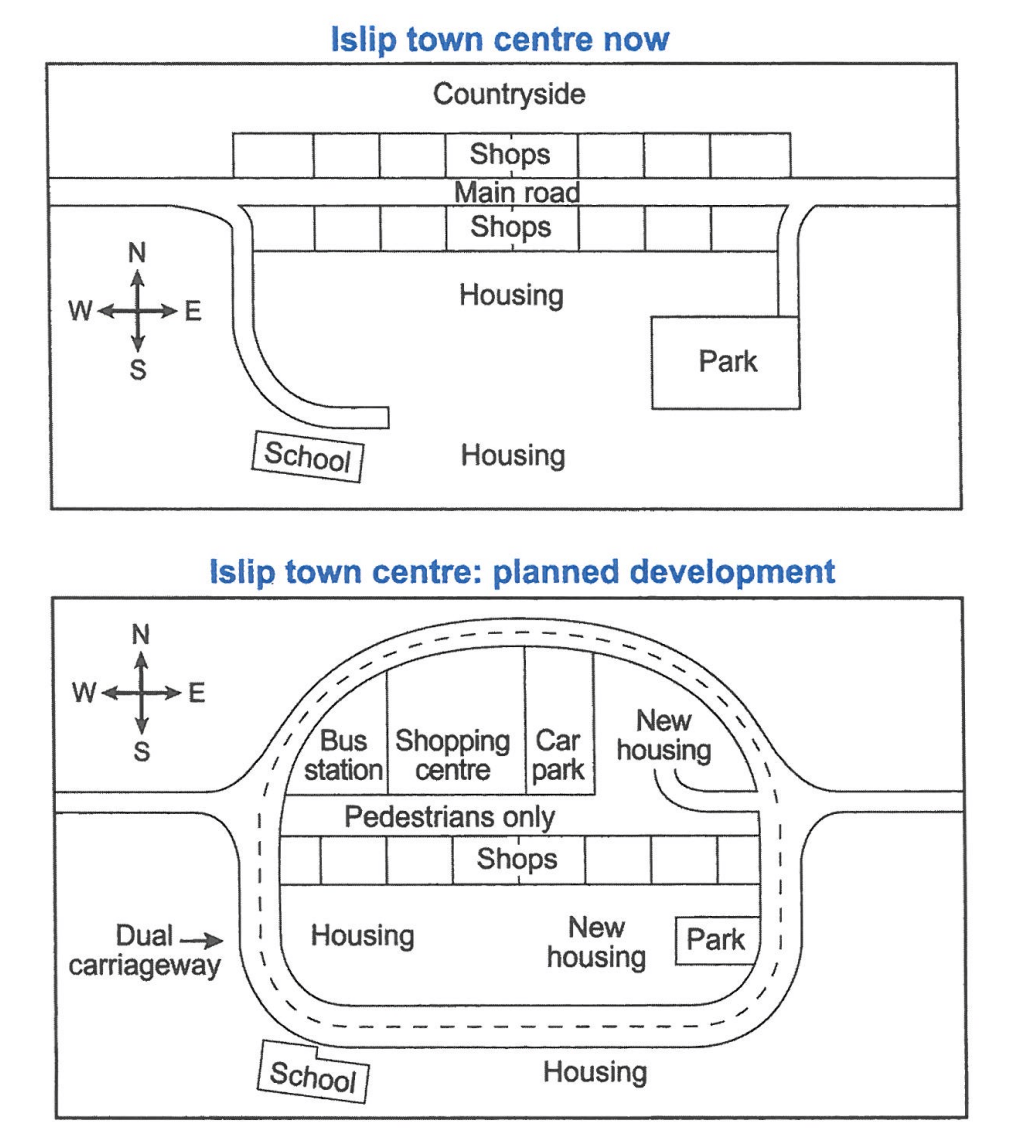
The maps below show the centre of a small town called Islip as it is now, and plans for its development.
Summarise the information by selecting and reporting the main features, and make comparisons where relevant.
Student answer (Band 6.0)
The maps demonstrate the current picture of Islip town centre and how it will look like after the development.
Overall, it is clear that the outlook of the centre of Islip will be completely transformed when it will go through the development process.
Currently, there are some shops in both sides of the main road. Then there are some residential areas in the middle of the town. Besides, the school is situated in the southern part of Islip, whereas a part is in the Eastern portion of that town.
In the new map, it is planned that a dual carriageway will be constructed in the centre of Islip town. In the northern part, bus station, shopping centre, and car park will be built. Apart from that new housing society will be constructed in the eastern part adjacent to car park and the park. There will be a road which will be accessed by pedestrains only. Though the size of the park will be decreased as there will be more housing and shops in the town centre, the school will be remained in the same place.
AI examiner evaluation
| Criterion | Band |
|---|---|
| Task Achievement / Task Response | 6.5 |
| Coherence and Cohesion | 6.5 |
| Lexical Resource | 6.0 |
| Grammatical Range and Accuracy | 5.5 |
| Overall | 6.0 |
Task Achievement / Task Response: Band 6.5
You identify the broad transformation and report several key features, including the new dual carriageway, the northern bus station, shopping centre and car park, and the reduced park. This gives the response a relevant overview and covers the present and planned layouts. However, some details are incomplete or unclear: the current school is described as being in the south, but its position relative to the housing and side road is not explained; the planned pedestrian-only route is incorrectly described as a road, and the southern shops and the retained housing are not clearly reported. The claim that the carriageway is constructed “in the centre” also misrepresents its role as a loop around the centre. More precise comparisons and fuller coverage of what remains and changes would strengthen the summary.
Coherence and Cohesion: Band 6.5
The response has a clear overall sequence: an introduction, an overview, a description of the current map and then the proposed plan. This makes the main stages easy to follow, and linking expressions such as “Overall,” “Besides,” and “Though” help connect ideas. However, some connections are mechanical or unclear. “Whereas a part is in the Eastern portion” does not establish a meaningful contrast, and “Apart from that” introduces the new housing without a clear relationship to the preceding list. The final sentence combines the park’s reduction, added housing and shops, and the school’s location, making the comparison less focused. Grouping features by area and using clearer references to the two maps would improve progression and cohesion.
Lexical Resource: Band 6.0
You use an adequate range of vocabulary for describing maps, including “residential areas,” “adjacent to,” “constructed,” and “decreased.” These choices communicate the general changes, and some variation avoids excessive repetition. However, several expressions are imprecise or unnatural for this task: “current picture” and “outlook” are vague, while “housing society” is not the appropriate term for the mapped housing areas. “A road which will be accessed by pedestrians only” also does not accurately name the pedestrian-only street. There is a spelling error in “pedestrains,” and “in both sides” is an unsuitable phrase. More precise map vocabulary, such as “located,” “retained,” and “pedestrianised,” would make the description more natural and exact.
Grammatical Range and Accuracy: Band 5.5
You attempt a mix of simple and complex sentences, including a contrast clause beginning “Though” and a comparison using “whereas.” Most of the intended meaning remains understandable, but some grammatical errors recur. For example, “how it will look like” combines two incompatible patterns; use either “what it will look like” or “how it will look.” The future clause “when it will go through” should use “when it goes through,” and “the school will be remained” has an incorrect passive construction. Articles are also missing in “bus station, shopping centre, and car park,” and “in both sides” needs a different preposition. Greater control of verb forms, articles and sentence patterns would make the writing more accurate.
See this exact question answered at other band scores. The same prompt compared across bands.
Browse more IELTS Writing model answers or get your own writing scored by the same AI examiner.