Band 5.5 IELTS Writing Task 1 Model Answer
Overall Band Score: 5.5 · Cambridge IELTS 12 · 2026-11-08
IELTS Writing Task 1 question
The maps below show the centre of a small town called Islip as it is now, and plans for its development.
Summarise the information by selecting and reporting the main features, and make comparisons where relevant.
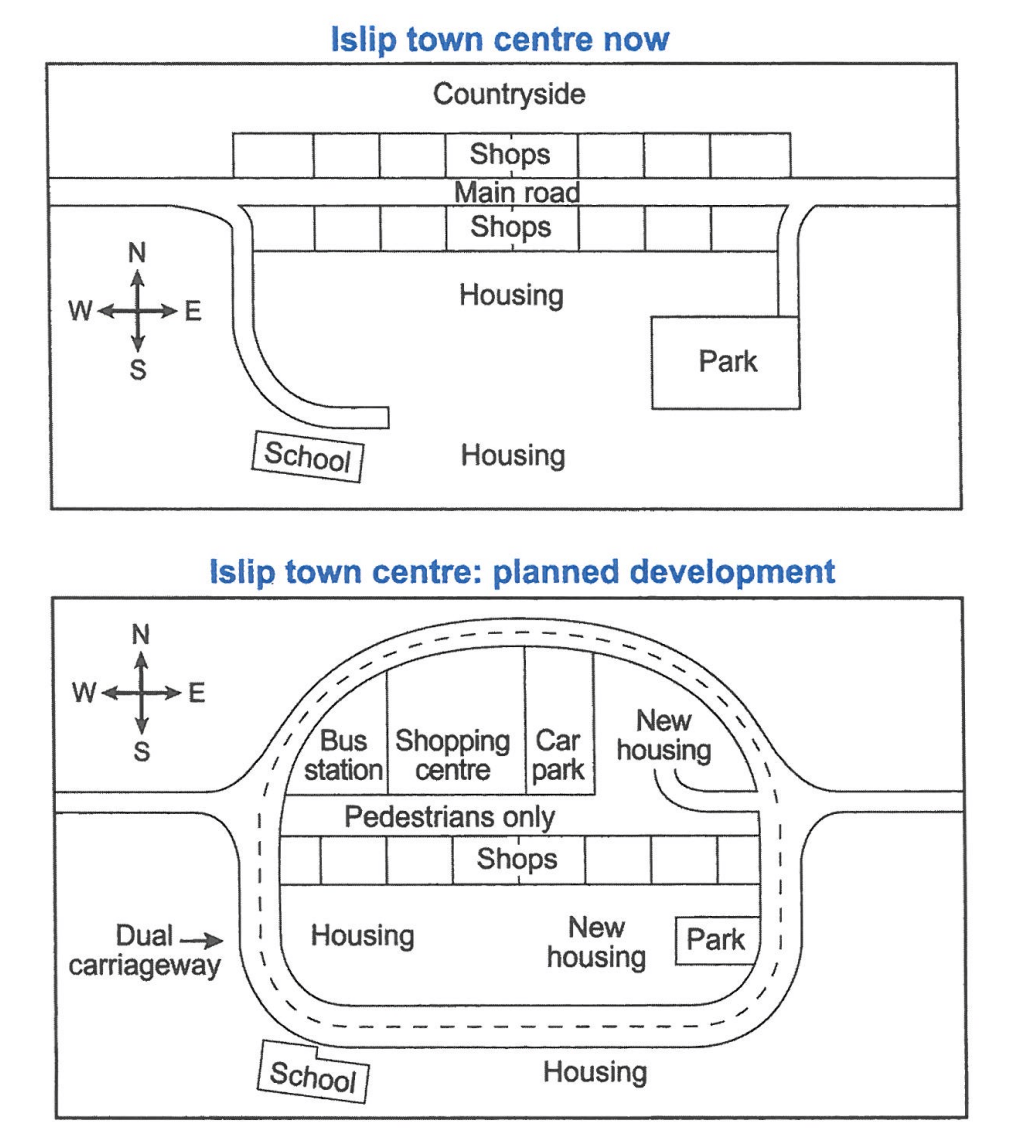
Student answer (Band 5.5)
The islip is a small town ,now it has a main road road crossing the town from west to east ,the country side is on the north side and its housing is on the south, the shops are spread along the sides of the main road ,and there is a park located on the far east ,the housing side, where the school is also located but on its west side.
The town is planning for some major changes as parts of the its developement , where in the new schema,the road will cross around the country and the shops will be located in the center going from the entry to the end of the town,on the north side you find the bus station,shopping centre,car park, coming from the north west to the centre,the housing are spread inside the road circle ,most of them are new,
mainly the new planned developement ,is giving a more flexible accessibility to the locations,and has pedestrian access to the shops,
In the otherhand the school is located in dangerous position where it has diffcult access point for pedestrians .
mostly we can see that this is a good design but it may require more changes imporovements to make it a good habitable town.
AI examiner evaluation
| Criterion | Band |
|---|---|
| Task Achievement / Task Response | 5.5 |
| Coherence and Cohesion | 5.5 |
| Lexical Resource | 5.0 |
| Grammatical Range and Accuracy | 5.0 |
| Overall | 5.5 |
Task Achievement / Task Response: Band 5.5
You identify the broad contrast between the current town and its planned redevelopment, including the east–west main road, shops, park, bus station, shopping centre and car park. However, the account only partially covers the maps: it does not clearly explain that the central road becomes pedestrian-only, that a dual carriageway loops around the centre, or which existing features remain and which change. Some details are inaccurate or unclear, such as saying the new road goes “around the country” and that shops are “located in the center”; the northern facilities are arranged along the north side of the pedestrian street. The final comments about the design being good and the school being dangerous are unsupported opinions, rather than map information. A clearer overview and more precise comparisons would strengthen the response.
Coherence and Cohesion: Band 5.5
There is some organisation: the opening describes the town as it is now, followed by a section on the proposed changes. This gives the reader a basic sense of progression. However, the response is largely presented as long, loosely connected sentences, and the sequence of locations is sometimes difficult to follow. For example, “on the north side you find the bus station, shopping centre, car park, coming from the north west to the centre” does not clearly show how these features are arranged. Linking phrases such as “In the otherhand” are inaccurate, while repeated use of “and” creates run-on sentences. Use separate paragraphs for the current and planned maps, and organise each description by direction or by what changes and remains.
Lexical Resource: Band 5.0
You use some relevant map vocabulary, including “main road,” “bus station,” “shopping centre,” “car park” and “pedestrian access,” so the topic is generally recognisable. However, the range is limited and several word choices or collocations are imprecise, which sometimes makes the description hard to interpret. For instance, “the road will cross around the country” does not accurately express a road encircling the town, and “the shops will be located in the center” misrepresents their position. There are also noticeable spelling and word-form errors, including “developement,” “imporovements” and “diffcult.” Aim for precise location language and check spelling; terms such as “surround,” “north of,” and “remain” would help describe the plan accurately.
Grammatical Range and Accuracy: Band 5.0
The response attempts to combine ideas using longer sentences, but these structures are often faulty, and errors frequently make relationships between features unclear. The opening, for example, joins several clauses with commas: “The islip is a small town, now it has a main road…” This creates a run-on sentence. There are also problems with articles, agreement and sentence construction, as in “the housing are spread,” and “where in the new schema, the road will cross…” Capitalisation and punctuation are inconsistent, including the lowercase “islip” and spaces before commas. Use shorter, complete sentences with a clear subject and verb, and check singular/plural agreement and punctuation. More accurate control of basic sentence patterns would make your map comparisons easier to understand.
See this exact question answered at other band scores. The same prompt compared across bands.
Browse more IELTS Writing model answers or get your own writing scored by the same AI examiner.