Band 4.5 IELTS Writing Task 1 Model Answer
Overall Band Score: 4.5 · Cambridge IELTS 12 · 2026-11-09
IELTS Writing Task 1 question
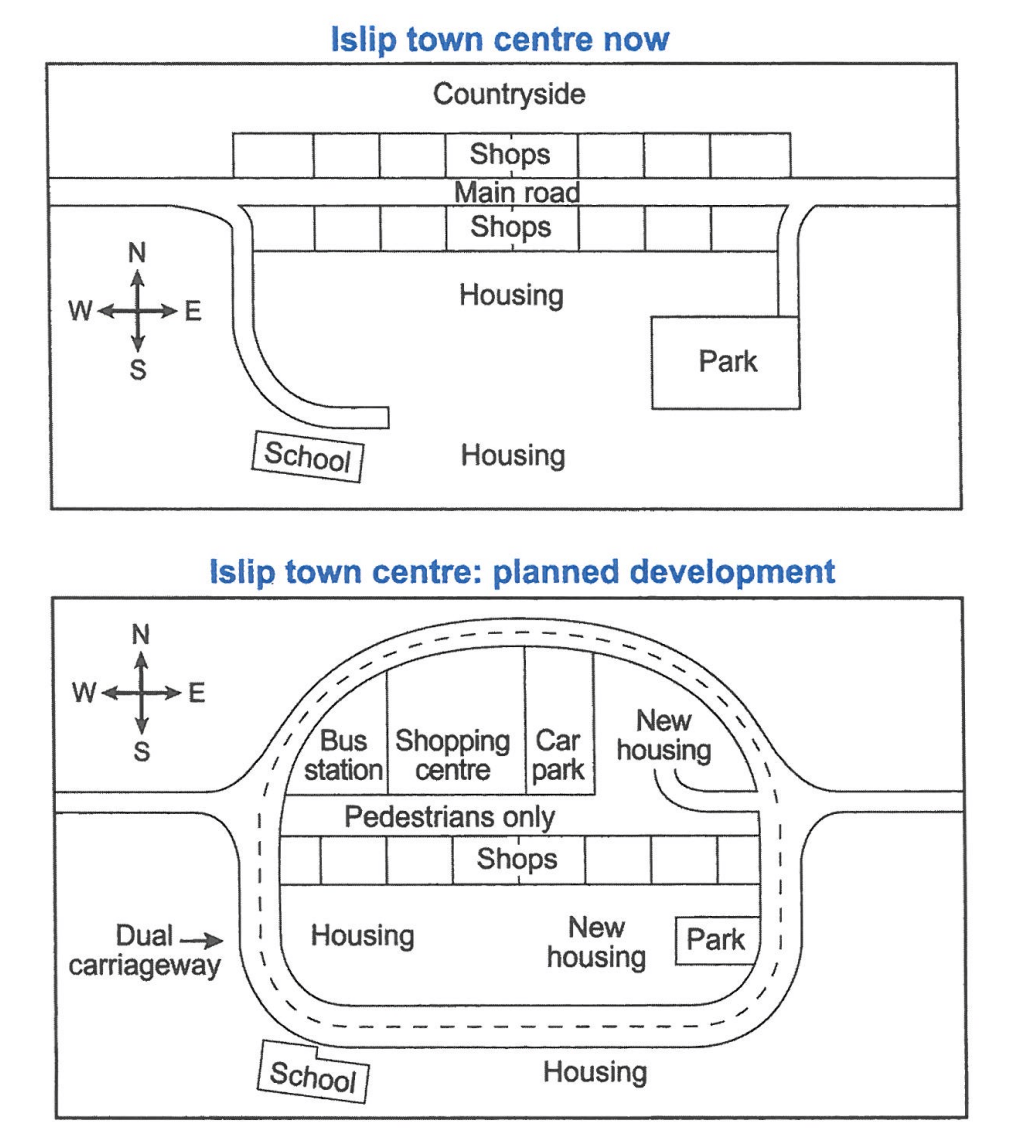
The maps below show the centre of a small town called Islip as it is now, and plans for its development.
Summarise the information by selecting and reporting the main features, and make comparisons where relevant.
Student answer (Band 4.5)
there is a two maps given in the picture show's the center of a small town which is known by name Islip In the first picture map show's the center situation of the town center amd in the next picture it show's how the town transform after development
In the current picture there is only a few shops present around tge both sides of main road which can be transform into various addition of bus station , shopping center and car park in the north side of the town and convert main road into walking street only for children along with addition of new housing socities
AI examiner evaluation
| Criterion | Band |
|---|---|
| Task Achievement / Task Response | 4.0 |
| Coherence and Cohesion | 5.0 |
| Lexical Resource | 5.0 |
| Grammatical Range and Accuracy | 4.5 |
| Overall | 4.5 |
Task Achievement / Task Response: Band 4.0
You identify the two maps as showing Islip before and after development, and you mention several genuine planned changes: the bus station, shopping centre, car park and pedestrian-only street. However, the response covers the task only minimally. It gives no clear overview of the most important changes and omits major features, including the dual-carriageway loop, the retained southern shops, the reduced park, and the school and housing that remain outside the loop. The description of the pedestrian street as being “only for children” is inaccurate; it is for pedestrians generally. The response is also 44 words below the required minimum, leaving the comparison substantially underdeveloped. To improve, report the main changes accurately and organise them into a fuller comparison of the northern and southern areas.
Coherence and Cohesion: Band 5.0
There is a basic sequence from the current map to the planned development, signalled by phrases such as “In the current picture” and “in the next picture.” This gives the reader a general sense of the comparison. However, the response consists of two long, loosely connected sentences, with no paragraphing or clear progression through the map’s features. The second sentence combines existing shops, new facilities and the pedestrian street without clearly separating what is removed, retained or added. Use a brief overview followed by organised details—for example, describe the northern changes first and then the southern area. Clear sentence boundaries and more precise linking would make the information easier to follow.
Lexical Resource: Band 5.0
You use some relevant map vocabulary, including “bus station,” “shopping center,” “car park” and “main road,” so the reader can identify several planned features. However, the range is limited and some wording is inaccurate or awkward, such as “the center situation,” “various addition” and “walking street.” “Only for children” also mislabels the pedestrian-only street. Spelling and word-form errors, including “amd,” “tge” and “socities,” further reduce clarity. Aim for precise, conventional map-description language, such as “the town centre,” “additional facilities,” “pedestrianised street” and “new housing.” Check spelling carefully and avoid repeating general terms when the map provides specific labels.
Grammatical Range and Accuracy: Band 4.5
The response attempts to compare the present and planned maps, but grammatical control is weak and sentence structures are very limited. Errors appear in basic clauses, including “there is a two maps” and “there is only a few shops,” where subject–verb agreement is incorrect. The repeated construction “picture show's” also has an incorrect verb form and apostrophe, while the long second sentence lacks clear punctuation and makes the relationships between changes difficult to follow. These problems sometimes impede understanding. Practise accurate simple sentences first, then combine related details with controlled clauses—for example, “The main road will become pedestrian-only, while a dual carriageway will loop around the centre.” Check articles, agreement, verb forms and sentence boundaries.
See this exact question answered at other band scores. The same prompt compared across bands.
Browse more IELTS Writing model answers or get your own writing scored by the same AI examiner.