Band 5.5 IELTS Writing Task 1 Model Answer
Overall Band Score: 5.5 · Cambridge IELTS 12 · 2026-11-11
IELTS Writing Task 1 question
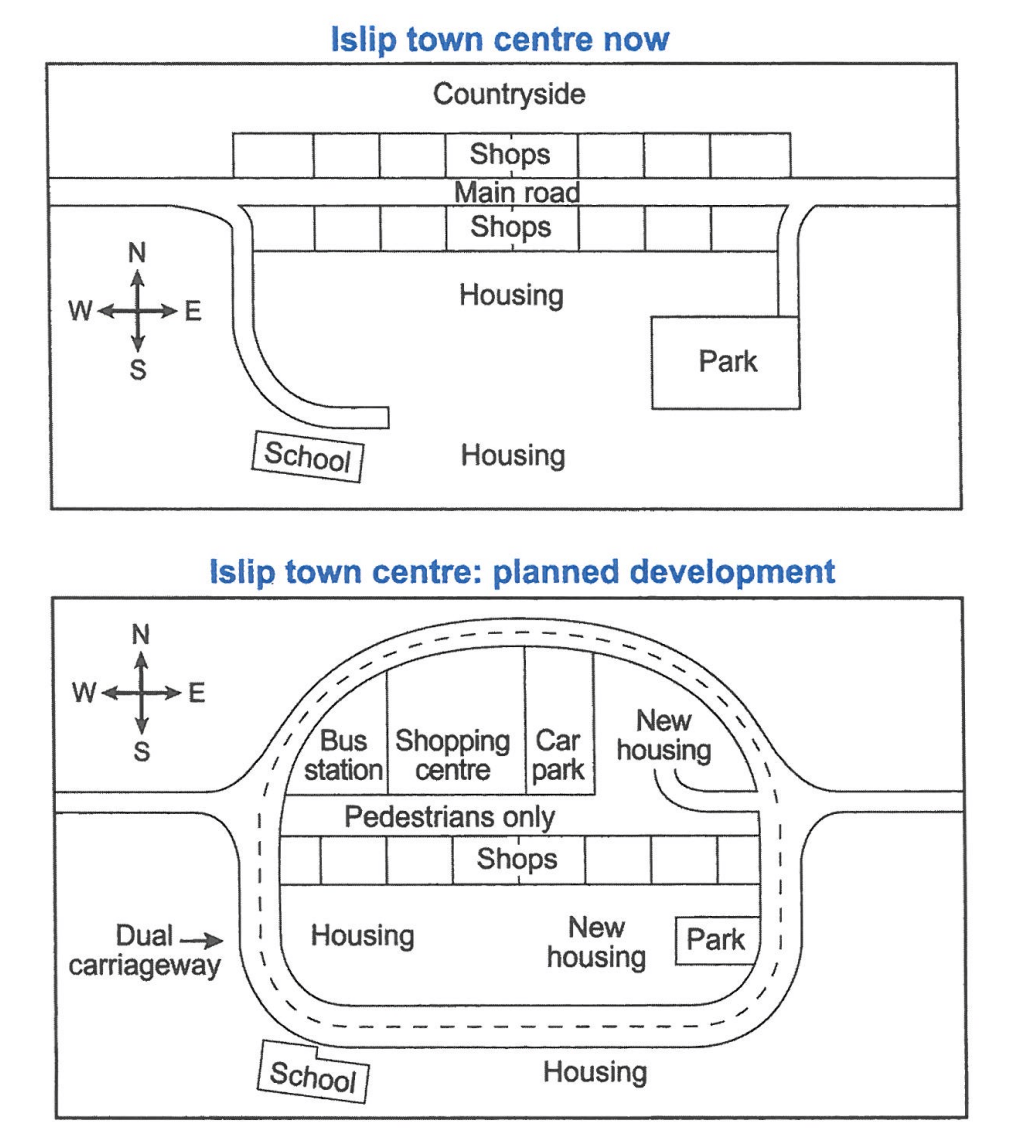
The maps below show the centre of a small town called Islip as it is now, and plans for its development.
Summarise the information by selecting and reporting the main features, and make comparisons where relevant.
Student answer (Band 5.5)
the given pictures show the relevance if how time passes by and how modern communities are made by human, Once there used to less population and now as population have increased urban areas have decreased and more markets, housing communities and shopping centers are made. therefore in the given pictures first of all the countryside is effected and new road is being made around the whole community. lets start from the north west first there was nothing there but now there is a bus station for people to commute easily and access this new planned development, on the east side of bus station a big sjhopping centre is developedand then a car park same on east side and then new housing.
in front of it which means south of all these bulding there is a pedestrian footpath which used to be a main road in past.
On south of this road more shops are developed, there is a full line of shops expansding from west side of road to east side of road, then on southwest of these shops is housing and on south east of these shops is the new housing, on east of new housing is the park which was already there before development as well.
this all community is enclosed by road on west of hosing is Dual carriage was after road. there is also a school located which is on south of housing and south east of the carriageway
AI examiner evaluation
| Criterion | Band |
|---|---|
| Task Achievement / Task Response | 5.5 |
| Coherence and Cohesion | 5.5 |
| Lexical Resource | 5.5 |
| Grammatical Range and Accuracy | 5.0 |
| Overall | 5.5 |
Task Achievement / Task Response: Band 5.5
You identify several important planned features, including the bus station, shopping centre, car park, pedestrian-only street, new housing and the dual carriageway. You also make some useful comparisons with the current map, such as noting that the pedestrian route was previously the main road and that the park existed before. However, the response does not give a clear overview of the main changes, and some details are inaccurate or unclear: the northern countryside is described as being affected, although the map does not show this, and the southern shops are said to be newly developed even though they remain. The school is also outside, not inside, the carriageway loop. A concise overview and more precise reporting of what is retained, replaced or added would strengthen the response.
Coherence and Cohesion: Band 5.5
The response follows a broadly understandable route through the planned map, moving from the north-west to the east and then to the southern area. Paragraph breaks also separate some of the information. However, there is no clear overall progression from an overview to organised details, and the opening discussion about population and modern communities distracts from the map comparison. Linking phrases such as “first of all,” “then,” and “on south” are repetitive or awkward, while references such as “in front of it” are not always precise. Group the changes by area or by what is removed, retained and added, and use clear transitions to show how each feature relates to the others.
Lexical Resource: Band 5.5
You use some relevant map vocabulary, including “pedestrian footpath,” “bus station,” “car park,” “housing” and “dual carriageway,” which helps communicate the main locations. However, the range is limited and several choices are imprecise or unnatural for describing maps. For example, “the relevance if how time passes by” does not clearly express the changes shown, and “a full line of shops expanding” is less precise than describing a row that remains. Spelling errors such as “sjhopping,” “bulding” and “h osing” (in “h osing”/“hosing”) also reduce accuracy. Use concise, standard terms such as “is replaced by,” “remains,” and “is located to the south of” to report changes precisely.
Grammatical Range and Accuracy: Band 5.0
The response attempts some longer sentences and uses past and present forms to compare the maps, but control is inconsistent. Errors in sentence structure and verb forms appear in examples such as “there used to less population,” “as population have increased,” and “there is a full line of shops expansding.” Articles, agreement and prepositions are also often missing or incorrect, as in “on south of these shops” and “on southwest of these shops is housing.” Several sentences run together or begin with lowercase letters, making the relationships between clauses harder to follow. Practise accurate comparison patterns such as “There used to be…” and “The shops remain, while…”; shorter, correctly punctuated sentences would improve clarity while you build more complex structures.
See this exact question answered at other band scores. The same prompt compared across bands.
Browse more IELTS Writing model answers or get your own writing scored by the same AI examiner.