Band 5.5 IELTS Writing Task 1 Model Answer
Overall Band Score: 5.5 · Cambridge IELTS 12 · 2026-11-12
IELTS Writing Task 1 question
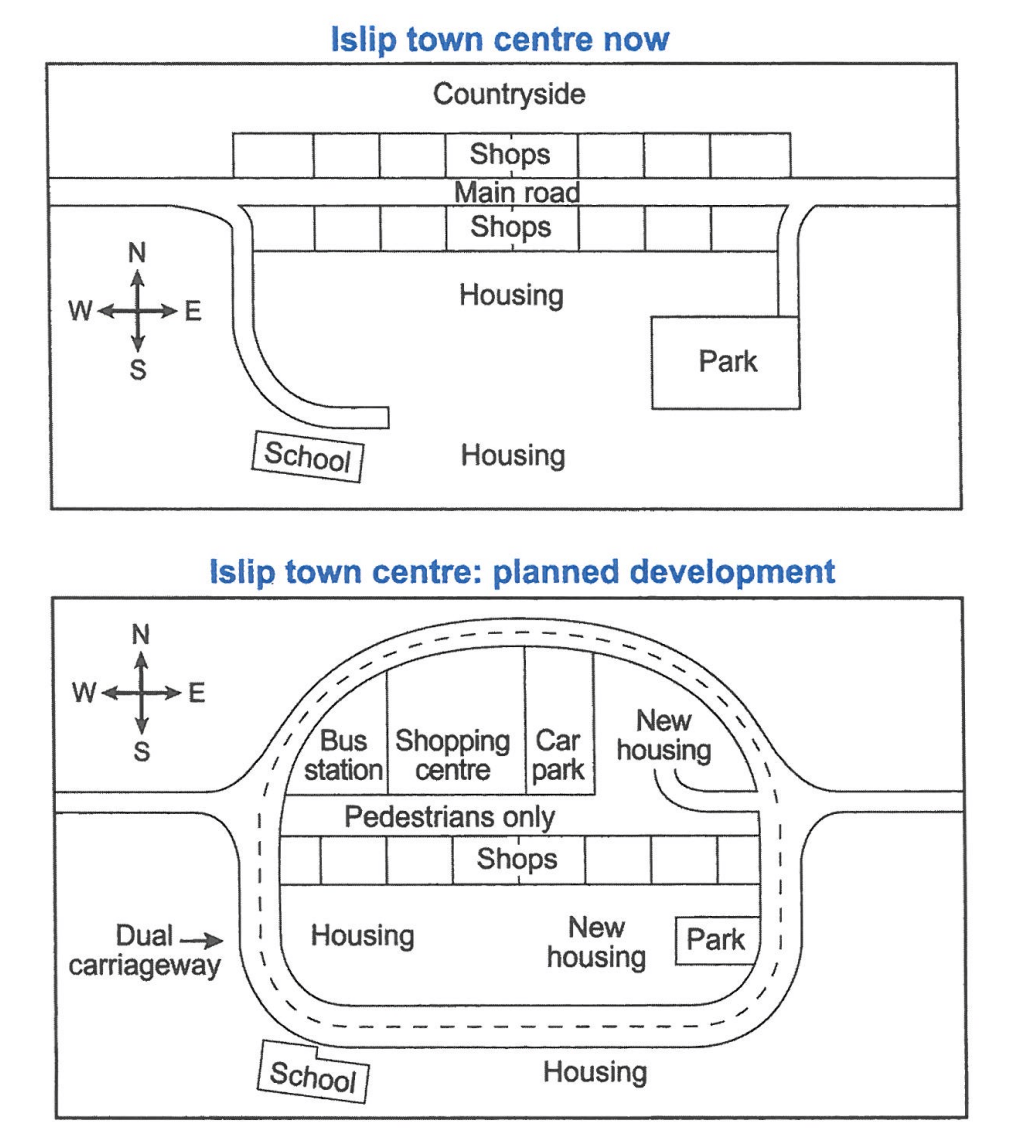
The maps below show the centre of a small town called Islip as it is now, and plans for its development.
Summarise the information by selecting and reporting the main features, and make comparisons where relevant.
Student answer (Band 5.5)
The activity shows the centre of a small town named as Islip as it is today, and plans for its development is depited by maps.
Overall, although several changes take place in future the most noticeable is the development of bus station, shopping centre and car park.
Now there is main road pass through the centre of Islip but in new planing the road will pass round this that make a circle and almost all the thinks are in this circle. Moving towards northside of Islip now there is a country side and shops but in new era this will chnge with bus station, shopping centre, car parking and aslo new housing will made in beside these. Below this pedestrians only area will construct and lookind downward the shops will remain same.
Moving further, there is housing in centre and one in southern side of Islip but in new plan new housing will built up and one housing will built at one corner and another onw will shift towards right side. Park will become smaller in new development. The school will be at the same place in the project but the building will expand.
AI examiner evaluation
| Criterion | Band |
|---|---|
| Task Achievement / Task Response | 6.0 |
| Coherence and Cohesion | 6.0 |
| Lexical Resource | 5.0 |
| Grammatical Range and Accuracy | 5.0 |
| Overall | 5.5 |
Task Achievement / Task Response: Band 6.0
You identify the maps as showing Islip now and in the future, and your overview correctly highlights the new bus station, shopping centre and car park. You also report several important changes: the central road becomes pedestrian-only, a road is planned around the centre, the park becomes smaller, and new housing is added. However, some details are unclear or inaccurate. The countryside north of the shops is not described as being replaced, and the school remains in place rather than expanding. The southern housing changes are also difficult to interpret, and the planned facilities’ positions could be reported more precisely. Covering these features accurately and distinguishing what remains from what changes would make the summary more complete.
Coherence and Cohesion: Band 6.0
The response has a recognisable structure: an introduction, an overall statement and two paragraphs describing areas of the map. Phrases such as “Moving towards northside” and “Moving further” help signal progression through the town. However, the organisation is sometimes mechanical, and the reader has to work to understand relationships between features. For example, “one housing will built at one corner and another onw will shift towards right side” does not clearly identify which areas are being compared. The description also moves between north and south without consistently anchoring locations to the map. Use clearer spatial links such as “to the north of the pedestrian street” and group related changes together to improve cohesion and precision.
Lexical Resource: Band 5.0
You use some relevant map vocabulary, including “pedestrians only,” “development,” “southern side,” and “smaller,” which helps communicate the main changes. However, the range and control of vocabulary are limited, with several noticeable spelling and word-choice problems: “depited,” “chnge,” “lookind,” “thinks,” and “onw.” Some expressions are also unnatural or imprecise, such as “the road will pass round this that make a circle” and “new housing will made in beside these.” These choices can make the intended meaning difficult to follow. Build a more accurate set of terms for describing locations and changes, and check spelling and collocations carefully; for example, use “a road encircles the centre” and “new housing will be built nearby.”
Grammatical Range and Accuracy: Band 5.0
There are attempts at complex sentences and comparisons, such as “although several changes take place in future” and “The school will be at the same place in the project but the building will expand.” However, some errors in sentence structure and verb forms make parts of the description unclear. For instance, “there is main road pass through” needs a relative clause or a finite verb (“a main road passes through”), while “new housing will built up” needs “will be built.” Agreement and article use are also inconsistent, as in “plans for its development is.” The response relies heavily on simple present and future forms. Practise accurate passive constructions for planned changes and vary sentence patterns while checking articles, agreement and clause structure.
See this exact question answered at other band scores. The same prompt compared across bands.
Browse more IELTS Writing model answers or get your own writing scored by the same AI examiner.