Band 5.0 IELTS Writing Task 1 Model Answer
Overall Band Score: 5.0 · Cambridge IELTS 12 · 2026-11-12
IELTS Writing Task 1 question
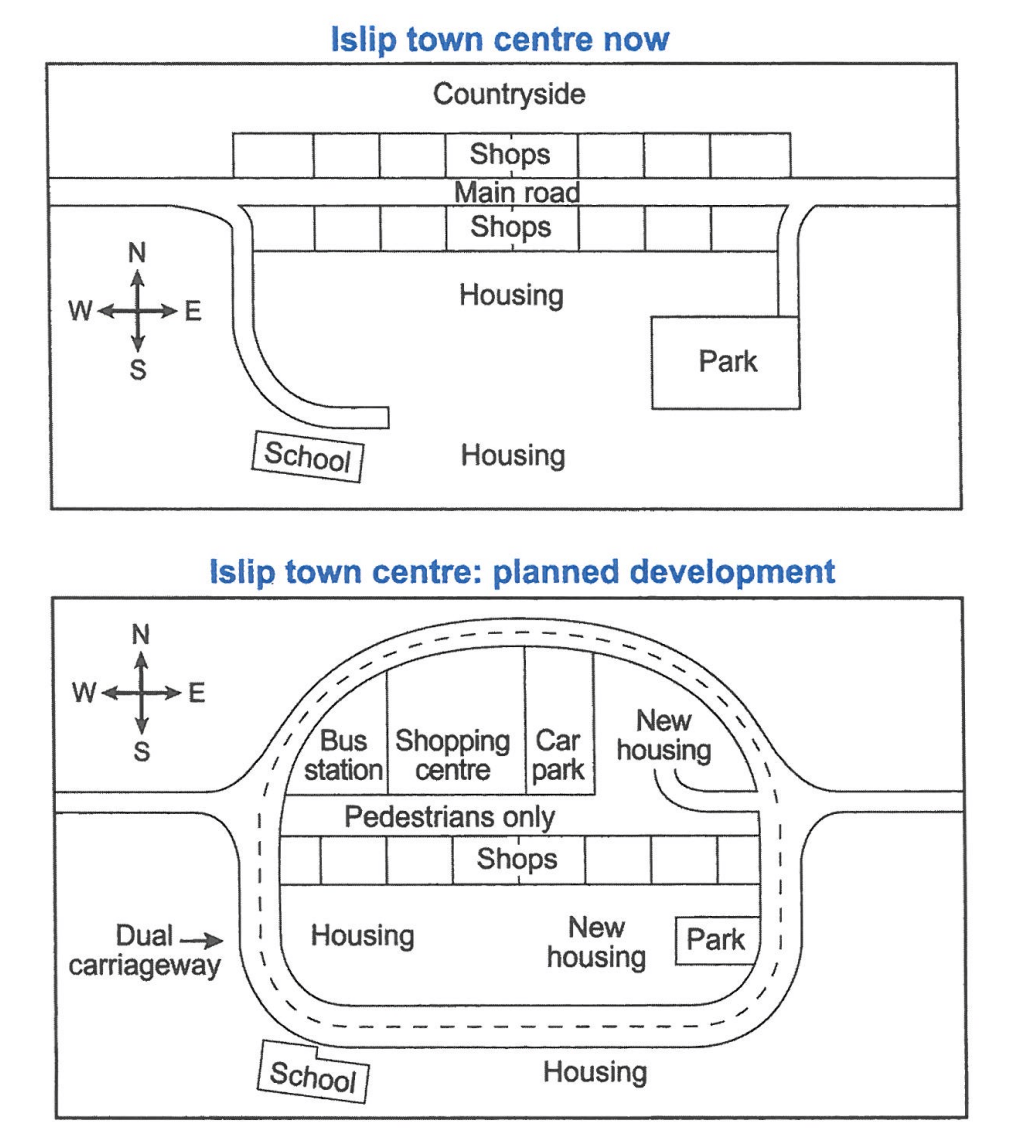
The maps below show the centre of a small town called Islip as it is now, and plans for its development.
Summarise the information by selecting and reporting the main features, and make comparisons where relevant.
Student answer (Band 5.0)
The given maps demostrate the information about the centre of a small town as known as Islip now and plans for it transformation.
Overall, it is clearly see that the centre is now as seems like the traditional designed and the new designed that are more addition of entertainment places.
On the one hand, the central part of town is like that in the north countryside beside the road the shopping area front and back. In the south east the park, in the middle housind and extend to the south and in south west a school.
On the other hand, the new plan for this place has lots of changes for example, first the today centre place will be demolish than bunchies of place will be build according to modern designed like in the boundry cover with dual carriageway and the places are build in the middle. In addition, bus station, shopping centre, parking, pedestrians area for walk, more shops, park and new housing are planned to be develop. The school in old place.
Finally, today's Islip town centre is looks like and old and traditional as compared to new planned.
AI examiner evaluation
| Criterion | Band |
|---|---|
| Task Achievement / Task Response | 5.0 |
| Coherence and Cohesion | 5.5 |
| Lexical Resource | 5.0 |
| Grammatical Range and Accuracy | 4.5 |
| Overall | 5.0 |
Task Achievement / Task Response: Band 5.0
You identify the two maps as showing Islip now and after redevelopment, and you mention several relevant planned features, including the dual carriageway, bus station, shopping centre, pedestrian area and new housing. However, the account only partially reports the main changes. The overview that the new plan adds “entertainment places” is vague, and the claim that the centre will be demolished is not supported: the southern shops remain, while the school and some housing are retained. Some current locations are also unclear or inaccurate, such as placing the school in the southwest rather than south of the town centre. To improve, give a clear overview of the major changes and compare what is retained, replaced and added.
Coherence and Cohesion: Band 5.5
The response has a basic structure, with an introduction, an overview, a description of the current map and a paragraph about the plan. Phrases such as “On the one hand” and “On the other hand” signal a contrast between the maps. However, progression within the paragraphs is difficult to follow: the current layout is compressed into a fragment-like list, and the planned features are presented as a loosely connected sequence. “Finally” introduces a repeated conclusion rather than a new point. Organise the details by location or by what changes and remains, and use clear links between complete ideas. This would make the comparison easier to follow without relying on formulaic transitions.
Lexical Resource: Band 5.0
You use some relevant map vocabulary, including “dual carriageway,” “bus station,” “shopping centre” and “new housing,” so the reader can recognise several planned features. However, the range is limited and many expressions are inaccurate or unnatural, which sometimes makes the meaning hard to interpret. For example, “traditional designed,” “bunchies of place,” “parking” and “places are build” do not describe the map clearly; “parking” would be better expressed as “car park.” Spelling errors such as “demostrate” and “housind” also reduce precision. Build a bank of accurate location and change terms, such as “to the north of,” “will be replaced by” and “will remain,” and check spelling and word forms.
Grammatical Range and Accuracy: Band 4.5
The response attempts to use both simple and more extended sentences, including “On the other hand, the new plan for this place has lots of changes for example…”. However, sentence structures are often faulty, and errors frequently make relationships between ideas unclear. Examples include “it is clearly see,” “the centre is now as seems like,” and “today's Islip town centre is looks like,” where verb forms and sentence patterns are not controlled. The sentence “The school in old place” is incomplete, while “the places are build” has an incorrect passive form. Focus first on accurate basic clauses and past/present/future forms, then connect them with simple comparison structures such as “whereas” and “while.”
See this exact question answered at other band scores. The same prompt compared across bands.
Browse more IELTS Writing model answers or get your own writing scored by the same AI examiner.