Band 4.5 IELTS Writing Task 1 Model Answer
Overall Band Score: 4.5 · Cambridge IELTS 12 · 2026-11-14
IELTS Writing Task 1 question
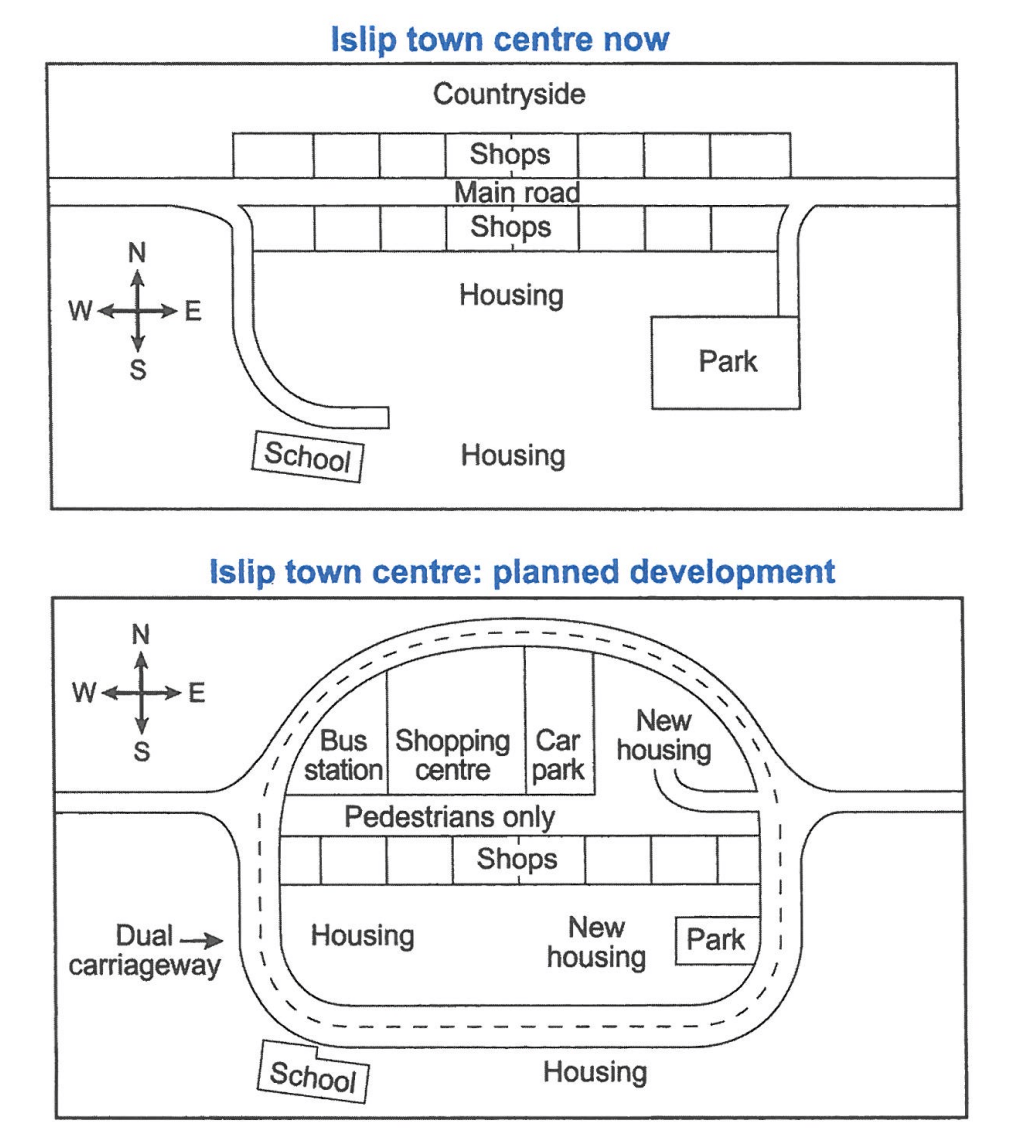
The maps below show the centre of a small town called Islip as it is now, and plans for its development.
Summarise the information by selecting and reporting the main features, and make comparisons where relevant.
Student answer (Band 4.5)
as i can see in the graph of development its looks very clealry . now town centere looking only for their some shops and only one main road with 2 house and one school as well one more park park looking very long but you can see another developement graph park was area less some better than frist park . and we can see clearly develope of road secend graph duel haighway and that is developemnt and also one mention their one bus sataion , as well shopping centere where people can do shopping with famliy and they can spend som time at shopping centere in secend graph also made new two new housing that is also big development for the people which their live near by of that area so as i see many development has been their so this is big achivement for the people whoom want live their
AI examiner evaluation
| Criterion | Band |
|---|---|
| Task Achievement / Task Response | 5.0 |
| Coherence and Cohesion | 4.0 |
| Lexical Resource | 4.5 |
| Grammatical Range and Accuracy | 4.5 |
| Overall | 4.5 |
Task Achievement / Task Response: Band 5.0
You identify several relevant changes, including the new dual carriageway, bus station, shopping centre and housing, and you notice that the park becomes smaller. However, the response only partially summarises the maps: it does not give a clear overview of the main transformation or explain how the town centre is reorganised. Some details are inaccurate or unclear, such as saying there are “2 house” in the current plan and referring to “two new housing” without locating them. The maps show a pedestrian-only central street, a loop road, and several distinct land-use changes; these important features need clearer comparison. Focus on describing what is present now, what changes, and what remains, rather than commenting on the benefits to residents.
Coherence and Cohesion: Band 4.0
The response follows a basic sequence from the current town centre to the planned development, and phrases such as “now” and “in second graph” help signal comparison. However, it is presented as one long, loosely connected passage, so the reader has difficulty separating the existing layout from the proposed changes. Repeated links such as “and also” and “as well” do not show the relationships between features clearly, while references like “that” and “their” are sometimes unclear. Organise the report into short paragraphs, for example an overview followed by details of the northern and southern areas. Use precise connectors such as “by contrast,” “while,” and “in addition” to make comparisons easier to follow.
Lexical Resource: Band 4.5
You attempt relevant map vocabulary, including “main road,” “park,” “bus station,” “shopping centre,” “housing,” and “development,” so the reader can recognise the general subject. However, the range is limited and several words are repeated, especially “development” and “shopping centre.” Frequent spelling errors, including “clealry,” “develope,” “haighway,” and “sataion,” make the description harder to read. Some expressions are also imprecise for a map report: “park was area less” and “big achivement” do not clearly describe the changes shown. Build a small set of accurate terms for location and change, such as “to the north of,” “is replaced by,” “remains,” and “is reduced in size,” and check spelling before submitting.
Grammatical Range and Accuracy: Band 4.5
The response attempts to connect ideas in longer sentences, but sentence structures are often faulty and the range remains limited. For example, “now town centere looking only for their some shops” lacks a clear subject and correctly formed verb, while “many development has been their” has problems with agreement and verb form. Articles, plurals and sentence boundaries are also inconsistent, as in “one bus station” and the extended sentence beginning “and we can see clearly.” These errors sometimes make the intended relationships difficult to understand. Practise writing complete subject–verb sentences in the present simple, then combine them with accurate clauses using “while” or “whereas.” Use full stops to separate each main comparison.
See this exact question answered at other band scores. The same prompt compared across bands.
Browse more IELTS Writing model answers or get your own writing scored by the same AI examiner.