Band 5.0 IELTS Writing Task 1 Model Answer
Overall Band Score: 5.0 · Cambridge IELTS 12 · 2026-11-15
IELTS Writing Task 1 question
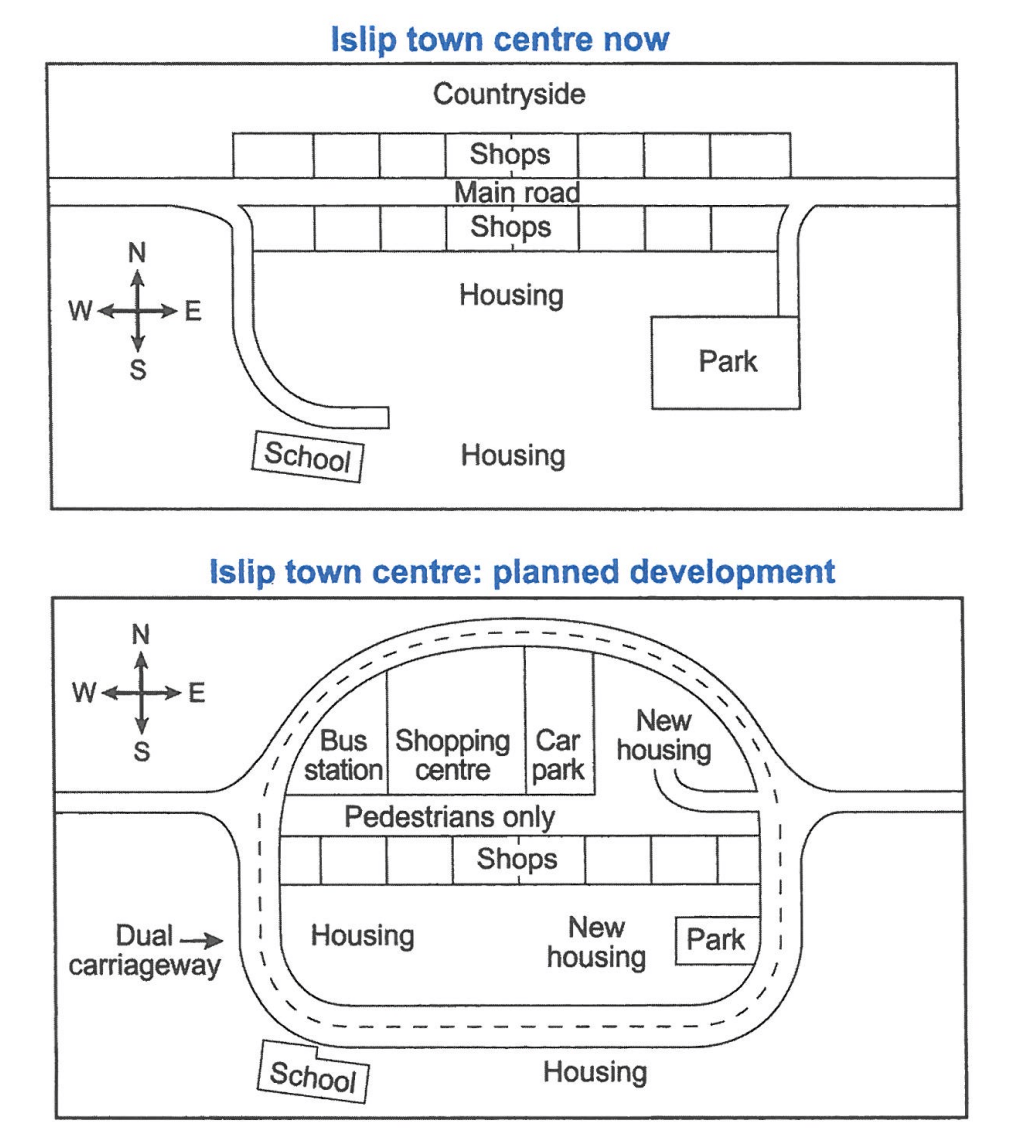
The maps below show the centre of a small town called Islip as it is now, and plans for its development.
Summarise the information by selecting and reporting the main features, and make comparisons where relevant.
Student answer (Band 5.0)
For the first when the centre was not developed we had in the north the main road and 2 shops in the left and right of this in the sud we have a school and housing and in the east of this we have a park for people who are living here
After the development we will have a lot of changes on the place, they will upgrade the centre and add in the north a bus station with a shopping center and car park with a new housing who they will found a big benefic for him, They changed the main road to the pedestrians only and in the left of this we have a lot of shops
In the east we have a park with new housing side the oldest housing in the sud they changed road and let the housing with school for the people and for the west we have to road that people take to come to the lslip town centre
AI examiner evaluation
| Criterion | Band |
|---|---|
| Task Achievement / Task Response | 4.5 |
| Coherence and Cohesion | 5.0 |
| Lexical Resource | 5.0 |
| Grammatical Range and Accuracy | 4.5 |
| Overall | 5.0 |
Task Achievement / Task Response: Band 4.5
You identify several relevant changes, including the pedestrian-only street, the bus station, shopping centre, car park and new housing. However, the account is only a partial summary and does not clearly present the main overall transformation. Some locations are misreported: the school is south of the town centre, not simply in the south of the original centre, and the planned shops remain on the south side of the pedestrian street, rather than being described as “in the left.” You also omit key features, especially the dual-carriageway loop and the fact that the park becomes smaller. The claim that the new housing will bring “a big benefic” is unsupported by the maps. Select the major changes accurately and give a concise overview before describing locations.
Coherence and Cohesion: Band 5.0
The response follows a basic before-and-after order, so the reader can recognise that you are comparing the existing centre with its planned development. However, the information is packed into three long, loosely connected sentences, and there is little clear progression within each description. Repeated phrases such as “in the north,” “in the east,” and “we have” make the account feel list-like, while references such as “this” are not always clear. The final sentence introduces roads and the school without a clear link to the earlier points. Use separate paragraphs for the current and planned maps, and organise each around north, centre and south, with accurate linking phrases.
Lexical Resource: Band 5.0
You use some relevant map vocabulary, including “bus station,” “shopping center,” “car park,” “housing” and “pedestrians only,” which helps communicate the main subject. However, the range is limited and several expressions are inaccurate or unnatural, such as “the centre was not developed,” “in the left and right of this,” and “a big benefic.” Repeating “we have” also restricts precision and makes the description less suitable for a formal report. Choose verbs that describe map changes, such as “is replaced by,” “remains,” and “is relocated,” and use location phrases such as “to the north of” or “on the eastern side.” Check spelling and word forms, including “Islip” and “benefit.”
Grammatical Range and Accuracy: Band 4.5
The response attempts to connect several ideas using “and,” “after,” and relative clauses, but sentence structures are limited and frequently faulty, which sometimes makes relationships between features difficult to follow. For example, “For the first when the centre was not developed” lacks a clear grammatical structure, while “a new housing who they will found” has problems with articles, relative pronouns and verb form. The shifts between “we had,” “we have” and “they changed” also make the time reference inconsistent. Punctuation is sparse, leaving long run-on sentences. Practise writing short, complete sentences with a clear subject and verb, and use the present tense for the current map and future or planned forms for the proposed changes.
See this exact question answered at other band scores. The same prompt compared across bands.
Browse more IELTS Writing model answers or get your own writing scored by the same AI examiner.