Band 5.5 IELTS Writing Task 1 Model Answer
Overall Band Score: 5.5 · Cambridge IELTS 12 · 2026-11-16
IELTS Writing Task 1 question
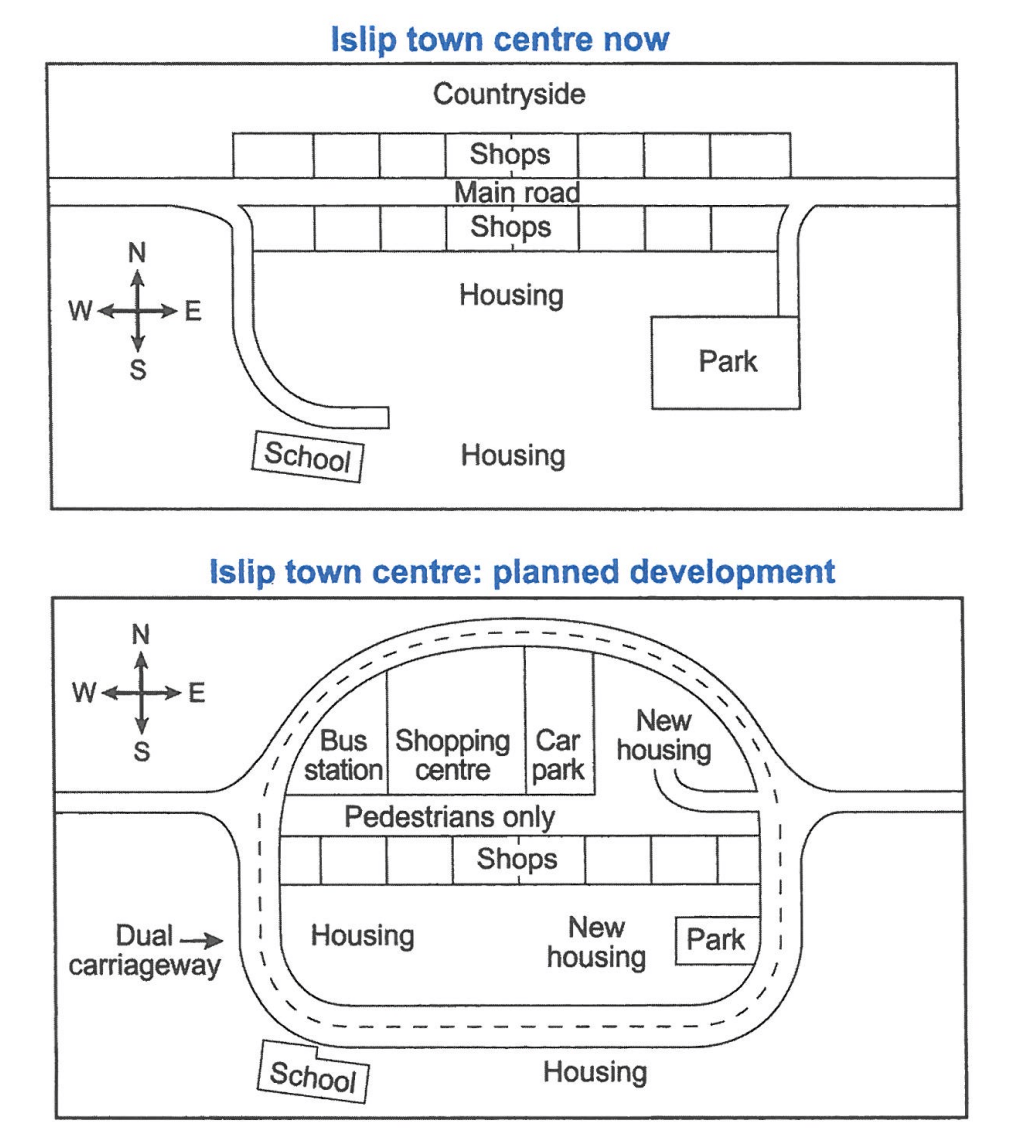
The maps below show the centre of a small town called Islip as it is now, and plans for its development.
Summarise the information by selecting and reporting the main features, and make comparisons where relevant.
Student answer (Band 5.5)
The map illustrates the difference between the centre of a small town called Islip before and after development.There have been several changes, the most noticeable being the increases in good organization.
Now, to the north of the village where the bus station,shopping centre, car park and new housing is there was previously only shops and main road as well. On the other side of the main roadd there is a also plenty of shops. The housing is locatef in the south side of the shops, while situated in the south west around a housing is the school.Furthermore, the park is on the east side of the town centre.
Turning to the Islip town centre: planned developed it can be seen that main road have all gone, being replaced by the pedestrian, and the north side of the shops have become bus station,shopping centre, car park and new housing. The opposite side of shops will remained the same as does the housing, although the old housing remain,new housing will build and the park will become smaller. The biggest change will be the dual carriageway which is located around the all shops, houses and parks.
AI examiner evaluation
| Criterion | Band |
|---|---|
| Task Achievement / Task Response | 5.5 |
| Coherence and Cohesion | 5.5 |
| Lexical Resource | 5.5 |
| Grammatical Range and Accuracy | 5.0 |
| Overall | 5.5 |
Task Achievement / Task Response: Band 5.5
You identify the main contrast between the existing centre and the proposed redevelopment, including the pedestrian street, new facilities to the north, smaller park and surrounding dual carriageway. However, the overview is vague: “increases in good organization” does not clearly summarise the major changes. Some locations are also misreported or unclear. The school is south of the western side road, not “in the south west around a housing,” and the planned dual carriageway loops around the centre rather than around “all shops, houses and parks”; the school and some housing remain outside it. To strengthen the response, give a precise overview and compare the key features and their positions more accurately.
Coherence and Cohesion: Band 5.5
The response has a basic sequence: it describes the current layout and then turns to the planned development. Phrases such as “Furthermore” and “Turning to” help signal this shift. However, the progression within each section is not consistently clear, and several details are crowded into long sentences, making relationships between locations difficult to follow. For example, the sentence beginning “Now, to the north of the village” combines the northern facilities, the former shops and the main road without a clear structure. Paragraphing and more systematic grouping—north of the street, south of it, then the outer road—would make the comparison easier to track. Some linking phrases also feel mechanical rather than precise.
Lexical Resource: Band 5.5
You use relevant map vocabulary, including “pedestrian,” “dual carriageway,” “shopping centre” and “car park,” so the reader can identify many of the proposed features. However, the range is limited and some word choices or collocations are inaccurate or vague. “Increases in good organization” does not express a clear map change, while “the opposite side of shops” and “around the all shops” are imprecise. There are also spelling and word-form slips, such as “roadd,” “locatef” and “planned developed.” Aim for precise location language and standard map-reporting expressions, such as “to the north of,” “is replaced by,” and “the road forms a loop around the centre.”
Grammatical Range and Accuracy: Band 5.0
You attempt both simple and more complex sentences, including clauses with “while” and “although,” but control is inconsistent. Errors in verb forms and agreement occur in key descriptions: “the north side of the shops have become” should use a singular verb, and “new housing will build” needs a passive form such as “will be built.” Other examples include “the housing is locatef” and “the opposite side of shops will remained the same.” Articles and sentence boundaries also need attention; the opening has no space after the full stop, and “a also plenty” is not grammatically formed. These errors sometimes make the intended relationships harder to understand. Practise accurate present and future passive constructions, agreement, and proofreading.
See this exact question answered at other band scores. The same prompt compared across bands.
Browse more IELTS Writing model answers or get your own writing scored by the same AI examiner.