Band 4.0 IELTS Writing Task 1 Model Answer
Overall Band Score: 4.0 · Cambridge IELTS 12 · 2026-11-17
IELTS Writing Task 1 question
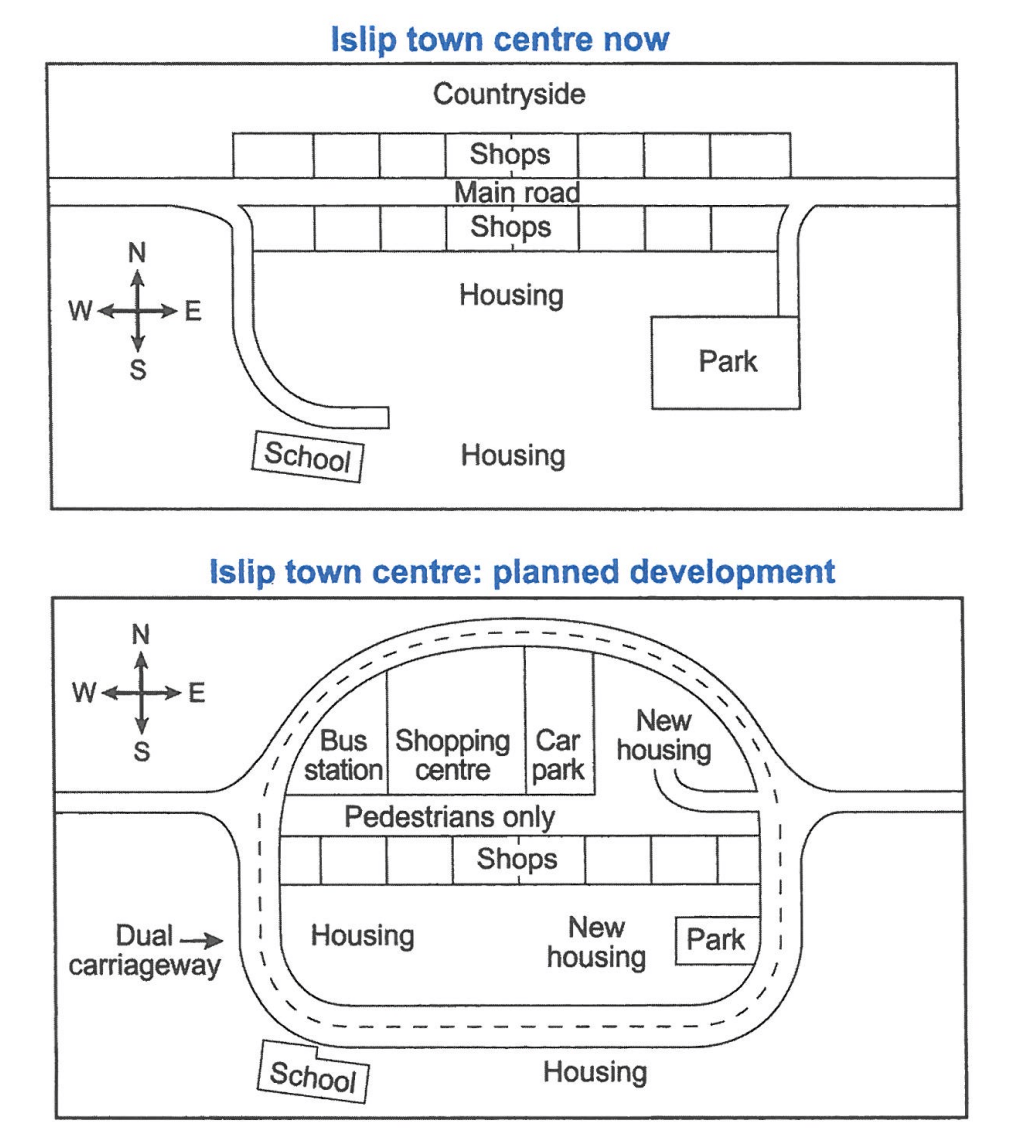
The maps below show the centre of a small town called Islip as it is now, and plans for its development.
Summarise the information by selecting and reporting the main features, and make comparisons where relevant.
Student answer (Band 4.0)
This map shows Lslip town centre.this plan shows the main road with prallel shops on both sides.On the sides behind the shops there is country side in north and on south there are housing mainly with parks and schools located closeby.overall the plan shows possible redevelopment.so as seen in the map the country side is less developed and there are no school and parks on that side and specially the roads are not build on countryside which is a clear distinction on both sides . the map only shows development on south side of the map which includes all facilities for housing in town with proper road way and all basic nessessities
so above where the main features ansd comparision of the map. by summerising the map its clearly stating the overall map of rural and urban area and the basic necessities and scarcity. which is the main difference between them.
AI examiner evaluation
| Criterion | Band |
|---|---|
| Task Achievement / Task Response | 3.5 |
| Coherence and Cohesion | 4.0 |
| Lexical Resource | 4.5 |
| Grammatical Range and Accuracy | 4.5 |
| Overall | 4.0 |
Task Achievement / Task Response: Band 3.5
The response makes a limited attempt to describe the maps, identifying the main road, shops, countryside, housing, parks and schools. However, it largely describes the present layout and does not report the planned development, which is a central part of the task. The claim that development occurs only on the south side is inaccurate: the plan adds a bus station, shopping centre and car park north of the pedestrian street, as well as new housing and a dual-carriageway loop. The overview is also unclear; describing a contrast between rural and urban areas does not capture the main changes. To improve, compare the two maps directly and summarise the major transformations, including the pedestrianised street and new transport and shopping facilities.
Coherence and Cohesion: Band 4.0
There is a basic attempt to organise the response, beginning with the current map and using phrases such as “overall” and “so above” to signal summary. However, the ideas do not progress clearly from the existing layout to the proposed plan, and the response is presented as one long, loosely connected paragraph. Several links are difficult to follow, particularly the shift from the countryside to “both sides” and then to the claim that the map shows “rural and urban area.” Use separate paragraphs for an overview and the key details, and organise the comparison by location or by what changes and remains. More precise referencing would also help readers understand which map and area each point concerns.
Lexical Resource: Band 4.5
The response uses some relevant topic vocabulary, including “main road,” “shops,” “housing,” “parks” and “schools,” so the basic subject can be recognised. However, the range is limited and several expressions are vague or unsuitable for describing a map, such as “all facilities,” “basic necessities” and “scarcity.” There are also spelling errors in “prallel,” “nessessities” and “ansd,” while “Lslip” appears to misspell the town’s name. These inaccuracies reduce clarity and control. Build a more precise map vocabulary, for example “pedestrianised street,” “dual carriageway,” “shopping centre” and “the area to the north/south,” and check spelling carefully.
Grammatical Range and Accuracy: Band 4.5
The response attempts both simple and longer sentence forms, but control is uneven. Sentence boundaries and punctuation are often unclear: “This map shows Lslip town centre.this plan shows…” runs two sentences together, while the final sentence beginning “so above…” is not a complete, well-formed summary. There are also problems with articles and sentence structure in “on south there are housing” and “the roads are not build,” where the intended meaning is understandable but the grammar is inaccurate. Capitalisation after full stops is inconsistent. Aim for shorter, complete sentences first, then use accurate comparison structures such as “In the proposed plan, the main road becomes pedestrian-only, while…”.
See this exact question answered at other band scores. The same prompt compared across bands.
Browse more IELTS Writing model answers or get your own writing scored by the same AI examiner.