Band 5.5 IELTS Writing Task 1 Model Answer
Overall Band Score: 5.5 · Cambridge IELTS 12 · 2026-11-18
IELTS Writing Task 1 question
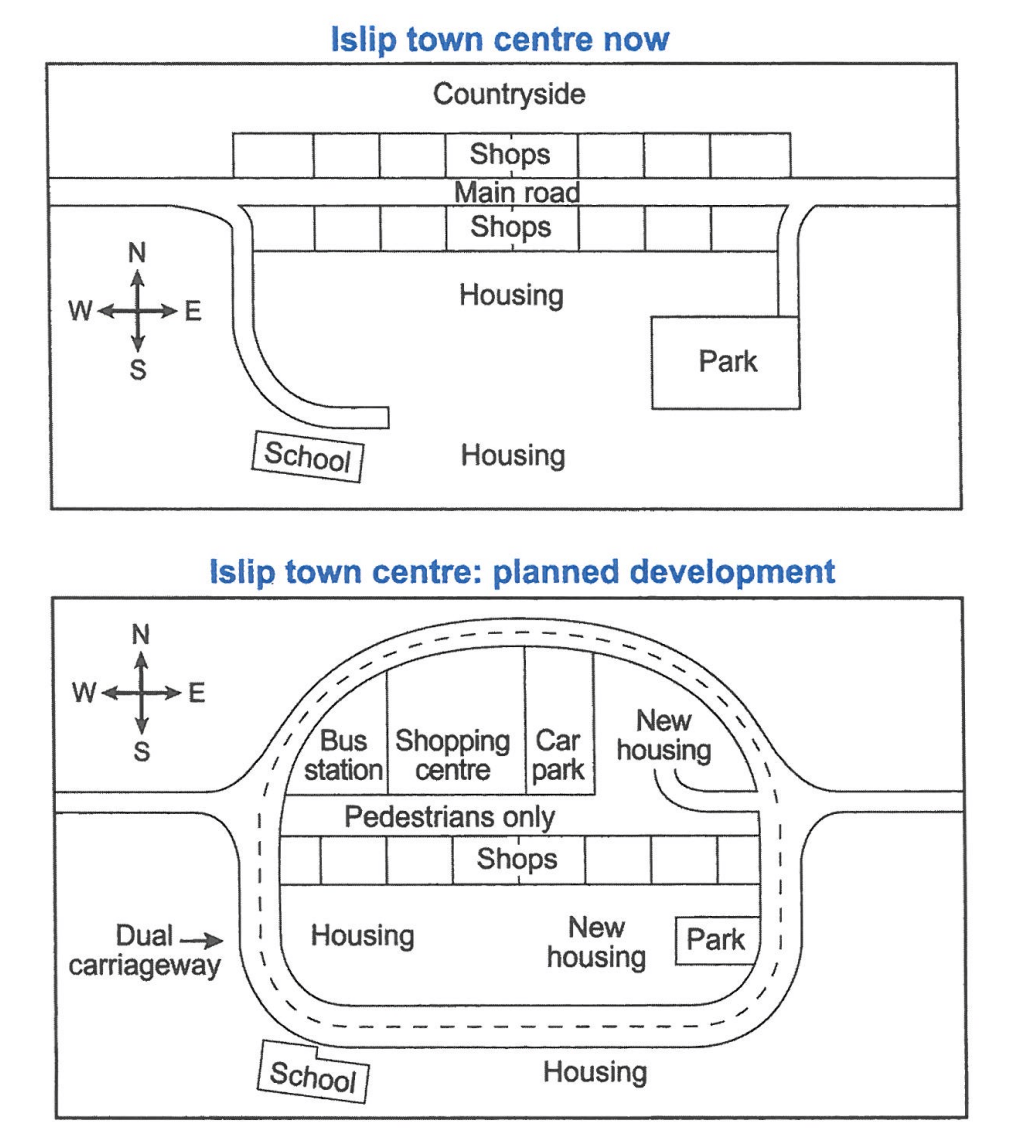
The maps below show the centre of a small town called Islip as it is now, and plans for its development.
Summarise the information by selecting and reporting the main features, and make comparisons where relevant.
Student answer (Band 5.5)
The maps illustrates the information about Islip town centre now and planned development.
Firstly, there are limited amenities in town centre, which planned to develop with more facilities. Additionally, in correct map, there are 2 shops on the North side of the map and main road pass between 2 shops, which planned to development in bus station, shopping centre, car park, and new housing at the North side of the map. In contrast, main road will changed into pedestrians only above the shops.
On the other hand, Islip town centre has larger park at South-East in the map, which decrease the size of park in future. Moreover, new housing planned to develop at South side and other housing will across the dual carriageway. School is South-West side at the present map, which slightly expand in size in future map.
Overall, there are less facilities in present map, but it will planned to develop more facilities in Islip town centre.
AI examiner evaluation
| Criterion | Band |
|---|---|
| Task Achievement / Task Response | 6.0 |
| Coherence and Cohesion | 6.0 |
| Lexical Resource | 5.5 |
| Grammatical Range and Accuracy | 5.0 |
| Overall | 5.5 |
Task Achievement / Task Response: Band 6.0
You identify the main contrast between the current centre and the proposed redevelopment, including the pedestrian-only street, new transport and shopping facilities, and changes to the park and housing. These are relevant features, and the response gives an overall summary. However, some details are inaccurate or unclear: the park is described as being in the south-east, although it is on the eastern side, and the school is said to expand, which is not shown. The statement that housing will be “across the dual carriageway” also misrepresents the plan: the school and existing housing remain outside the loop. To strengthen the report, describe the loop road and the retention of the southern shops more precisely, and avoid unsupported changes.
Coherence and Cohesion: Band 6.0
The response has a recognisable structure, moving from an introduction to current-versus-planned features and then an overall statement. Paragraphing helps separate the northern changes from the southern area, and connectors such as “Additionally,” “In contrast,” and “Moreover” show relationships between points. However, some links are mechanical or confusing: “in correct map” does not clearly identify which plan is meant, while “On the other hand” introduces another location rather than a genuine contrast. The final overview also repeats the idea of more facilities without summarising the most important spatial changes. Use clearer references such as “in the proposed plan” and organise details consistently by area or by what changes and remains.
Lexical Resource: Band 5.5
You use relevant map vocabulary, including “pedestrians only,” “bus station,” “shopping centre,” “car park,” and “dual carriageway,” which makes the main development understandable. There is also some attempt to describe change through phrases such as “decrease the size” and “planned to develop.” However, several choices are imprecise or unnatural, including “limited amenities,” “2 shops on the North side,” and “housing will across the dual carriageway.” Repetition of “map,” “housing,” and “planned” also limits flexibility. Aim for precise location and change language, such as “north of the main road,” “is replaced by,” and “the park is reduced in size.”
Grammatical Range and Accuracy: Band 5.0
You attempt both simple and more complex sentences, including clauses with “which” and contrasts introduced by “but” and “in contrast.” The main ideas are generally recoverable, but some grammatical errors recur and occasionally make relationships unclear. For example, “The maps illustrates” has subject–verb disagreement, and “which planned to develop” is missing an auxiliary verb. Other examples include “main road will changed” and “new housing planned to develop,” where verb forms are incomplete, as well as “School is South-West side,” which lacks an article and a suitable preposition. Practise accurate present and future passive forms, such as “is planned to be developed” and “will be changed,” and check agreement and articles.
See this exact question answered at other band scores. The same prompt compared across bands.
Browse more IELTS Writing model answers or get your own writing scored by the same AI examiner.