Band 6.5 IELTS Writing Task 1 Model Answer
Overall Band Score: 6.5 · Cambridge IELTS 12 · 2026-11-18
IELTS Writing Task 1 question
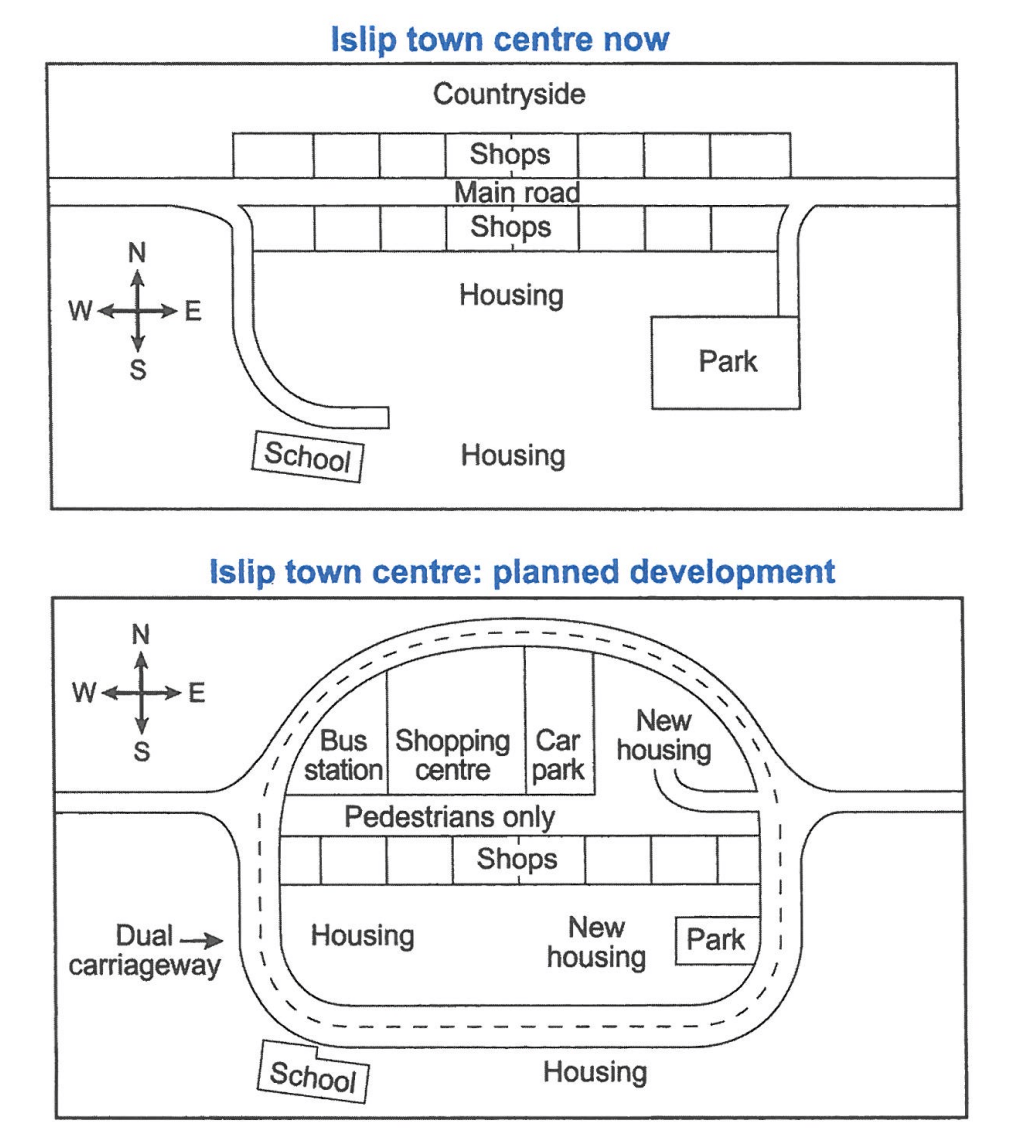
The maps below show the centre of a small town called Islip as it is now, and plans for its development.
Summarise the information by selecting and reporting the main features, and make comparisons where relevant.
Student answer (Band 6.5)
The given pictures represent the information about the structure of the centre of a small town known as Islip and the changes that are planned to develop in the future.
Firstly, right now the central area of the town Islip is structured with a main road, which is surrounded shops on each sides, alongwith the countryside area in its north and housing area towards the south direction. There is a school just in the west of the housing and park in the southeast corner.
Secondly, the developments that are planned are as follows. Instead of a straight main road, a dual carriageway surrounding all the central area is planned to be constructed. The position of the school remains unchanged, while new areas for housing might be added on the upper area of the school and beside the park situated in the southeast corner inside the carriageway. Alongwith the shops, a route is planned only for pedestrians following a bus station, shopping centre and a car park towards the north direction of the town.
Overall, the things that are mostly planned to change are the main road, countryside and addition of more place for housing.
AI examiner evaluation
| Criterion | Band |
|---|---|
| Task Achievement / Task Response | 6.0 |
| Coherence and Cohesion | 7.0 |
| Lexical Resource | 6.0 |
| Grammatical Range and Accuracy | 6.0 |
| Overall | 6.5 |
Task Achievement / Task Response: Band 6.0
You identify the main purpose of the maps and report several important changes, including the pedestrian-only route, the new transport and shopping facilities, and additional housing. You also note that the school remains in place. However, some details are inaccurate or unclear: the dual carriageway does not surround all of the central area in the sense of replacing the central street; it forms a loop around it, while the east–west street becomes pedestrian-only. The countryside is omitted from the planned layout, and the new housing is not simply “on the upper area of the school.” The overview that the main road, countryside and housing change is also less precise than a summary of the overall reorganisation. More accurate positioning and a clearer overview would strengthen the response.
Coherence and Cohesion: Band 7.0
The response is organised in a clear sequence: an introduction, a description of the current town, planned changes, and a concluding overview. The signposts “Firstly,” “Secondly,” and “Overall” make the progression easy to follow, and the reader can distinguish the two time periods. Some linking is a little mechanical, and the final overview repeats points rather than synthesising the main transformation. In addition, “Alongwith” is used to connect ideas in both description paragraphs, but it does not clearly express the relationships between the features. Grouping the changes by location—for example, the northern facilities and southern residential area—would make the progression more natural and comparisons easier to follow.
Lexical Resource: Band 6.0
You use a reasonable range of topic vocabulary, including “dual carriageway,” “pedestrians,” “shopping centre,” and “housing,” which helps communicate the map features. Some word choices and collocations are imprecise, however. “Surrounded shops on each sides” does not clearly describe shops bordering the road, while “the things that are mostly planned to change” is vague for an overview. “Upper area” is also an imprecise way to locate the new housing. There are spelling and form issues in “alongwith” and “southeast,” and “place for housing” is less natural than a concise planning term. Aim for precise spatial language and standard collocations when describing locations and changes.
Grammatical Range and Accuracy: Band 6.0
The response includes both simple statements and longer sentences, such as the sentence beginning “Instead of a straight main road,” so there is some structural variety. Meaning is generally understandable, but some grammatical errors remain. For example, “which is surrounded shops” is missing a required preposition, and “on each sides” has an agreement and plural-form problem. In “There is a school just in the west of the housing and park,” the article and preposition pattern is not controlled, and the sentence does not clearly distinguish the two locations. The phrase “new areas for housing might be added” also uses a tentative modal where the map presents planned development. Review articles, prepositions, and agreement, and use direct, accurate sentence patterns for map descriptions.
See this exact question answered at other band scores. The same prompt compared across bands.
Browse more IELTS Writing model answers or get your own writing scored by the same AI examiner.