Band 5.0 IELTS Writing Task 1 Model Answer
Overall Band Score: 5.0 · Cambridge IELTS 12 · 2026-11-19
IELTS Writing Task 1 question
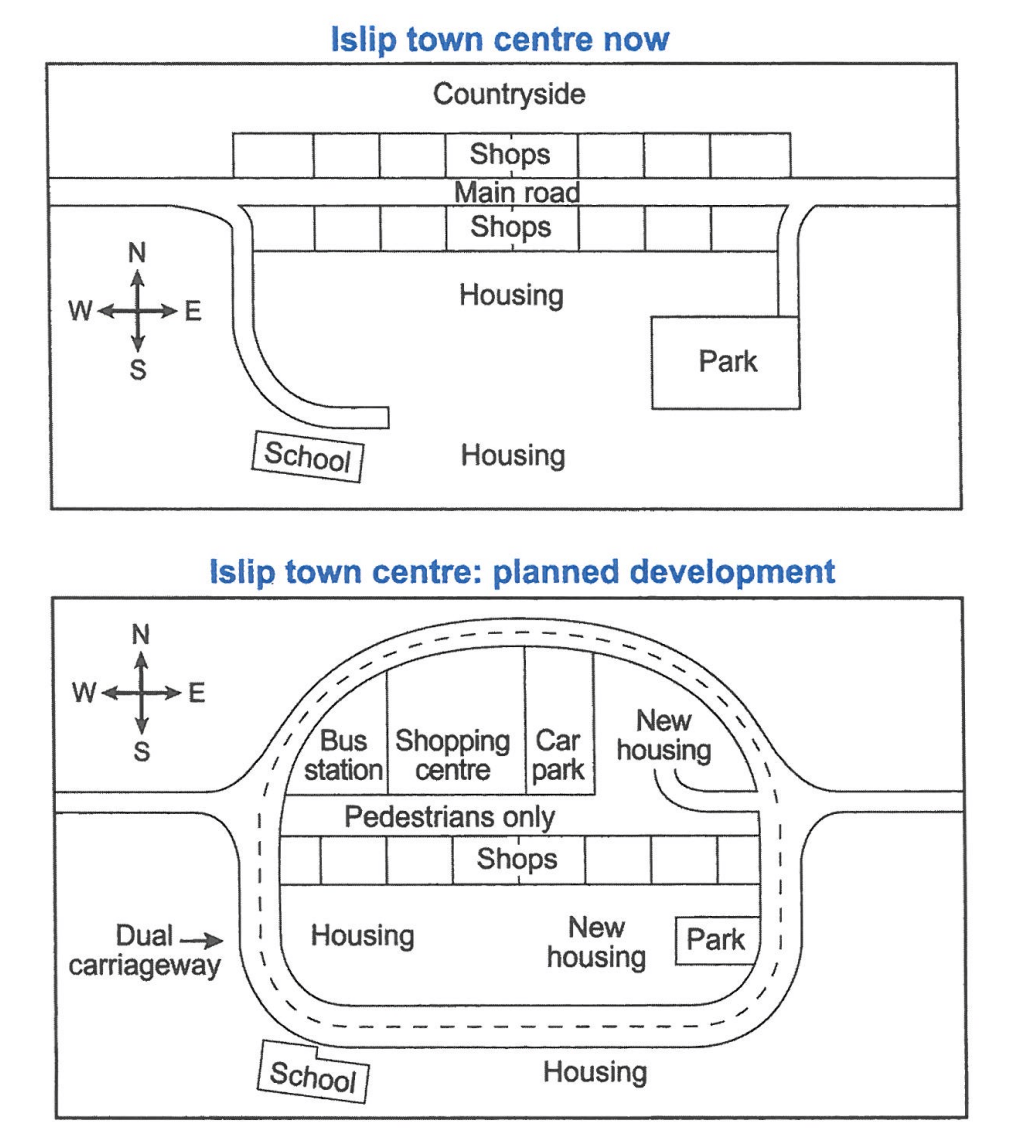
The maps below show the centre of a small town called Islip as it is now, and plans for its development.
Summarise the information by selecting and reporting the main features, and make comparisons where relevant.
Student answer (Band 5.0)
The map illustrate the centre of small town now and its planing for development.
In the initial map, it shoes the structured are not well maintained. The northen side of shops beside countryside are very close to each other. However, in the middle it has main road, and in the southern side are shops also along housing society. Along with it sees Park for children playing in the east corner and west side there is a school.
Futhermore, in plannned development a well organized town centre ellaborate. There are many structured roads around the centre. Align with it in middle include numerous north side bus station, shopping centre, card park along with new housing society for loca residence living. East and west both sides are open for entrance. Likewise in the centre there is only pedestrains alongthrough shops. Besides the shops housing and park are there o nthe outside of the centre there is a dual carriageway and school.
Overall, its profoundly describe with in dashing way dishevelled and well kept.
AI examiner evaluation
| Criterion | Band |
|---|---|
| Task Achievement / Task Response | 5.0 |
| Coherence and Cohesion | 6.0 |
| Lexical Resource | 5.0 |
| Grammatical Range and Accuracy | 4.5 |
| Overall | 5.0 |
Task Achievement / Task Response: Band 5.0
You identify the two maps as showing the town now and after development, and you mention several relevant changes, including the pedestrian-only street, new facilities and the dual carriageway. However, the account only partially reports the main features, and the overview is unclear: “dishevelled and well kept” is an unsupported judgement rather than a concise summary of how the layout changes. Some details are inaccurate or confusing. For example, the school is west of the centre in the current map, not in the east, and the planned bus station, shopping centre and car park are not all simply “north side” facilities without their west-to-east arrangement. Explain the major changes more precisely and compare what remains with what is replaced or added.
Coherence and Cohesion: Band 6.0
The response has an overall structure, moving from the current map to the planned development and then to a concluding statement. This gives the reader a basic route through the information. However, progression within paragraphs is sometimes difficult to follow, particularly in “Align with it in middle include numerous north side bus station…” and “Besides the shops housing and park are there…”. Linking expressions such as “Furthermore,” “Likewise” and “Besides” are used, but they do not always show the relationship between the features clearly. Some references, including “it” and “the centre,” are also vague. Group details by location or by change, and use simpler, more precise links to make comparisons easier to follow.
Lexical Resource: Band 5.0
You attempt a range of vocabulary relevant to maps, including “development,” “entrance,” “pedestrians” and “dual carriageway.” However, word choice and spelling errors are noticeable and sometimes make the intended meaning difficult to recover. Examples include “structured” for the town’s layout, “card park” for “car park,” and “elaborate” where a verb such as “show” or “include” is needed. Phrases such as “housing society” and “for children playing” are not natural descriptions of the map features. Use standard map vocabulary consistently, and check spelling carefully; accurate, straightforward terms are more effective than ambitious words used imprecisely.
Grammatical Range and Accuracy: Band 4.5
You attempt both simple and longer sentence forms, but control is uneven, and errors often make relationships between features unclear. For example, “The map illustrate” has subject–verb disagreement, while “in the southern side are shops” has an incorrect sentence pattern. The sentence beginning “Along with it sees Park” lacks a clear grammatical subject, and “in the centre include numerous…” does not form a complete, accurate clause. Articles, plurals and prepositions also need attention. Practise building clear sentences with a subject and verb, such as “The current map shows…” and “In the plan, the northern shops are replaced by…”. Then check agreement and punctuation in each sentence.
See this exact question answered at other band scores. The same prompt compared across bands.
Browse more IELTS Writing model answers or get your own writing scored by the same AI examiner.