Band 5.5 IELTS Writing Task 1 Model Answer
Overall Band Score: 5.5 · Cambridge IELTS 12 · 2026-11-19
IELTS Writing Task 1 question
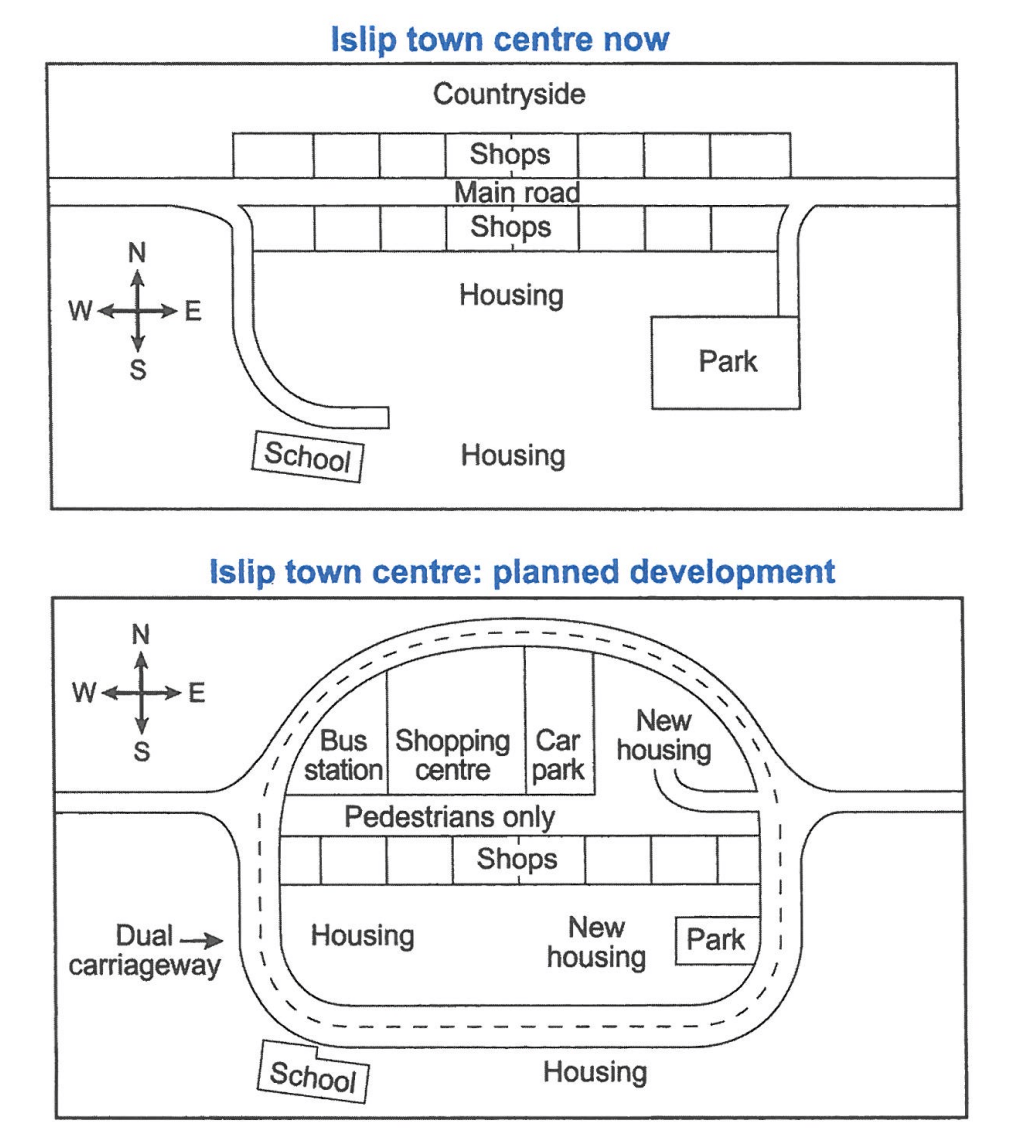
The maps below show the centre of a small town called Islip as it is now, and plans for its development.
Summarise the information by selecting and reporting the main features, and make comparisons where relevant.
Student answer (Band 5.5)
The given maps demonstrates the current condition of Islip, which is a small town and the idea of its development.
The recent structure of map shows the shops around each side of main road. Another road which leads to school, stops midway and after that we can see housing there. On the other side, a road has been there leads to park.
In the development plan, a dual carriageway has been made which connects the two road like a roundabout. Moreover, they keep the main road for pedesterians only. Shops will be there on the south of road but on the north side of a road a bus station, a shoppin centre and car parking will be developed. Other than that, new housing schemes will be launched on the west of park and east of the car parking.
In conclusion, a development plan is more advanced and have amazing use of its space. Increased housing near shops can beneficial for the people of this town.
AI examiner evaluation
| Criterion | Band |
|---|---|
| Task Achievement / Task Response | 5.5 |
| Coherence and Cohesion | 6.0 |
| Lexical Resource | 5.5 |
| Grammatical Range and Accuracy | 5.0 |
| Overall | 5.5 |
Task Achievement / Task Response: Band 5.5
You identify several important changes, including the pedestrian-only central street, the dual carriageway, and the new bus station, shopping centre and car park. However, the account is only partly complete: it does not clearly summarise the overall transformation, and some locations are inaccurate or vague. In particular, the new housing is described as west of the park, whereas the plan places it in the middle area south of the shops; another new housing area is northeast of the car park. The school and housing south of the loop, the retained southern shops, and the park’s reduction are also omitted. The concluding claim that the plan makes “amazing use” of space is evaluative rather than a map-based overview. Prioritise the main spatial changes and report them precisely.
Coherence and Cohesion: Band 6.0
The response has a clear overall sequence: it describes the present map, moves to the proposed plan, and ends with a conclusion. Paragraphing helps distinguish the two stages, and linking expressions such as “Moreover” and “In conclusion” make the progression easy to follow. However, some connections are mechanical or unclear. For example, “On the other side” does not specify which side, and “Other than that” introduces additional changes without showing how they relate spatially. The final paragraph also shifts from describing the maps to making a general claim about benefits. To improve, organise the planned changes by location—north of the pedestrian street, south of it, and around the town—and use clear references to connect each feature.
Lexical Resource: Band 5.5
You use relevant map vocabulary, including “dual carriageway,” “pedestrians only,” “housing,” and “shopping centre,” so the reader can understand the main subject. However, the range is limited and several choices are imprecise or unnatural for a map report. “The recent structure of map” is unclear, while “a road has been there leads to park” does not describe the feature naturally. “Amazing use of its space” is informal and evaluative rather than precise. There are also spelling errors in “pedesterians” and “shoppin.” Aim for accurate location and change vocabulary, such as “is situated,” “will be replaced by,” and “will remain,” and check spelling carefully.
Grammatical Range and Accuracy: Band 5.0
You attempt both simple and more extended sentences, including “Shops will be there on the south of road but on the north side…” This shows some ability to combine related information, but grammatical control is inconsistent and errors sometimes make relationships difficult to follow. For example, “The given maps demonstrates” has subject–verb disagreement, and “a road has been there leads to park” has a faulty verb construction. Articles and prepositions are also often missing, as in “on south of road” and “leads to park.” The conclusion contains further errors in “a development plan is more advanced and have” and “can beneficial.” Practise accurate present and future forms, agreement, and article use before adding more complex structures.
See this exact question answered at other band scores. The same prompt compared across bands.
Browse more IELTS Writing model answers or get your own writing scored by the same AI examiner.